
Forex in the economy: trade, financing and currency risk
The foreign exchange market lets businesses and households exchange currencies, agree the terms of a future exchange and obtain currency funding for a defined period. Its effect depends on both sides of the budget: an exporter can receive euros and pay suppliers in euros too. A small workshop’s cash flows show why the amount, currency and payment date matter more than the label “exporter”.
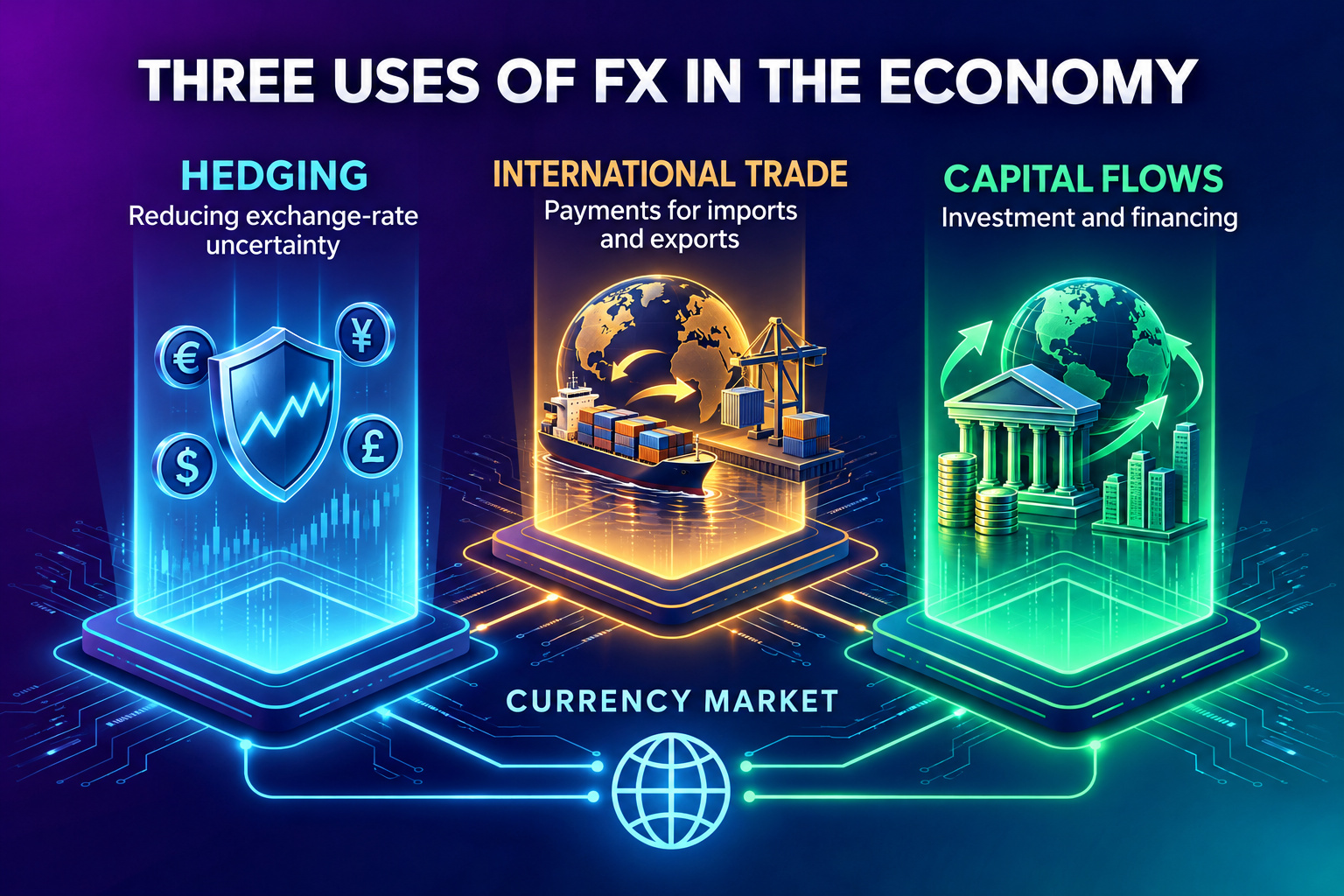
An exporter can also be an importer
Imagine a small US workshop selling custom fittings to a European customer. It will receive EUR 18,000 and must pay a European component supplier EUR 11,000. Both cash flows fall on the same day. It also has $7,000 of local operating costs due in dollars that day. These are hypothetical amounts, not an account of a real company.
Assume the workshop can use its euro receipt directly for the euro payment, has no other currency balances or contracts, and converts the remainder to US dollars. Ignore conversion charges, tax, interest and any other revenue or costs. This isolates the exchange-rate mechanism; the resulting balance is not a complete accounting profit.
Calling the workshop an “exporter” describes only part of its activity. It is also buying inputs from abroad. The amount it still needs to convert is EUR 18,000 − EUR 11,000 = EUR 7,000, not the full export receipt.
A $0.10 move changes this balance by $700
EUR/USD = 1.10 means $1.10 per euro. Compare the same cash flows at 1.10 and 1.20; nothing except the exchange rate changes. A rise in EUR/USD means the euro strengthens and the dollar weakens relative to it.
| Item | EUR/USD 1.10 | EUR/USD 1.20 |
|---|---|---|
| EUR receipts less EUR supplier payment | EUR 7,000 | EUR 7,000 |
| Remainder converted to USD | $7,700 | $8,400 |
| Local operating costs | $7,000 | $7,000 |
| Balance after those costs | $700 | $1,400 |
The change is EUR 7,000 × $0.10/EUR = $700. Looking only at the EUR 18,000 receipt would suggest $1,800. That leaves out the $1,100 rise in the dollar equivalent cost of the EUR 11,000 supplier payment. If the workshop pays that supplier directly from its euro receipt, it need not make both conversions; the gross comparison simply explains the net effect.
The reverse move, from 1.20 to 1.10, reduces this balance by $700. A business with euro payments exceeding euro receipts would have the opposite exposure. The direction of the effect comes from the currency balance, not from whether a stronger currency sounds good.
Exchange, hedging and funding solve different problems
- Exchange: the workshop already has euros and needs US dollars for a near-term payment. A spot transaction converts the funds on its agreed settlement terms.
- Hedging: the euro receipt is due later and the workshop wants to reduce uncertainty about the dollar amount. A forward can agree a future exchange rate, subject to its contractual obligations.
- Funding: a supplier must be paid before the customer pays. The workshop needs money for the gap; fixing a future rate does not itself accelerate the customer’s payment.
Forex serves these needs, as well as investment and speculative transactions. Banks intermediate, manage liquidity and hedge their own positions. An FX swap exchanges currencies with an agreed later reverse exchange, so currency is obtained for a defined period; renewing it creates a new funding deadline. [11]
That activity explains why turnover is not a simple mirror of merchandise trade. BIS data and their definitions are covered in the market-size lesson. A trade invoice, a currency contract and its funding can be related without being the same transaction. [1]
The EUR 7,000 balance works only with the right calendar
Now change one assumption: EUR 11,000 is payable today, but EUR 18,000 arrives in a month. The arithmetic still gives a positive EUR 7,000 over the whole period. It does not provide the EUR 11,000 required today.
With no existing balance, the workshop must arrange how to meet today’s payment. Its future receipt does not settle it automatically. The appropriate arrangement depends on available funds, credit, contract terms and whether the receipt arrives as expected. A forward on the later conversion also does not solve today’s funding gap by itself.
Write down amount, currency and date for each cash flow before offsetting receipts against payments. In the original same-day case, using EUR 11,000 directly left EUR 7,000 exposed to conversion. In this timing variant, the workshop also faces a funding need and the risk of a late customer payment. The detailed natural-matching example adds further conditions.
Why does the exchange rate reach beyond the company?
A weaker domestic currency can raise the local price of imported inputs, energy or finished products when their foreign-currency prices stay unchanged. The final customer’s price need not rise by the same percentage: inventories, contracts, competition, margins and the share of imported inputs affect how much and how quickly the change passes through. Empirical central-bank research, such as the cited NBP study, examines this mechanism in a historical setting rather than offering one fixed coefficient for every product. [6]
Households and investors also have currency balances. A household receiving euros while spending another local currency, a UK fund owning dollar assets and a borrower earning domestic income while owing Swiss francs are affected through different channels. The investment discussion separates an asset’s local-currency return from the exchange-rate effect. The debt example follows the liability side.
We cannot infer “a weaker currency helps the economy” from our workshop alone. Other firms have different inputs, debts, pricing power and payment dates. Economy-wide effects also depend on how customers, suppliers and policy respond.
Follow the payment obligation before choosing a tool
For each case, ask: what must be delivered, in which currency, how much and when? Then distinguish a conversion need from exchange-rate uncertainty and a lack of funding. A hedge can reduce one uncertainty while creating payment, collateral or liquidity obligations of its own. It need not remove commercial risk or guarantee a better outcome than remaining unhedged.
The same discipline helps with global figures. Official currency reserves are assets held at a point in time, not daily trading. In Q2 2026, the dollar and euro represented 56.70% and 20.60% of global FX reserves in the IMF’s COFER data. Those shares describe a different function from a currency’s share of turnover or invoice pricing. The reserve-data section explains the scope and revised methodology. [3]
Try it yourself
Three exercises: the number, its meaning and its limits
The first two check the main explanation. The third is optional. Choose an answer or open the worked solution; it remains available without JavaScript.
Explore the details
From one company’s cash flows to the global economy
The workshop keeps the first calculation small. The detailed discussion below follows larger export and import contracts, forward obligations, investments, FX swaps, reserves and crises. It also separates a contract’s valuation from the cash that a company may need before it matures.
Invoice, payment and funding currencies
The invoice currency determines the unit in which the price is agreed. The payment currency specifies the funds that must be delivered to the seller. The funding currency identifies the currency in which the buyer or seller borrowed. The first two are often the same, but a contract can provide for payment in another currency under an agreed conversion rule.
| Item | Currency | Meaning for the company |
|---|---|---|
| Invoice: €1 million | EUR | The euro price does not change when EUR/PLN moves. |
| Receipt in three months | EUR | The company receives euros whose domestic-currency (PLN) value is uncertain today. |
| Production costs | PLN | Payroll and local suppliers must be paid in zloty. |
| Production loan | PLN | Principal and interest are zloty obligations. |
A foreign-currency (EUR) receipt combined with domestic-currency (PLN) costs creates currency risk. Knowing that the counterparty is foreign is not enough. If the company also has euro expenses, it can use some of the receipt directly to pay them.
Dates are as important as currencies. The price may be agreed when the order is placed, the invoice issued on shipment and the cash received weeks later. Risk involving future revenue therefore begins before the currency conversion itself. The company may already know how many euros it will receive without knowing the domestic-currency amount it will obtain.
Spot exchange helps when funds are available and must be matched to a near-term payment. A forward agrees a later exchange’s terms; it does not make the customer pay the receivable immediately. Financing provides funds before the receipt. These three operations answer different questions: at what rate, in what currency and until what date does the company need money? [11, section 5.1]

Why does FX turnover exceed the value of trade?
Merchandise trade is only one need served by the market. Foreign exchange turnover also includes investment, financing, hedging and successive intermediary transactions. Comparing a daily notional of FX contracts with annual exports does not give the share of speculation or the percentage of “unbacked” transactions.
Not every foreign sale requires a new FX transaction. Payment can come from an existing balance, and receipts and expenses in the same currency can offset. The common currency also reduces conversion needs in trade between euro-area countries.
Imagine two companies with similar foreign sales. One spends most of its euro receipts on suppliers in the same currency; the other must convert the whole receipt into its domestic currency. Their exports are similar but their FX needs differ. Renewing funding can also generate new currency contracts repeatedly without a new shipment of goods. This is one reason why the market’s economic role cannot be inferred from a simple turnover-to-export ratio.
Why does the dollar appear outside the United States?
A contract’s currency need not belong to the seller’s or buyer’s country. The dollar can be a common currency of prices, financing and hedging. Users benefit from developed markets and established contractual practices. The euro has a particularly large role in Europe. [2]
Changing the invoice currency does not automatically remove risk. It shifts risk between counterparties or changes its source. A seller that starts pricing in its own domestic currency may have less direct receivable exposure, but its foreign customer may respond to a more expensive purchase.
The invoice currency creates a common reference point
Economists describe this mechanism as the dominant currency paradigm: many contract prices are set in a widely used currency rather than always in the seller’s currency. The Fed’s July 2025 note reports historical averages for 1999–2019: the dollar accounted for 96% of export invoicing in the Americas, 74% in Asia-Pacific and 79% in the other regions outside Europe. In Europe, the euro dominated with 66%. These are figures for the available sample and a historical period, rather than the current composition of invoices in October 2026; the European figure includes trade within the euro area. [2, Figure 7]

Imagine a Brazilian buyer and an Asian seller hypothetically agreeing a machine’s price in USD. The seller need not receive its own domestic currency and the buyer need not pay in its own. The dollar exchange rate can then affect the purchase cost even when neither party is in the United States. If the USD price remains fixed for a time, depreciation of the exporter’s currency does not automatically lower the buyer’s dollar price; it first changes the exporter’s revenue in its own currency.
The dollar can also serve as a vehicle currency when two other currencies are exchanged. This is not a mandatory route for every trade: an intermediary may use a direct pair, existing balances or netting. Invoice currency, vehicle currency and reserve currency are separate roles, even if the same dollar often serves all three.
Exporter and importer: opposite effects of exchange-rate changes
Currency-risk hedging aims to limit risk already arising from operations. A business often wants a predictable operating margin rather than profit from forecasting exchange rates.
An exporter expecting euros
Continuing our illustrative Polish exporter model (shown in the diagrams above and below), the manufacturer receives €1 million and domestic costs are PLN 4 million. All costs and receipts are assumed to settle on the payment date. Taxes, financing and conversion costs are excluded. None of the exchange rates in the example is a current bank quote.
Suppose the company agrees the machine’s price and its budget three months before receiving payment. With a budget rate of 4.40 PLN per EUR, it expects PLN 4.4 million of revenue and a PLN 400,000 contract result. It does not know the future conversion rate. The invoice remains €1 million: a change in EUR/PLN does not add or subtract euros.
On the due date the customer transfers euros into the manufacturer’s account. Using them for zloty expenses requires conversion. If the company keeps the euros, their PLN value can continue to change. The calculation below assumes conversion on the payment date, comparing three scenarios for the same receivable rather than different investment decisions.
| EUR/PLN on the payment date | Receipt in PLN | Result after PLN 4 million of costs |
|---|---|---|
| 4.20 | 4,200,000 | 200,000 |
| 4.40 | 4,400,000 | 400,000 |
| 4.60 | 4,600,000 | 600,000 |
A fall in EUR/PLN means zloty appreciation and reduces the exporter’s result in this example. The goods, order count and euro price are unchanged. The receivable’s value in the cost currency changed.
An importer that must pay dollars
Now take an illustrative Polish importer facing the opposite exposure: it must pay $500,000 while domestic sales revenue is PLN 2.4 million and other domestic costs are PLN 300,000. These remain fixed; taxes, financing and conversion costs are again excluded.
The importer orders goods payable in dollars in three months. At a budget rate of USD/PLN 4.00, it assumes an invoice cost of PLN 2 million and a PLN 100,000 result. Its domestic selling price was agreed earlier. It can accumulate the budgeted zloty amount before payment and still lack the funds to buy $500,000 if the dollar appreciates.
On the due date the company must deliver dollars to the supplier. Without buying them earlier or fixing a future rate, it buys on the terms then available. Earning the planned PLN 2.4 million of sales revenue does not guarantee the planned margin: a higher currency invoice cost absorbs some of the receipt.
| USD/PLN on the payment date | Cost of $500,000 | Result after all assumed costs |
|---|---|---|
| 3.80 | PLN 1,900,000 | PLN 200,000 |
| 4.00 | PLN 2,000,000 | PLN 100,000 |
| 4.20 | PLN 2,100,000 | PLN 0 |
The importer is hurt by a rise in USD/PLN: it needs more domestic currency for the same invoice. Receiving some revenue in dollars could reduce that risk. This is why a business hedges its net currency needs with dates in mind, rather than automatically hedging every foreign invoice.
Agreeing a future exchange rate
An outright forward lets the parties agree today the exchange rate for a future date. [9] Assume hypothetically that the exporter sells its future €1 million at PLN 4.38 per euro and the importer buys its future $500,000 at PLN 4.05 per dollar. If the contracts are performed on those terms, the exporter receives PLN 4.38 million and the importer pays PLN 2.025 million, irrespective of later spot rates. Their hypothetical results are PLN 380,000 and PLN 75,000 respectively.
An exchange-rate hedge is not an exchange-rate forecast. The exporter may later see a better market rate while its hedge still fulfils its purpose: the payment’s outcome was known in advance. A forward rate also depends on interest-rate differences, maturity and transaction terms. It is not simply the bank’s prediction of where the market will be. [8]
What does the company gain, and what does it give up?
Let us check every earlier scenario using the same hypothetical forward rates: 4.38 for the exporter and 4.05 for the importer. We compare the entire commercial contract’s result rather than the derivative’s valuation alone. A plus in the last column means the hedged result is higher than the unhedged result; a minus means it is lower. All other assumptions are unchanged.
| Company and spot rate at maturity | Unhedged | With the forward | Difference |
|---|---|---|---|
| Exporter: EUR/PLN 4.20 | PLN 200,000 | PLN 380,000 | +PLN 180,000 |
| Exporter: EUR/PLN 4.40 | PLN 400,000 | PLN 380,000 | −PLN 20,000 |
| Exporter: EUR/PLN 4.60 | PLN 600,000 | PLN 380,000 | −PLN 220,000 |
| Importer: USD/PLN 3.80 | PLN 200,000 | PLN 75,000 | −PLN 125,000 |
| Importer: USD/PLN 4.00 | PLN 100,000 | PLN 75,000 | −PLN 25,000 |
| Importer: USD/PLN 4.20 | PLN 0 | PLN 75,000 | +PLN 75,000 |
At EUR/PLN 4.60, the exporter could earn PLN 220,000 more without the hedge. This is forgone benefit from a better rate, rather than an additional PLN 220,000 invoice automatically payable for the forward. It still earns the assumed PLN 380,000 result. At 4.20, the hedge works the other way and produces a PLN 180,000 higher result. The company exchanges a variable outcome for known payment terms.
The importer gives up a benefit when the dollar weakens but protects the invoice cost when it strengthens. Judging a hedge only after learning the future rate can therefore produce a misleading conclusion. The decision is made earlier, when both directions remain possible. Additional fees and contractual terms need separate assessment; these simple models do not value them.
The contract requires the agreed exchange to be performed. If the customer cancels the order or fails to pay, the hedge does not disappear automatically. There may be termination costs or a need to obtain currency. Depending on the agreement and the client’s position, credit collateral may also be required. These risks do not appear in a simple exchange-rate table.
Dates can also become mismatched. An exporter may have a forward maturing at the end of June but receive payment in mid-July. The agreed rate does not supply the missing euros in June. Hedging the full order is also excessive if the buyer reduces it. The instrument’s amount and maturity must be considered alongside the cash flow’s amount and date; matching the currency name alone is insufficient.
When a forward does not deliver the local currency
Some currencies are subject to restrictions on market access or delivery outside their home country. One instrument is a non-deliverable forward (NDF): the parties settle the difference between an agreed rate and a specified reference rate instead of exchanging both full currency amounts. Settlement occurs in the agreed currency, often USD. These contracts can serve hedging or speculation. [19]
A business hedging a future invoice this way still needs to obtain the supplier’s payment currency if the invoice requires delivery. The NDF result may offset part of the change in cost, but the contract does not credit its account with the full local-currency amount. The match between the reference rate and the actual conversion rate matters as well. Large NDF turnover alone does not prove the domestic market is ineffective.
The notional of hedges is not the possible loss
A €1 million contract identifies the quantity of currency being hedged. Its current value can be positive or negative and depends on the contract terms and current prices. Adding all contract notionals therefore does not give total deposits or current losses. The same distinction applies to market-wide statistics.
A business can reduce its need for contracts by matching receipts and expenses in the same currency or changing dates or settlement currencies. This protection has limits: amounts and dates do not always match, and changing a commercial contract may cost money. Selecting instruments in detail requires analysis of the particular exposure.
$155 trillion: a stock of contracts, not the size of corporate hedging
In its 8 December 2025 publication, the BIS reported $155 trillion in outstanding FX derivatives notional at end-June 2025, approximately 19% more than a year earlier. Around $100 trillion consisted of forwards and swaps maturing within a year. This is a stock of contracts on a particular date, not April’s daily turnover or the current stock in October 2026. [14]
This large amount covers financial institutions’ and clients’ contracts serving different purposes. It does not solely measure business hedges, losses already incurred or cash deposited in the market. A long chain of contracts may serve one underlying economic risk. Conversely, a business matching receipts and expenses in the same currency can reduce risk without adding a derivative.
Notional and current market value therefore answer different questions. Notional identifies the amount covered by a contract; market value measures its rights and obligations under prevailing conditions. The amounts actually deliverable at maturity are another question. The $155 trillion figure should not be compared with annual GDP as though the contracts were additional production, or used to calculate the percentage of invoices hedged.
Where forward points come from: a simple funding calculation
The difference between a forward rate and spot is called forward points. A simplified covered interest parity model relates it to funding the two currencies over the same period. The model excludes margins, credit risk, balance-sheet constraints and basis, and assumes borrowing and lending are available at the stated rates. It is neither an exchange-rate forecast nor a calculator for a bank’s offer. The relationship and its limits are discussed by the BIS. [15]
Using the same pair, our hypothetical EUR/PLN assumptions are: spot S = PLN 4.3000 per EUR, T = one year, and simple annual funding rates rPLN = 5% and rEUR = 3%. These are model rates for the same maturity, not current Polish or euro-area policy rates. The simplified parity rate is:
F = S × (1 + rPLN × T) / (1 + rEUR × T)
F = 4.3000 × 1.05 / 1.03 ≈ PLN 4.3835 per EUR.
After rounding the rate, buying EUR 100,000 in a year would cost PLN 438,350, compared with PLN 430,000 at today’s hypothetical spot. The PLN 8,350 difference is neither an automatic exporter profit nor an independent importer commission. It concerns payment at a different time and is related to the cost of holding and funding currencies. A comparison must account for what the business would otherwise do with the money during that year.
In practice, funding obtained by exchanging currencies and reversing the exchange can cost a different amount from direct borrowing. That deviation is termed the cross-currency basis, influenced by factors including hedging demand and intermediaries’ balance-sheet capacity. It is not one fixed surcharge applicable to every pair, direction and maturity. [15]
Hedging costs and liquidity before maturity
The forward rate depends partly on the two currencies’ financing conditions. The interest-rate difference is neither an arbitrary bank surcharge nor a forecast of a later exchange rate; market conditions, margins and sometimes deviations from simple interest parity, known as the cross-currency basis, also affect the price. The full cost of a long investment cannot be calculated by subtracting two current policy rates from its coupon. Maturities, asset prices and the ability to renew protection matter. [8]
The BIS describes how higher costs of hedging dollar assets after the 2022–2023 interest-rate increases led some institutional investors to reduce protection. It cites, among other examples, a fall in Japanese life insurers’ hedge ratio from approximately 60% to 40% in the period before the 2025 survey. This is neither a ratio for every company nor a recommended hedging level. It illustrates a trade-off: a lower cost today means greater unhedged currency exposure. [8, Figure 5 and discussion]
A derivative’s valuation and cash can also have different timelines. A forward sale of euros can have a negative market value when an equivalent new contract allows euros to be sold at a better rate. Meanwhile, the exporter’s future euro receipt has a higher domestic value. If the agreement requires credit or cash collateral, the company may need funds before its customer pays. The difference between current spot and the old forward rate is not an exact valuation: the forward price of an equivalent contract and discounting must be considered.
A negative valuation and a hedged receipt: different cash timings
Extend the exporter model selling EUR 1 million forward at 4.38 (illustrated in the timeline diagram below). Before maturity, a new forward for the same amount and date hypothetically allows euros to be sold at 4.53. The existing contract is PLN 0.15 per euro less favourable to the seller. The difference is PLN 150,000, an approximation of a negative valuation before discounting, costs and other terms. It must not be calculated by simply comparing the old forward with current spot, because the payment dates would differ.

If the agreement requires collateral and its conditions trigger that obligation, the bank may request cash before the foreign buyer pays. The exporter still has a right to the future EUR 1 million receipt but cannot yet use it to meet today’s call. Reducing the receivable’s currency risk does not automatically solve a liquidity problem. Collateral amounts and thresholds depend on the agreement; not every negative valuation creates an identical call.
At maturity, if the exporter receives the full EUR 1 million and performs the deliverable forward, it obtains the agreed PLN 4.38 million. Previously posted collateral must not automatically be added as a second final loss: its contractual release or application must be considered. A different result arises if the buyer defaults, the contract closes early or amounts no longer match. A budgeted-margin calculation and a liquidity plan are therefore needed together.
When a hedge creates new risk: unequal notionals
An option can preserve the benefit of a favourable currency move, but a structure combining purchased and written options requires particular care with obligations. “No upfront premium” means neither “no economic cost” nor “no risk”. Writing an option gives the other party rights, and the obligation can exceed the company’s actual receipt.
A separate hypothetical model, rather than a reconstruction of a historical offer: an exporter expects €1 million, but in a specified scenario an option it has written requires it to sell €2 million at PLN 4.30. At settlement, hypothetical spot is 4.60. The company has only €1 million from operations; it must obtain the missing €1 million and sell it under the obligation. Buying that additional million at 4.60 and selling at 4.30 produces a PLN 300,000 difference before costs. This is neither a loss equal to the whole notional nor the entire structure’s result. It shows additional exposure beyond the actual receivable.
The excess obligation is new risk in this model, even if the product was advertised as protection. Not every option contract has this structure. Every possible obligation amount and date, trigger and termination condition must be checked, even if the product name sounds familiar.
Why is a hedge ratio not a universal standard?
A hedge ratio describes the portion of a defined exposure covered by protection. The cash flow, period and denominator must be specified. The percentage of businesses using any hedging is not the percentage of their receivables fully hedged. One survey result cannot determine the appropriate programme for every company.
Consider a hypothetical business forecasting EUR 1 million in receipts over three months: EUR 600,000 comes from confirmed contracts, while EUR 400,000 depends on future orders. Hedging EUR 600,000 covers 60% of the forecast amount. If the other EUR 400,000 arrives and is converted, a PLN 0.20 exchange-rate change alters its zloty value by PLN 80,000. This is the open portion of that exposure, not a loss measure for the whole business.
If the final receipt is only EUR 300,000, the EUR 600,000 forward exceeds the receivable. The business must establish where the additional euros will come from or how a contract change will be settled. A chosen percentage does not solve uncertainty over amount and date. Such a programme requires an updated cash calendar, counterparty assessment and control of obligations; the example does not recommend a 60% hedge.
Natural matching: the balance and calendar matter
Take a second, separate exporter model. It expects €1 million and owes suppliers €600,000 on the same date. It can use part of the receipt for the euro expenses and convert the remaining €400,000 into its domestic currency (PLN). This is natural matching: operations reduce the conversion need without adding an FX contract.
If EUR/PLN rises from 4.40 to 4.60, the whole revenue’s zloty value increases by PLN 200,000. At the same time, the zloty value of the €600,000 cost increases by PLN 120,000. The remaining change is PLN 80,000 on the €400,000 net balance. Looking only at revenue would overstate the currency benefit; looking only at costs would conceal the export receipt. Other domestic costs and the overall business result are outside this separate calculation.
The match is incomplete if the supplier demands €600,000 two months before the customer pays. Amounts match, but the business needs financing for two months. Protection is also lost if the customer fails to pay while the supplier obligation remains. A common currency removes some exchange-rate uncertainty, but not timing and credit risk.
Euro debt can similarly correspond to euro revenues if the required amounts and dates match. That does not make the financing safe in every circumstance. Sales can fall, interest payments change, and principal fall due before receipts. Actual cash flows matter, rather than merely classifying the company as an exporter.
Cross-border investment and financing
A company building a plant abroad needs funds for acquisition and subsequent spending. It can convert its own funds, borrow in the local currency or use group financing. A direct investment need not therefore create one transfer and one exchange on the announcement date.
Plants, equity interests and retained profits
Foreign direct investment (FDI) connects an investor with an enterprise in another country through control or a significant influence over management. It includes not only equity purchases but also specified financing between related entities. Reinvested earnings count as investment in the statistics, even without a new transfer from the foreign owner. [12, paragraphs 6.8–6.10 and 8.15]
Hypothetically, a European parent contributes euros to an overseas subsidiary. It needs local currency for construction and wages, but buys some machinery in EUR. It need not convert every euro: some can be retained for the machinery. Once the plant operates, sales receipts, local borrowing and retained profits can cover further expenses. An announced investment amount therefore cannot predict one-off demand for local currency on the announcement day.
Later profit transfers to the owner or repayment of an intragroup loan create other needs. Payment requires the contractually specified currency; its rate affects the value to both parties. An investment can generate currency needs over many years rather than ending with the first asset purchase.
The asset price and its currency’s exchange rate
A portfolio investor buying foreign shares or bonds combines asset-price risk with currency risk. For a UK investor, a hypothetical US bond still worth $10,000 is worth £8,000 at USD/GBP 0.80 and £8,500 at 0.85. A gain in sterling terms can arise with no change in the dollar price. The opposite movement works in reverse; interest, taxes and costs are excluded.
Both returns must be considered together. If the hypothetical bond falls from $10,000 to $9,000 while USD/GBP rises from 0.80 to 0.85, its value changes from £8,000 to £7,650. Sterling depreciation partly offsets the dollar-price fall but does not reverse it in this example. Sterling appreciation could deepen the translated loss. Merely investing in a stronger currency does not determine an asset’s result. You can model multi-currency positions and exchange-rate sensitivity using the portfolio currency exposure tool and the profit and loss calculator.
An international group also reports subsidiaries’ results in a reporting currency. A rate movement can change reported revenues or assets without an immediate currency exchange. This differs from the risk of a specific invoice and from longer-term effects on competitiveness.
FX swaps: currency for a defined period
A bank holding euros but needing dollars for three months can exchange EUR for USD and simultaneously agree the reverse exchange in three months. This is an FX swap. [9] It provides financing in the required currency and fixes the later exchange rate. It is not equivalent to the daily financing charge a broker applies to a CFD account.
A currency swap instead exchanges financing cash flows in two currencies, usually involving interest payments and often a longer period. Both instruments belong to the FX market, but their structures and BIS categories are separate. [1][9]
The distinction appears in the contract’s calendar. An FX swap combines an initial exchange with an agreed reverse exchange and does not itself provide a series of periodic interest payments. A currency swap can provide periodic interest payments in two currencies and exchanges of principal. It can match financing cash flows, but the precise structure comes from the agreement. These are not two names for the same product. [11, section 5.1]
Short-term contractual financing requires attention to maturity. Funding a long-term asset with three-month swaps means obtaining a new contract or delivering currency after three months. In stress, renewal can become more expensive and the available amount can fall. Fixing the exchange rate alone does not remove this risk.
One FX swap, different economic needs
| User | Need | What must be checked when the exchange reverses? |
|---|---|---|
| Bank | Holds domestic currency but needs USD for a week to fund an asset. | The source of dollars for repayment and availability of subsequent funding. |
| Institutional investor | Matches currency funding or a rolling portfolio hedge to obligations to beneficiaries. | Asset and payment timing, changes in asset value and the cost of renewing the contract. |
| Business | Holds EUR but temporarily needs GBP (or local operating cash) before an expected domestic receipt. | Will the future receipt arrive on time to reverse the swap and recover EUR? |
In the last example, the business delivers euros and receives domestic cash today, then performs the agreed opposite exchange at maturity. This differs from permanently selling its entire EUR receipt. A change in the customer’s payment date can leave it without the domestic funds needed to reverse the contract. The instrument shifts access to currency over time but does not ensure customer solvency.
A fund may renew protection more frequently than its assets mature. Each new contract creates turnover without implying another identical investment. For a bank, providers’ ability to use credit limits and balance-sheet capacity also matters. The same instrument name therefore identifies neither one user group nor one purpose.
A three-year asset, three-month currency funding
A separate hypothetical example: an institution has €1 million and wants to finance a dollar asset for three years. It agrees a three-month FX swap. Today it delivers €1 million and receives $1.10 million. After three months it must return $1.105 million and recover €1 million. The rates of 1.10 and 1.105 are calculation assumptions rather than quotes or forecasts. It spends the dollars on an asset whose principal will not return within those three months.
| Time | Swap cash flow | Institution’s need |
|---|---|---|
| Today | Delivers €1,000,000; receives $1,100,000 | Finances the USD asset purchase. |
| In three months | Returns $1,105,000; recovers €1,000,000 | Must obtain dollars before the asset’s principal has returned. |
| Later | The first swap has matured | May need another funding source to retain the asset. |
The dollar amounts differ by $5,000. In this model, that results from agreeing two different exchange rates; it is not a complete calculation of the investment’s cost. Euro capital costs, fees, revenue and asset-price changes are excluded. In a real trade, the forward rate is associated partly with both currencies’ financing conditions. [8]
Before maturity the institution may try to sell the asset, use other funds or seek renewed funding. None of those possibilities guarantees the old price or available amount in this example. When many institutions seek renewed dollar financing together, intermediaries’ ability to supply USD matters as well as the spot rate. This problem played a role in March 2020. [10]
A small contract valuation, a large amount to repay
In our three-month swap model, the institution must return $1.105 million. That payment obligation remains important even if the derivative’s current market value is small. The balance-sheet valuation of derivatives alone does not describe all amounts that must eventually be delivered. This does not mean the contract is unknown to its parties or unrecorded.
In a December 2022 analysis, the BIS estimated more than $80 trillion in global dollar payment obligations arising from FX swaps, forwards and currency swaps. This is a historical estimate of defined obligations, not a current 2026 figure or another $80 trillion to add to the earlier $155 trillion notional. The measures have different scopes and can cover the same contracts. [17]
With short-term contract funding, repayment timing becomes critical: an asset may be profitable over the long term, while dollars are needed at the next maturity. If many institutions seek them simultaneously, available credit, cash and intermediaries’ capacity matter more. Exchange-rate movements and funding problems can reinforce each other, but they are different risks.
When capital responds to interest-rate differences
Some flows arise from seeking a higher return in another currency. The result then also depends on exchange rates and funding costs; higher interest alone does not guarantee profit. A separate lesson explains interest-rate differences and carry trade. Here it is enough to recognise that such flows can reverse quickly.
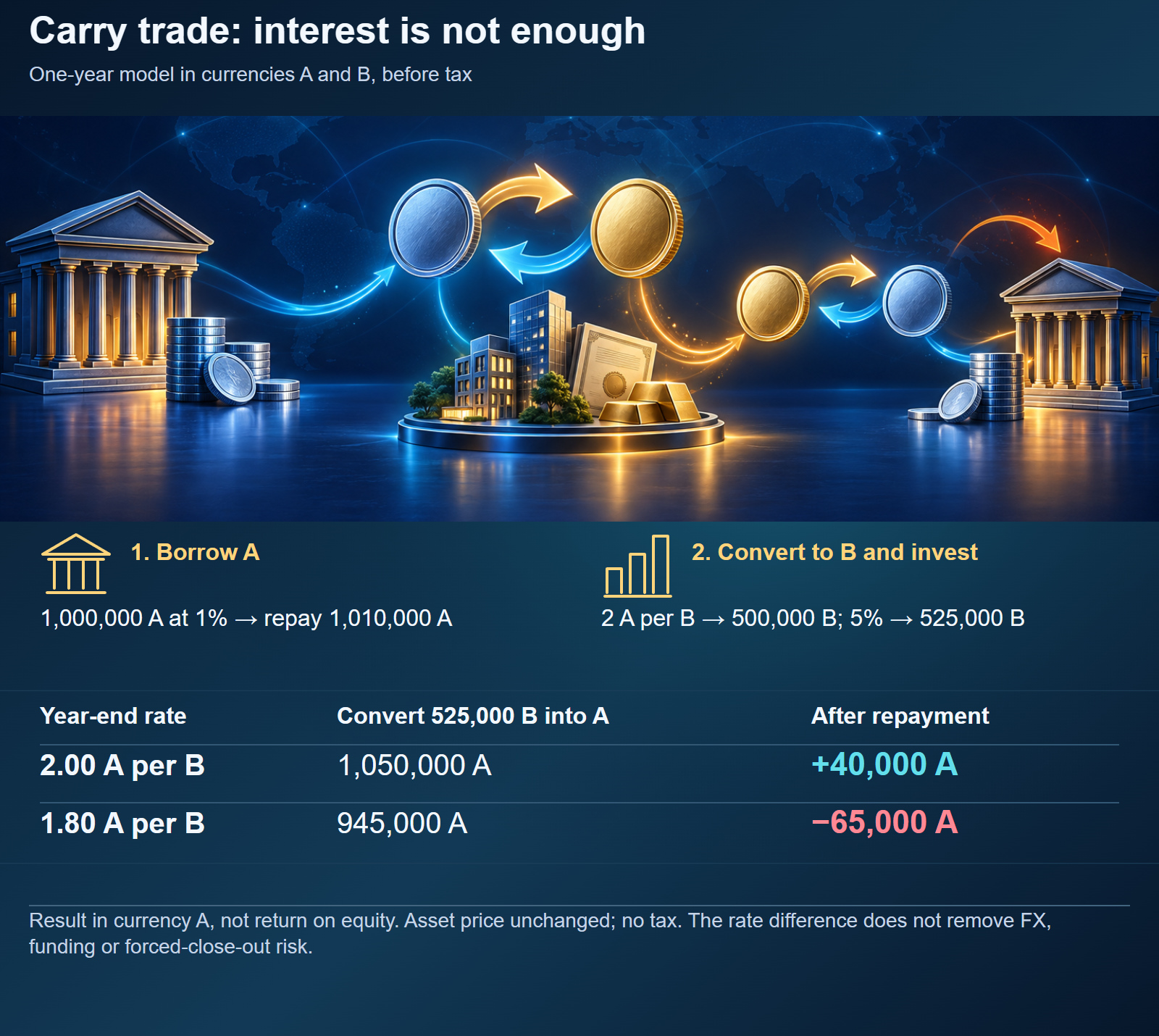
Example: higher interest, but a negative result
A separate one-year model is funded by borrowing and excludes taxes. Equity is not specified, so the result is stated in the funding currency rather than as a return on account capital. An investor borrows 1 million units of currency A at 1% annually. At 2 A per 1 B, the investor buys 500,000 B and holds an asset yielding 5%, with no change in its price. After one year there are 525,000 B and an obligation of 1.01 million A.
| Final rate, A per 1 B | 525,000 B converted into A | After repaying 1.01 million A |
|---|---|---|
| 2.00 | 1,050,000 A | +40,000 A |
| 1.80 | 945,000 A | −65,000 A |
The interest-rate difference did not protect against appreciation of funding currency A. Closing such positions involves selling B assets and buying back A. If investors do so together or have margined obligations, pressure can reinforce itself across markets. This is a possible mechanism rather than a certain forecast of a crisis.
The BIS identified carry-trade unwinding as an amplifier of early August 2024 turbulence. It should not be treated as the sole cause of the sell-off: the publication also discusses changing expectations and closure of other leveraged positions. The mechanism explains the relationship between funding, currency and asset prices without importing an entire trading strategy into an introductory lesson. [13]
August 2024: from changing expectations to position reduction
The episode did not begin with one click or one central-bank decision. The BIS describes an earlier reversal in the yen, monetary-policy expectations and a response to US data, amplified by the unwinding of leveraged positions. The following stages are documented observations, not an invented reconstruction of every order flow. [13]
| Date | What does the analysis describe? |
|---|---|
| 2 August 2024 | US labour-market data became a catalyst for revised expectations and selling. |
| 5 August 2024 | The TOPIX fell 12% and the S&P 500 3%; the VIX briefly exceeded 60 in off-hours trading. |
| 9 August 2024 | The S&P 500 had recovered its decline since Monday; the TOPIX had recovered most of that move. |
An investor funding an asset with yen borrowing must repay yen. When yen strengthen against the asset currency, more units of that currency are needed for the same debt. Losses or higher collateral requirements may prompt asset sales and purchases of the funding currency. Simultaneous unwinding of similar positions connects exchange-rate pressure with asset-price pressure. This helps explain why individual participants’ risk reduction can amplify a market move.
The BIS offered a rough middle estimate of carry positions before the episode: around JPY 40 trillion, or $250 billion, potentially understated because of data gaps. It was not a complete register of every strategy or a number to add to daily turnover. [13] Nor does the event show that every interest-rate differential causes a crisis. Borrowing, liquidity, collateral requirements and similarities across participants’ positions matter.
The dollar, euro and central-bank reserves
Central banks hold foreign-currency assets partly to maintain access to external liquidity and the ability to act during stress. Reserves include assets such as deposits and securities, rather than simply cash in a vault. IMF COFER describes their currency composition, excluding monetary gold, special drawing rights (SDR) holdings and the reserve position in the IMF, among other items. [4]
| Currency | First quarter 2026 | Second quarter 2026 | Share change |
|---|---|---|---|
| USD | 57.18% | 56.70% | −0.48 percentage points |
| EUR | 20.04% | 20.60% | +0.56 percentage points |
| JPY | 5.43% | 4.96% | −0.47 percentage points |
| CNY | 1.98% | 2.11% | +0.13 percentage points |
Source: IMF Data Brief, 30 September 2026. Total global foreign exchange reserves: $13.22 trillion. The table shows selected currencies, so its shares do not add up to 100%. [3]
The new COFER series has a different scope from the old “allocated reserves”. From the release for the third quarter of 2025, the IMF imputes the missing currency composition of some reserves. The data therefore cover the entirety of global foreign exchange reserves, and all currency shares total 100%. The series was revised back to the first quarter of 2000. Part of the result is estimated rather than directly reported by currency. [4][5]
Comparisons across years should use one version of that series. Comparing a new share of all reserves with an old share of reserves whose composition was known can suggest a change partly caused by methodology.
What does the quarterly table actually measure?
COFER describes a stock of assets at quarter-end. Dollar amounts provide a common valuation unit; they do not mean every deposit and bond is dollar-denominated. The euro share identifies the part of reserve value assigned to EUR assets, valued in USD so that all currencies can be compared and added. [4]
The table expresses share changes in percentage points. A fall from 57.18% to 56.70% is 0.48 percentage points. It does not mean that 0.48% of all dollar assets were sold. That conclusion would require the change in their amount and a separation of transactions from valuation. The IMF publishes aggregate composition; confidential individual-country data are not released through COFER. [4]
Imputing missing composition creates a complete denominator, but does not turn every observation into a direct report of asset currency. The method uses available reports and missing-data rules. Long histories should also be read alongside the published imputed share and methodological changes, rather than treating a small share shift as proof of a specific decision by every central bank. [5]
A change in share does not necessarily mean currency sales
Reserves are converted into dollars at end-period rates. Purchases and sales, asset prices and exchange rates can therefore change shares. A hypothetical portfolio holds $100 and €100. At EUR/USD 1.00, the dollar represents 50% of its value. After EUR/USD rises to 1.10, the dollar share falls to approximately 47.6%, although the owner has neither bought nor sold anything.
For the second quarter of 2026, the IMF assessed currency-valuation effects as limited: it linked reserve growth mainly to other asset-price changes and portfolio reallocations. This describes one quarter, rather than a universal explanation of every change in the dollar’s share. [3]
The quarter makes the difference between a share and an amount particularly clear. According to the IMF, dollar claims were largely unchanged, but USD’s share fell because euro and several other currency holdings increased. Total reserves rose from $13.10 trillion to $13.22 trillion. The IMF linked growth in euro holdings mostly to purchases; it associated lower yen claims with sales, falling Japanese securities prices and currency movements. The release therefore separates causes that the percentage alone cannot reveal. [3]
Reserve composition is not a daily picture of FX transactions. Buying a foreign-currency bond may require conversion, but may also be financed from an existing balance. A currency move changes an asset’s valuation without a new contract. Conversely, high FX turnover can arise from renewed contracts without a comparable change in the stock of official reserves.
The dollar remains the leading reserve currency and the euro the second. Financing markets and international contracts also support their roles. A reserve share is not a payment or forex-turnover share, however. “De-dollarisation” can be discussed precisely only after identifying the function and period being measured. [2]
Geopolitics and renminbi: declarations, invoices and payments
A study published by the IMF in September 2025 covers 132 countries from 1990 to 2023. Its authors find continuing dollar dominance in invoicing and gradual, still limited growth in renminbi use, including outside Asia. They identify a stronger association between invoicing patterns and geopolitical relationships but no robust evidence that the initiatives studied effectively reduced dollar reliance in oil exports. These are research findings, not an IMF forecast that one system must prevail. [18]
Payment infrastructure, a central-bank line and an invoice currency can facilitate use of a currency, but they are different things. A business can invoice in USD and pay through banks outside the United States. It can also price in CNY while obtaining funds through separate financing. Growth in a payment system’s participant count alone does not measure that currency’s share of global pricing, reserves or hedging.
Consider a hypothetical buyer proposing to change an invoice from USD into its own currency. The seller checks not only whether payment can be received but also cost currencies, access to funding and hedging prices. If suppliers still require dollars, the invoice change can shift risk onto the seller. Developing alternatives expands choice; it does not automatically terminate existing contractual practices.
Exchange rates, prices, competitiveness and debt
A weaker domestic currency raises the local cost of foreign goods priced in another currency, all else equal. This does not mean the retail price immediately rises by the same percentage. The importer may have a hedge, previously purchased inventories or a different margin, and domestic products also contain local costs.
A separate hypothetical example using sterling: an imported euro-area component costs €100. A 10% rise in EUR/GBP from 0.85 to 0.935 raises its cost from £85.00 to £93.50. If other domestic costs remain £115.00, total cost rises from £200.00 to £208.50: 4.25%, rather than 10%. The example excludes margins, taxes, hedges and a change in the component’s euro price. It simply shows why, even without a time lag, the rate need not pass through to the whole product cost one for one.
Exchange-rate pass-through to inflation is therefore partial, delayed and dependent on the type of economic change. Research published by Narodowy Bank Polski (NBP) examines these monetary-policy transmission channels without providing one fixed exchange-rate-to-inflation coefficient valid in every country or period. [6]
The competitiveness effect is also complex. An exporter receiving foreign currency can obtain more in domestic terms while simultaneously paying more for imported components and foreign-currency debt. The pricing currency, existing hedges and ability to change customer prices matter. “A weak currency helps exports” is therefore insufficient to assess a particular business.
Foreign-currency appreciation increases the domestic value of debt instalments and principal. Revenue in the same currency may partly limit the problem. Domestic revenue alongside foreign debt creates a currency mismatch.
A hypothetical UK company must repay €2 million of principal while earning only GBP. At EUR/GBP 0.85 it needs £1.70 million; at 0.935 it needs £1.87 million. The debt remains €2 million but its sterling burden rises by £170,000. Interest, repayment schedules and hedges are excluded. This is not yet the entire company’s loss: it must be considered alongside assets and revenue.
If the same company expects €2 million on the repayment date, it can use the receipt for principal without converting into sterling and back. That match is lost if the receipt is delayed or reduced. Foreign-currency debt, exchange-rate risk and liquidity must therefore be considered together. An asset’s increase in value on paper may not supply cash needed today for an obligation.
A central bank considers the exchange-rate channel in monetary policy. Rate changes can affect currencies through financing conditions and expectations, but the response is not automatic. Economic information, risk and other countries’ policies operate at the same time. The lessons on central banks and exchange-rate drivers explain these relationships.
EUR revenue and USD inputs: two currencies in one margin
The label “exporter” does not reveal every cost. Consider a UK company selling goods for EUR 1 million, using imported raw materials costing USD 500,000 and incurring £300,000 in domestic costs. All cash flows occur at the same date; prices and quantities stay fixed. Hedges, taxes, financing and conversion fees are excluded.
| EUR/GBP and USD/GBP | Revenue in GBP | Materials cost in GBP | Result after £300,000 local costs |
|---|---|---|---|
| 0.85 and 0.78 | £850,000 | £390,000 | £160,000 |
| 0.88 and 0.84 | £880,000 | £420,000 | £160,000 |
| 0.82 and 0.84 | £820,000 | £420,000 | £100,000 |
In the second scenario, euros generate £30,000 more in revenue, but USD materials absorb precisely the same £30,000 increase. The business still exports, yet its result does not improve. In the third scenario, a lower EUR receipt value combines with a higher USD input cost. The euro exchange rate alone, or exports’ share of sales, cannot show this mechanism.
If the business also has dollar debt, another payment calendar enters the picture. Invoice, cost and funding currencies must not be treated as identical. The final result also depends on commodity prices, contracts, timing and protection of individual cash flows. The model shows the problem without relying on unverified figures from a named company.
CHF debt: the same mismatch for a household
A similar mismatch arises when a household earns domestic income (for instance in PLN, HUF or EUR) while its debt balance is denominated in Swiss francs (CHF). In a Central European household illustration, unchanged principal of CHF 100,000 translates to PLN 220,000 at 2.20 and PLN 400,000 at 4.00: a PLN 180,000 difference in principal valuation. This is not a calculation for an actual mortgage. Past repayments, interest, contractual structure and legal issues are excluded. Instalments and the result of the complete agreement require separate calculations.
The historical context matters: on 15 January 2015, the SNB discontinued the minimum EUR/CHF exchange rate of 1.20. [20] That change illustrated how monetary-system rules can shift abruptly. The hypothetical 2.20 and 4.00 rates here are not assigned to particular moments of that event. The lesson concerns income and debt currencies, without implying that every loan contract has the same consequences.
When dollars become scarce: March 2020
Funding demand rises while intermediaries have less capacity
The pandemic’s onset did not stop USD repayment and payment dates. Banks and investors outside the United States still needed dollars to fund assets and hedge portfolios. Meanwhile uncertainty increased and intermediaries used their balance sheets more cautiously. The BIS study published on 1 April 2020 describes dollar-funding demand meeting constraints on banks’ ability to supply it. [10]
Outflows from some money-market funds also reduced bank funding. Companies drew on committed credit lines, increasing banks’ cash needs. Dollar funding through FX swaps became more expensive, particularly at short maturities. This concerns access to currency and the price of financing; it cannot be described only as a rise or fall in the dollar’s exchange rate. [10]
Dollars through a network of central banks
Market tensions in March 2020 showed the importance of access to dollar financing outside the United States. The Federal Reserve (Fed) increased dollar liquidity through cooperation with other central banks. On 19 March it announced additional temporary lines with nine central banks alongside the existing standing arrangements. [7]
Under this arrangement the Fed supplies dollars to a foreign central bank in exchange for its currency. The exchange is later reversed at the same rate. The foreign central bank supplies dollars to eligible institutions in its market and bears their credit risk. This is distinct from the market FX swap described earlier. [7]
The operation has two levels. At the first, the Fed and foreign central bank agree the exchange and repayment of dollars, including interest. At the second, the foreign central bank selects eligible institutions and the terms of USD provision, including collateral. An institution using the facility owes its own central bank; it does not borrow directly from the Fed. [7]
Reversing the exchange between central banks at the same rate limits the Fed’s exchange-rate risk in this structure. The line supplies currency where private intermediation is under pressure, but funds still need to pass through the financial system to the final users. [7]
A line is not a financing offer for every investor or a promise of a stable rate. It aims to ease liquidity pressure. It nevertheless shows why a domestic currency can form part of many other countries’ financial infrastructure.
What can that response solve, and what can it not solve?
The BIS observed some easing after the arrangements expanded. Dollar provision did not end every funding problem, however. Not every economy had a line, and reaching non-bank entities was a separate challenge. A bank’s access to liquidity does not guarantee immediate credit for every business. [10]
Separating these layers remains useful. Spot meets a conversion need, a swap provides currency for a defined period, and a central-bank line can support supply under pressure. None removes an unprofitable asset, a non-paying customer or an obligation exceeding a company’s resources.
Hedging can also change currency demand
When investors increase currency hedges on foreign assets, demand for forwards changes and intermediaries adjust their own positions. The BIS analysis of April 2025 highlights the greater importance of such hedges under uncertainty. This does not mean every dollar move can be attributed to hedging or that daily turnover alone can reconstruct the mechanism. [8]
The portfolio stays; its hedge changes
Consider a hypothetical mechanism: a fund reporting in EUR retains its USD bonds but wants to reduce sensitivity to dollar depreciation. It can sell a future USD receipt for EUR through a forward. It is not selling the bonds in this step. It changes the currency risk of the same portfolio, so FX contract activity can increase without an equally large sale of securities.
The dealer taking the other side may match an opposing client order or reduce its own exposure through separate trades. In one possible arrangement, it sells USD and buys EUR spot, using appropriate funding to meet future contractual obligations. This is one model, not the mandatory route for every forward. Further trading depends on the dealer’s complete portfolio.
If many asset holders simultaneously increase protection against USD weakness, their hedging demand can become an additional driver of the exchange rate. Other investors observe the move and may change their protection too. Such a feedback loop need not occur or persist: other orders arise, and intermediaries have their own constraints and opportunities to offset flows.
The authors of BIS Bulletin 105 suggest that increased hedging of dollar securities by non-US investors probably contributed materially to dollar weakness in April and May 2025. High short-term USD rates and earlier dollar strength had previously discouraged some hedging. The analysis establishes neither a fixed share of every exchange-rate move nor a rule that all hedges trigger immediate spot sales. [16]
Everyday payments and the limits of protection
People also use the FX market through family remittances, purchases while travelling and card payments. A client’s rate depends on the service: conversion tables, charges, conversion timing and any choice of payment currency matter. It need not match the rate simultaneously displayed on a trading platform.
A bank or operator can combine many clients’ payments, offset opposing needs and then exchange currency. Every coffee bought abroad does not create a separate interbank trade. This explains the difference between a client’s experience and turnover statistics.
A family remittance: the amount after conversion matters
Remittances associated with working and living abroad supply households with funds for spending, saving or investment. In statistics they can include cash and non-cash transfers, rather than only transfers through a particular service. [12, Annex 4] For an individual recipient, however, the incoming currency and amount available to spend are what matter.
A simple separate model: a UK family receives €1,000. At a conversion rate of 0.85 GBP/EUR and a £5 charge, £845 remains; at 0.83 with the same charge, £825 remains. The difference is £20. This does not compare actual services: it shows that “a low fee” does not describe the entire cost. If the recipient retains euros, later conversion has a different timing and outcome.
A retail payment and the wholesale transaction serving it are different market levels. An operator can use its own balances and combine many people’s needs. The family’s transfer amount cannot reconstruct how many interbank contracts arose in its processing.
Protection against one risk leaves others. A forward can reduce exchange-rate uncertainty but retains a contractual obligation. An FX swap provides currency until a stated date without guaranteeing renewal. Payment also requires effective settlement. Problems at these points can travel between banks and clients.

How can individual protection connect market participants?
Consider an institution using a swap to obtain USD for an asset. It knows the reversal rate, but must deliver dollars at maturity. If its customer pays late, the asset cannot be sold quickly or the dealer restricts renewed funding, the institution may need another cash source. Its counterparty awaiting payment has obligations of its own. These links can transmit disruption even when the individual contract was intended to reduce risk.
This separates four layers: currency risk, liquidity risk, counterparty risk and operational risk. An effective payment system does not guarantee a party’s solvency. An asset with a positive valuation does not mean cash is available on time. A licensed intermediary also has credit and operational conditions; its capacity is not unlimited.
Eight questions for a business’s currency calendar
- In which currencies and on which dates will the company receive and pay money?
- Which receipts can directly cover expenses in the same currency?
- What changes if payment is delayed or an order is reduced?
- How much of the result depends on currencies, and how much on the price of goods or assets?
- What obligations, collateral and possible amounts does the selected contract create?
- Will funds be available when payment or funding renewal is due?
- How does the business monitor contract valuations and possible cash collateral calls before a customer pays?
- What happens to payment if an intermediary or the system used becomes unavailable?
This is a framework for exposure analysis, rather than a recommendation of a product or hedge ratio. Answers depend on the particular business, contracts and dates.
How can you connect data with the mechanism yourself?
For turnover and outstanding derivatives, use the relevant BIS Data Portal tables rather than substitute them for capital-flow data. Check reserve composition in IMF COFER. The Fed [7] explains dollar liquidity lines, whose purpose must be distinguished from a forecast of the dollar exchange rate.
Record each series’ unit, period, publication date and revision. Then establish whether it is a period-end stock, new-contract total, valuation or payment measure. For example, the amount drawn on central-bank lines is neither private swap notional nor daily trading volume. For a business model, add the currencies, amounts and dates of actual needs. Only then can the data be matched to the part of the mechanism they describe, while identifying what they do not show.
What does this mean in practice for a business or household?
Major international currencies — particularly the dollar in global invoicing and funding and the euro across European trade — affect businesses and households well beyond their domestic borders. That exposure should not be reduced to trying to forecast a single pair such as EUR/USD or EUR/GBP. What matters is the currency of revenues, payments and obligations, and their timing.
Practical analysis begins with a calendar of receivables and payments in each currency. The net balance, effect of a hypothetical rate change and terms of any hedge can then be examined. This creates a picture of the business’s needs that neither a record in global turnover nor a headline about reserve shares can replace.
The next lesson, Forex myths and facts, returns to mistaken conclusions about market size, leverage and the market’s economic role.
Questions and answers
Does every international trade require currency exchange?
No. Buyer and seller can use the same currency or pay from an existing foreign-currency balance. A business can also offset receipts and expenses in one currency. Conversion is needed when funds must be matched to an obligation’s currency.
Does a weaker domestic currency always help exporters?
No. It raises the domestic value of foreign-currency revenue but can also increase imported materials, machinery and foreign-currency debt costs. The result depends on the entire revenue, cost and hedging structure.
Why hedge a currency if the company could profit from it?
Hedging limits uncertainty about a future payment and helps plan margins. The company may give up extra currency gains in exchange for less adverse-move risk. Customer default and contractual performance risks remain.
How does an FX swap differ from a central-bank swap line?
An FX swap is a market contract exchanging two currencies and reversing the exchange at an agreed date. A central-bank line lets one central bank supply another with liquidity in its currency, for onward provision to eligible financial institutions.
What is the latest US dollar share of global FX reserves?
In IMF COFER data for the second quarter of 2026, published on 30 September 2026, USD accounted for 56.70%. The data cover global foreign-currency reserves, including IMF-imputed composition, but exclude monetary gold among other assets.
Does the dollar’s reserve share measure its share of all forex?
No. Reserves are an asset stock at quarter-end; forex turnover measures transactions agreed in a period. Invoice, payment and funding currencies are further distinct measures, whose shares need not match.
Does a stronger foreign currency immediately raise domestic prices by the same percentage?
No. Pass-through depends on invoice currency, hedges, inventories, import content and margin decisions, among other factors. It can be delayed and partial, while inflation also depends on other influences.
What does currency hedging cost?
There is no single rate. The instrument, maturity, funding in both currencies, basis, margin, fees and credit terms matter. A forward may also require cash collateral before a receivable arrives. Foregone favourable exchange-rate movements must be distinguished from paid commissions and the final business result.
What share of FX turnover comes from international trade?
It cannot reliably be calculated by dividing annual trade value by daily BIS turnover. One invoice may generate conversion, hedging and funding, followed by intermediaries’ contracts. Some payments use existing balances or natural matching. An instrument does not uniquely identify a transaction’s motive.
Why can a carry trade lose despite a positive interest differential?
The investor must repay the funding currency. Its appreciation against the asset currency may exceed interest income. Asset prices, leverage, collateral and exit costs also matter. Simultaneous unwinding can amplify moves, as in August 2024, without proving carry trades were the episode’s only cause.
Which currencies are used to invoice world trade?
The dollar and euro have large roles, but shares depend on region, period and sample coverage. The quoted Fed regional figures use historical 1999–2019 data; IMF study 25/178 covers 132 countries in 1990–2023. These are not the current composition of every invoice in 2026. Invoice currency may differ from the seller’s currency, payment currency and funding currency.
How does a forward differ from an FX swap?
A forward agrees one future exchange. An FX swap combines an initial exchange and an opposite exchange at a second date; both dates can be in the future. It can obtain currency temporarily or renew protection but requires contractual delivery. It is not a daily CFD-account charge, and instrument choice alone does not establish hedging or speculation as the purpose.
Sources
Verified on 12 October 2026. Business, portfolio and exchange-rate examples are hypothetical calculations. They do not represent actual offers or particular companies’ results. Source dates are retained where they explain a lasting mechanism rather than a current market size.
- BIS, Triennial Central Bank Survey 2025 — final annex, June 2026 (PDF). April 2025 turnover and instrument distinctions.
- Bertaut C., von Beschwitz B., Curcuru S., Federal Reserve, The International Role of the U.S. Dollar — 2025 Edition, 18 July 2025. Dollar and euro roles in invoicing, financing and reserves.
- IMF, IMF Data Brief: World Official Foreign Currency Reserves Increased Slightly in the Second Quarter of 2026, 30 September 2026. Latest COFER quarter, currency shares, reserve value and interpretation.
- IMF, Currency Composition of Official Foreign Exchange Reserves (COFER). Asset coverage, valuation and revised methodology.
- IMF, Improving the Analytical Usefulness of the IMF’s COFER Data (PDF), Technical Notes and Manuals 2025/14, November 2025. Imputation and revision of historical data.
- Chmielewski T. and co-authors, Mechanizm transmisji polityki pieniężnej w Polsce. Stan wiedzy w 2017 roku (PDF) [Monetary-policy transmission in Poland: knowledge as of 2017], Materials and Studies 330, Warsaw 2018. NBP-published research, especially section 3.2.3 on exchange-rate pass-through; not a source for a current 2026 coefficient.
- Federal Reserve, Central Bank Liquidity Swaps — Frequently Asked Questions, release of 19 March 2020, updated 17 February 2022. Mechanism and purpose of dollar lines. Supplement: Central bank liquidity swaps, updated 15 March 2023, interest costs and allocation of risk between the Fed and foreign central bank.
- Huang W., Krohn I., Sushko V., BIS, Global FX markets: when hedging takes centre stage, December 2025. Hedging and institutional activity in April 2025, and rate differentials in forward pricing.
- BIS Data Portal, Triennial Survey overview, Glossary, accessed 12 October 2026. Outright forwards, FX swaps and currency swaps.
- Avdjiev S., Eren E., McGuire P., BIS, Dollar funding costs during the Covid-19 crisis through the lens of the FX swap market (PDF), BIS Bulletin 1, 1 April 2020. USD demand, intermediary constraints, funding costs and limits of central-bank responses.
- BIS, Reporting guidelines for turnover in April 2025 (PDF), accessed 12 October 2026, section 5.1: spot, forward, FX swap and currency swap.
- IMF, Integrated Balance of Payments and International Investment Position Manual, seventh edition — BPM7, White Cover (PDF), March 2025, pre-edit publication version. Paragraphs 6.8–6.10 and 8.15: direct investment and reinvested earnings; Annex 4: remittances associated with migration and overseas work.
- Aquilina M., Lombardi M., Schrimpf A., Sushko V., BIS, The market turbulence and carry trade unwind of August 2024, BIS Bulletin 90, 27 August 2024. Position closure as an amplifier; estimated notionals are not used as an exact measure of all carry trade.
- BIS, OTC derivatives statistics at end-June 2025, 8 December 2025. FX notional $155 trillion and forwards/swaps maturing within a year $100 trillion; end-June 2025 stocks, not current turnover.
- Borio C., McCauley R., McGuire P., Sushko V., BIS, Covered interest parity lost: understanding the cross-currency basis, September 2016. Interest parity and deviations associated with hedging demand and intermediation constraints.
- Shin H. S., Wooldridge P., Xia D., BIS, US dollar’s slide in April 2025: the role of FX hedging, Bulletin 105, 20 June 2025 (PDF). Hedging retained USD assets and demand for FX contracts; not attribution of every exchange-rate move to one cause.
- Borio C., McCauley R., McGuire P., BIS, Dollar debt in FX swaps and forwards: huge, missing and growing, December 2022. USD delivery obligations and differences between notional, payment and valuation; a historical estimate.
- Boz E. et al., Patterns of Invoicing Currency in Global Trade in a Fragmenting World Economy, IMF Working Paper 25/178, September 2025 (PDF), abstract and introduction. 132 countries, 1990–2023; the authors’ findings are not an IMF institutional position.
- McCauley R., Shu C., BIS, Non-deliverable forwards: impact of currency internationalisation and derivatives reform, December 2016. NDF structure and market-access context; not a source for every currency’s present rules.
- SNB, Swiss National Bank discontinues minimum exchange rate and lowers interest rate to −0.75%, 15 January 2015, p. 1 (PDF). End of the EUR/CHF 1.20 floor; hypothetical loan conversion rates are not observations from the release.

