
Introduction to forex: a guide to six lessons
Buying currency for a trip and opening a contract in a broker’s app can involve the same currency pair — such as EUR/USD or EUR/GBP. Yet the client enters different agreements and receives different rights. This section explains the foundations: currency exchange and price formation, the market’s economic uses and the risks of retail speculation. Read the six lessons in order or choose a topic from the map below.

What the introduction explains
Forex and FX are names for the foreign exchange market. An exchange rate expresses one currency’s value in another. For someone converting US dollars or sterling into euros, it determines the purchase cost; for a business expecting euro payment, it affects the domestic amount later received. The Reserve Bank of Australia’s educational material [1] explains exchange rates’ effects on trade and payments.
After reading, it should be easier to identify what a piece of information describes: a reference rate, an available transaction’s price, turnover value or a client’s result. These distinctions are useful beyond investing.
A report that “the euro rose” does not yet say against which currency, from what level or over what period. A rise in EUR/USD increases the dollars needed to buy one euro. Someone receiving euros also obtains more dollars on conversion, all else equal. The same rate movement can therefore help one party while raising another’s cost.
History explains how floating exchange rates emerged. Market structure explains differences between offers. Statistics show market size, while economic examples explain why transactions take place. The myths lesson helps identify when a sound market description becomes a marketing promise.
One figure, several important distinctions
The final BIS survey reports average daily OTC turnover of approximately USD 9.51 trillion in April 2025. It counts notionals of new transactions after double-reporting adjustments, rather than client capital, profit or market capitalisation. The result describes a particular month of elevated volatility following US tariff announcements. It does not guarantee that any amount of every currency can be exchanged at a screen price. The market-size lesson 1.4 explains the figure fully and compares it with other measures. [4] [5]
Nor is there a simple division between “speculators' financial turnover” and “businesses' real needs”. A bank can repeatedly exchange or hedge exposure associated with a single client payment. The survey groups counterparties and instruments, but does not assign every transaction a single motive. This is why it helps to understand both the market's economic function and the measurement of its size.
The section map: choose the question you want to start with
Each lesson has its own subject. Links between them lead to more detailed explanations, so every answer need not be sought in one long article.
| Lesson | What it explains | After reading |
|---|---|---|
| 1.1. What is forex? | The market definition, currency pairs, OTC versus exchanges, rate types and an instrument map. | You distinguish buying currency from a CFD and understand why “the euro rate” can mean several different prices. |
| 1.2. How did forex emerge? | The gold standard, Bretton Woods, the breakdown of parities, floating rates, electronic trading and regime transitions. | You understand why currency systems changed and can distinguish successive historical stages. |
| 1.3. How does forex work today? | The path of information, prices and orders, participant relationships, execution and settlement. | You know what a platform screen shows and what information about the whole market it lacks. |
| 1.4. FX market size | The Bank for International Settlements (BIS) survey, duplicate reporting, instruments, currencies, counterparties and locations. | You can read notional turnover without confusing it with capital, capitalisation or profit. |
| 1.5. Forex in the global economy | Exporter and importer payments, currency hedging, financing, investment and reserves. | You recognise the economic needs behind currency transactions. |
| 1.6. Forex myths and facts | Claims about easy profits, one price, regulation, manipulation and client results. | You check a claim’s scope and evidence before accepting it as a description of the whole market. |
1.1. Identify the transaction first
The first lesson explains pair notation, buying and selling prices, and OTC versus exchanges. It also compares delivered currency, derivatives and retail CFDs. EUR/USD on a screen does not establish the client’s rights: the agreement, settlement method and ability to receive currency matter. Examples of different rates show why a reference quote need not be a bank’s or exchange provider’s offer.
1.2. Understand why currency systems changed
The history lesson moves from coins and bills of exchange through the gold standard to Bretton Woods and the 1971–1973 transition. It separates the suspension of official dollar-gold convertibility from the later move to floating major currencies. Crises, electronic trading and historical national reforms — including Poland's path to a floating rate — show how policy decisions and infrastructure changed the market. Dates are attached to specific events rather than forming a list to memorise.
1.3. Follow a quote through to settlement
The third lesson maps banks, clients, platforms and intermediaries. It explains what electronic trading changed, where a screen price comes from and why a quote is not yet an executed trade. Examples follow an order, confirmation and settlement. Delays, rejected orders, liquidity access and settlement risk are discussed separately.
1.4. Read a number with its definition
The market-size article breaks the final BIS result into instruments, currencies, counterparties and reporting locations. It explains double-counting adjustments, net-net versus net-gross and why currency shares total 200%. It also lets you assess regional currencies alongside major pairs without confusing turnover with capitalisation or client capital.
1.5. Connect the market to payments, risk and financing
The economic lesson explains why exporters, importers, investors and banks need currencies. It shows forward hedging, its costs and limits, invoicing currency and FX-swap financing. It also covers reserves, capital flows and the transmission of stress between countries. Hedging a future payment and speculation can use similar instruments but serve different purposes.
1.6. Check a promise’s evidence, scope and cost
The final lesson compares popular statements with data and contracts: easy income, “safe” leverage, one price, a profit-guaranteeing robot or regulation protecting against losses. Numerical models show how costs and exposure affect capital. Historical loss statistics identify period and population so a particular client group’s result does not become a statistic for the entire market.

Graphic sources: the final BIS annex [4] and analysis of April conditions [5]. Lesson 1.4 explains the methodology.
Currency conversion and trading a contract
The main part of the FX market operates outside exchanges, in a network described as OTC (over-the-counter). There is no global order book or price available to every participant on identical terms. An IMF explanation [2] describes this organisation; lessons 1.1 and 1.3 develop the details.
The agreement determines the transaction type, rather than the pair name on the screen. At an exchange provider the client can receive euros to spend. A currency contract for difference (CFD) settles a price change and does not thereby deliver euros to buy a ticket or make a transfer. Supervisory disclosures such as those of Poland's Financial Supervision Authority (KNF) [3] explain this product structure and its risks.
In advertising, “forex” may describe a particular broker’s offer. In a statistical report it may cover a defined set of institutional transactions. Before comparing numbers or warnings from both, check the instruments and participants each includes.
Transactions do not all serve the same purpose. A company may buy currency for an invoice, a fund hedge foreign assets, a bank obtain short-term funding and an investor take risk in expectation of a rate change. Turnover statistics cannot automatically assign every position to one motive.
A large institution’s conditions also differ from those of a retail account. Transaction size, credit relationships, timing and instrument type matter, among other factors. Execution, client protection and responsibilities should be read in the specific service’s documents rather than inferred from the word “forex”.
It helps to view the market as infrastructure connecting economies. In a speech on 17 December 2025, the New York Fed's Anna Nordstrom used a circulatory-system analogy: the market enables value to flow through trade, investment and financing. This does not mean that every payment creates a new currency exchange or that turnover itself is profit. When a business must pay in dollars, its ability to obtain USD on time matters alongside the latest rate. Lesson 1.5 examines this function through specific payments and hedges. [8]
Foreign exchange in everyday life
You do not need a trading account to encounter foreign exchange. Overseas travel, remittances, cross-border shopping, imported goods and foreign-currency borrowing all depend on exchange rates and service terms. Take an open European economy outside the euro area, such as Poland, as a concrete case study: in the World Bank's World Development Indicators for 2024, exports of goods and services were approximately 52.2% of GDP and imports approximately 48.2%. Those ratios compare trade flows with GDP; they are neither employment shares nor percentages of payments requiring conversion. A company may invoice in a foreign currency, use existing balances and hedges, and settle domestic items in local currency. [9]
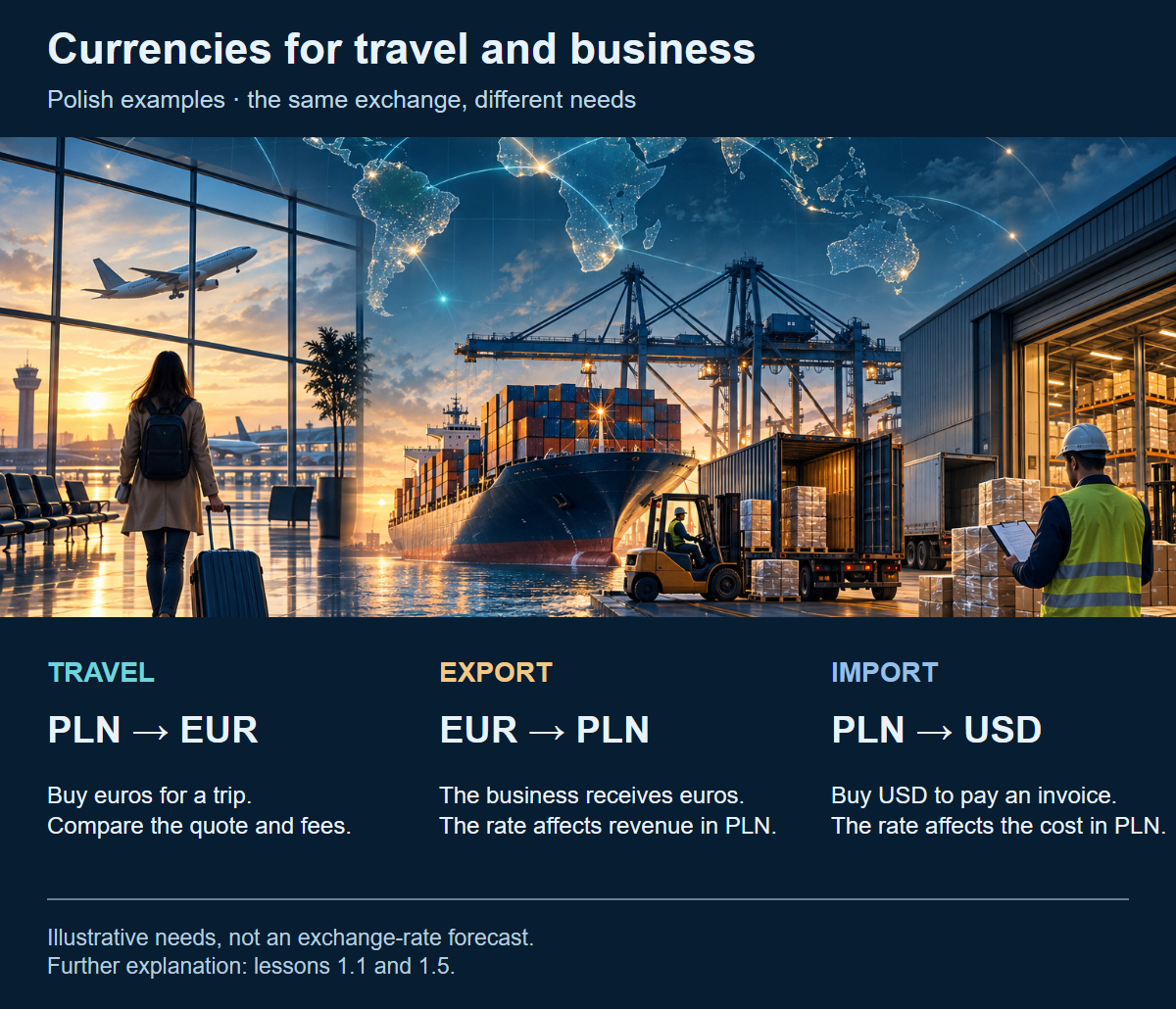
For overseas travel, the total amount charged for conversion matters. The lesson on different euro exchange rates compares reference publications with executable offers.
For businesses, an exporter expecting payment in euros may reduce uncertainty about its domestic-currency proceeds through currency-risk hedging. Exporter and importer examples appear in the lesson on the market’s economic role.
Exchange rates also affect imported goods’ cost. A shop’s final price additionally depends on supplier prices, taxes, transport, competition and the seller’s decisions. Every currency move should not be expected to cause an immediate identical retail-price change. The RBA [1] explains these channels and lags.
A family remittance from abroad. What matters is the amount received after every fee and conversion. An attractive advertised rate is insufficient if the provider adds commission or routes funds through another currency. Compare the same transfer amount and payout currency.
Foreign-currency debt. Earning income in one currency while owing principal in another creates a mismatch: depreciation of the income currency can raise debt-service costs. The final outcome also depends on interest and contractual terms. The Swiss National Bank’s removal of the EUR/CHF floor on 15 January 2015 illustrates that an exchange-rate regime can change abruptly [7]; it does not establish an identical course or outcome for every loan.
A central-bank reference rate. Central banks publish official daily rates for accounting and valuation rather than executable client quotes — for example, Narodowy Bank Polski (NBP) publishes Table A on business days between 11:45 and 12:15 local Warsaw time [6], while the ECB and Bank of England maintain their own schedules. Applicable law or the contract determines the rate used for a settlement.
How a rate changes a household or business payment
Using the illustrative currency in the diagram above, suppose a household receives EUR 500 from family. Conversion at 4.30 PLN/EUR gives PLN 2,150; at 4.40 it gives PLN 2,200 before fees. Someone paying a EUR 500 invoice has the opposite exposure: they need PLN 50 more. Similarly, for a CHF 400 loan instalment, a rate of 4.00 PLN/CHF gives PLN 1,600, while 4.50 gives PLN 1,800. These calculations use assumed rates, excluding forecasts, exchange costs and interest rate changes.
By scale, currencies outside the top few still participate in global wholesale trading: in the final BIS 2025 survey, transactions with PLN on one side averaged roughly USD 76.3 billion a day, or about 0.8% of global turnover (under the 200% currency-total convention). That global figure includes trades booked by London desks and other offshore hubs, not only domestic volume, and excludes separate interest-rate derivatives. The market-size lesson develops these distinctions. [4]
Using the lessons and sources
If you are starting from scratch, begin with 1.1. Its definitions help with later lessons. If you need specific information, choose the relevant topic from the map and use the article’s contents. Longer term explanations are available in the forex glossary.
For numbers, check the measurement period and what was counted. A figure published in one year can describe an earlier month. A currency’s turnover share and reserve share are different measures. Hypothetical examples illustrate a calculation or mechanism; they are neither quotes nor offers.
Source links lead to the institutions, reports and documents used in the text. Where a final version is specified, it takes precedence over an earlier preliminary release. Older documents remain appropriate for historical events: an old date does not make a historical source obsolete.
Who is this introduction for?
For someone converting currency before travelling, an entrepreneur paying a foreign invoice, an economic-news reader and a new market participant. Their common foundation is understanding rates, instruments and costs. Needs differ: travel conversion does not require learning leveraged trading, while understanding the market’s mechanism is not yet an investment plan.
On first reading, grasp the main distinctions and work through examples. Methodological tables and bibliographies let you return to detail later. If you already know a topic, select a lesson from the map; links to other sections help supply missing context.
Next: transaction notation and basic mechanisms
After the introduction, continue to forex basics and mechanisms. That section develops currency-pair structure, bid and ask, units, position sizes, costs and order types. Encountering an unfamiliar term does not require rereading the entire introduction: return to the definition.
Trading hours covers schedules and changing liquidity. Choosing a broker covers service terms and execution, while regulations and safety explains client protection. These develop topics introduced here only to the extent needed for an initial understanding. To test transaction arithmetic directly alongside the lessons, use the interactive forex calculators and the broker and prop due diligence scorecards.
Questions about learning in this section
Which article should I begin with?
If the subject is new, start with lesson 1.1, “What is forex?”. It explains terminology, currency-pair notation, rate types and the distinction between buying currency and a CFD. Later lessons cover history, market operation, statistics, economic functions and myths.
Do I need a brokerage account to read this section?
No. The articles can be read without a brokerage account or trading platform. Foreign exchange also concerns payments, international trade, savings and currency conversion before travelling.
Does this introduction teach profit-making strategies?
The section explains the market, instruments and basic risks. It contains neither trade signals nor promises of profit. Understanding the market alone is insufficient to forecast exchange rates or achieve positive results.
Where can I find explanations of unfamiliar terms?
Important terms are explained at first use. Term links lead to the forex glossary, while links within paragraphs lead to lessons developing the subject.
Does forex affect people who do not invest?
Yes. Travel conversion, overseas family remittances, imported goods and foreign-currency debt repayments can involve exchange rates. These differ from brokerage-account speculation and require assessment of different costs and risks.
Why do banks, exchange providers and news services show different rates?
They may show bid, ask or reference rates for different sizes and times. Margins and charges affect offers. There is no executable rate binding everyone; compare exactly how much you pay and how much currency you receive.
Does high turnover mean a transaction is safe?
No. Turnover is the notional value of agreed trades, not an execution or profit guarantee. Risk depends on instrument, position size, liquidity, counterparty and contract terms, among other things. Leverage increases capital sensitivity to rate changes.
Must I read all six lessons in order?
No. Each lesson answers a separate question and can be reached directly from the section map. The sequence from 1.1 to 1.6 is useful for someone who has not previously studied foreign exchange.
Sources for this guide
Sources checked on 12 October 2026. Detailed data, historical dates and bibliographies are in the relevant lessons. This page maps the section and its main distinctions.
- Reserve Bank of Australia, Exchange Rates and the Australian Economy, educational material with no publication date shown. Rate definitions and effects on trade, payments and prices.
- Randall Dodd, IMF, Financial Markets: Exchange or Over the Counter, Finance & Development, Back to Basics, with no date shown on the page. OTC dealer networks and non-identical participant quotes.
- Polish Financial Supervision Authority (KNF), Forex questions and answers, no publication date shown. CFDs settling price changes and associated risks; not used as evidence of current regulatory limits.
- BIS, 2025 Triennial Central Bank Survey — final OTC FX turnover annex, June 2026, Table 1: average daily notional in April 2025, net-net.
- BIS, Global FX markets: when hedging takes centre stage, December 2025: exceptional April volatility following US tariff announcements.
- Narodowy Bank Polski, Exchange-rate publication schedule, no publication date shown; Table A on business days between 11:45 and 12:15 local Warsaw time.
- Swiss National Bank, Swiss National Bank discontinues minimum exchange rate and lowers interest rate to −0.75%, 15 January 2015; discontinuation of the EUR/CHF 1.20 minimum rate.
- Anna Nordstrom, Federal Reserve Bank of New York, The FX Market Structure’s Ever-Evolving Landscape, 17 December 2025, Introduction. The market's infrastructure role in trade, investment and finance; preliminary speech statistics are not substituted for final BIS data.
- World Bank, World Development Indicators, Poland, 2024: exports of goods and services, % GDP and imports, % GDP. Official API export read on 12 October 2026; rounded to one decimal place.

