
How does Forex work? From quotation to settlement
Forex works through participants quoting prices, agreeing trades and arranging their settlement. A rate on a screen is only one part of that process: the currency direction, amount, fees, agreement and delivery terms determine what the client actually receives. A currency exchange at a bank, a trade on an institutional platform and a broker’s contract can follow different routes even when they display the same currency-pair symbol.

Start with the money the client actually needs
A freelance designer in the UK receives EUR 2,500 from a client. Her expenses are in pounds sterling (GBP), so she wants to sell the euros and receive GBP. The task is different from buying euros for a future payment: she is bringing euros to the provider, not asking it to supply them.
The following prices, fees and service terms are hypothetical. We assume the whole EUR 2,500 is available to exchange, both providers have confirmed the full amount, and the pounds will be delivered on identical terms. The fees shown are the only fees in this model. We are comparing the exchange itself, not tax treatment or the original overseas payment.
With EUR/GBP, the quoted number expresses pounds per euro. Our designer sells the base currency, EUR. She therefore uses the rate at which the provider buys euros: its bid. Reading the provider’s selling price, the ask, would price the opposite transaction.
Compare the pounds received after the stated fees
| Offer | Provider buys EUR: bid | Provider sells EUR: ask | Fee, GBP |
|---|---|---|---|
| A | 0.8520 | 0.8580 | 15.00 |
| B | 0.8490 | 0.8550 | 0.00 |
Offer A pays 2,500 × 0.8520 = GBP 2,130 before the fee, or GBP 2,115 net. Offer B pays 2,500 × 0.8490 = GBP 2,122.50 net. B delivers GBP 7.50 more under these assumptions, even though A has the higher bid.
The designer does not choose an offer by finding the largest number anywhere in the table. The ask is irrelevant to this direction of exchange. Nor does the narrower bid–ask spread alone decide the comparison: for this transaction, the executable bid, full amount, fees and delivery terms determine what she receives. The spread is already reflected in the buying and selling prices; we do not subtract it again.
A quote, an order, an execution and a payment are separate stages
A useful way to read the provider’s screen is to ask what has happened so far:
- A quote appears. It may be indicative or available under stated conditions. Its presence alone does not establish that the exchange has taken place.
- The designer sends an instruction. She needs to know whether she is accepting a firm offer or submitting an order subject to the service’s execution rules.
- The trade is executed and confirmed. The confirmation identifies the agreed currencies, amounts, rate and other terms. Those are the terms to check against the instruction.
- The payment obligations are fulfilled. The required amounts are credited or transferred according to the agreement. Funds being available for another payment is a further practical question.
These events may occur close together in a simple account conversion. They are still different events. The Basel Committee [6] describes the risks that can remain between agreeing a currency trade and completing settlement.
The attractive rate still needs an amount and a deadline
Suppose the designer needs pounds to pay a bill on Friday. A slightly better rate does not solve her problem if that service will make the money available only on the following Monday. She needs the provider’s actual delivery and transfer terms, including any relevant cut-off times. The transaction date is not automatically the date funds can be spent elsewhere.
The amount matters too. A price available for EUR 1,000 does not establish the price for all EUR 2,500. A displayed quote may change before an order reaches the provider, or only part of an order may be executable under particular rules. The detailed section on aggregation and available size shows why quantity belongs beside the price.
There is no need to guess a universal settlement delay from the word “Forex”. An account conversion, a deliverable trade and a cash-settled derivative do not promise identical cash flows. Read the terms of the service actually being used.
What the provider does next is a separate transaction
After buying the designer’s euros, a bank might match that currency need against another customer’s transaction, keep some exposure within its limits or hedge with another participant. Her exchange does not require each customer instruction to appear as an identical separate trade on one global exchange.
That also explains why two providers can show different rates for the same pair. They may have different funding, inventory, counterparties, client terms and pricing policies. A chart or reference rate describes a particular data source; it is not automatically a binding offer from either provider. The BIS analysis of market fragmentation [1] explains this network structure. The later sections distinguish internalisation, electronic venues and the broker’s own contractual role.
Five checks before treating a screen price as a completed exchange
- Identify what you give up and what you need to receive.
- Use the provider’s buying or selling side that matches that direction.
- Calculate the amount after the stated fees, for the full required quantity.
- Check whether the screen shows an indication, an instruction or a confirmed execution.
- Check when and where the money becomes available.
Try the questions below, then follow the market infrastructure behind those five checks. The same framework remains useful when the interface changes from a bank app to a professional terminal.
Put the exchange through three practical checks
The first question changes a fee, so it needs a fresh calculation. The second checks payment timing. The optional third question introduces prices available for different quantities.
Explore the details
Behind the screen: prices, execution and settlement
The designer’s receipt shows how to read one client exchange. The following sections widen the view: dealer conversations, competing electronic routes, internalisation, settlement and the behaviour of liquidity in calm and stressed markets.
A dealing conversation: terms first, then the trade
Voice trading helps explain what also happens behind today’s screen. A dealer may ask another bank for buying and selling prices for a specified currency, amount and delivery date. A voice broker may connect the parties without necessarily assuming their obligations. Once terms are agreed, the trade still needs recording, confirmation and payment preparation. Relationships and the ability to enter a contract matter alongside the rate. The IMF’s OTC-market explanation covers these dealer negotiations and intermediaries’ roles. [13]
Now switch from the designer to a UK company buying EUR 10,000. In a hypothetical conversation, it requests euros against GBP for a specified delivery date. If its employee remembers only 0.8510, it remains unclear whether this was the price for selling euros to the company, how many euros it covered and whether it was accepted. The same information can be missing from a screenshot. Electronic systems record and transmit data faster without eliminating the need to identify counterparties, amount, direction and contractual status.
Information screens, electronic conversations and matching serve different purposes
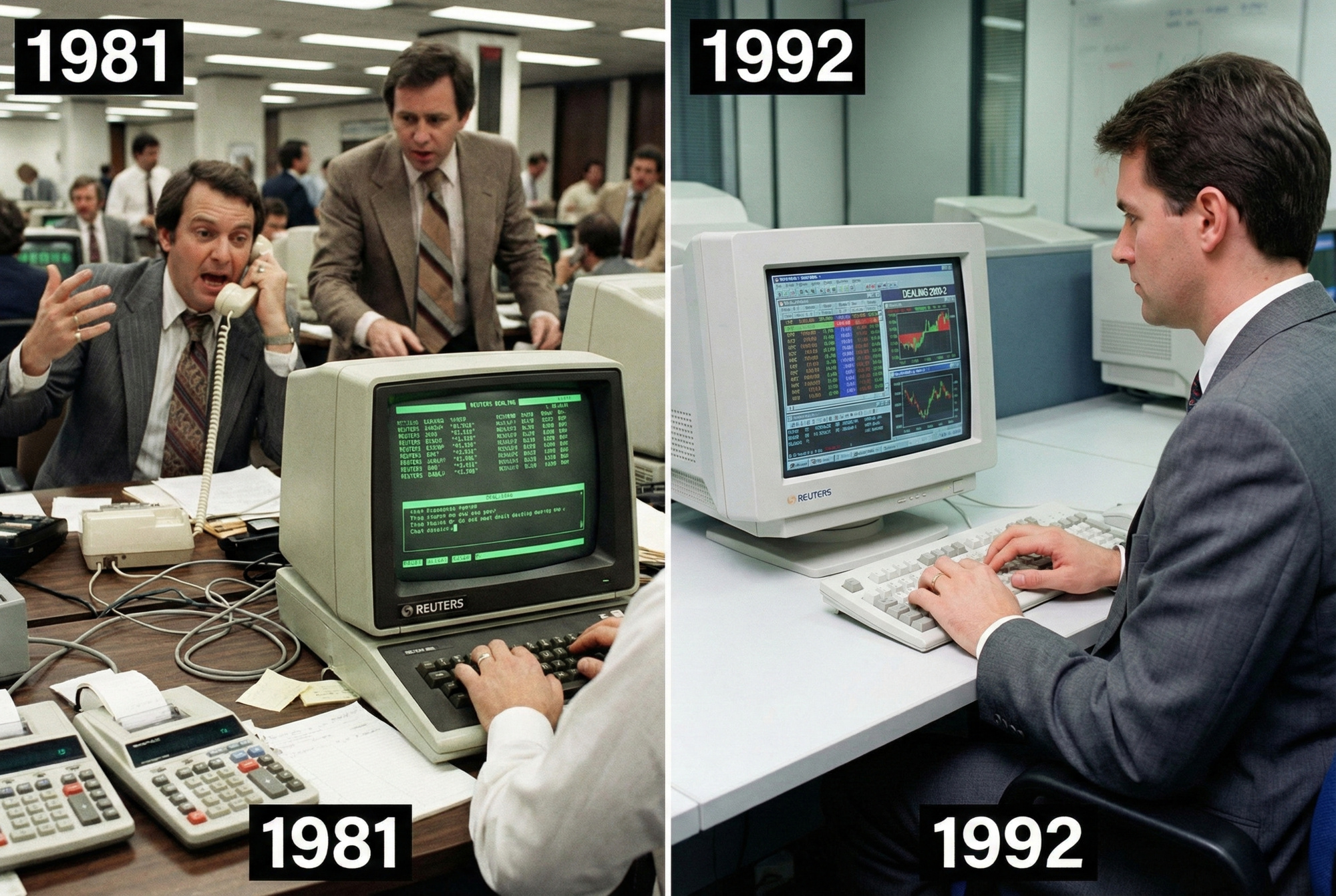
Reuters Monitor, introduced in 1973, transmitted quotations; Reuters Dealing System, introduced in 1981, enabled electronic negotiation of trades. Electronic matching of compatible offers subsequently developed through Reuters Dealing 2000-2 in April 1992 and EBS in September 1993. [19] This evolution cannot be reduced to “the telephone disappeared and computers arrived”. Information access changed first, followed by the negotiation channel and then the matching of offers.
Automation made searching prices easier and reduced some manual work. It did not make every visible price unconditionally available to everyone. Conversations remained useful for larger or bespoke trades. BIS analysis of April 2025 still describes voice channels alongside electronic ones, linking their use to size, market impact and individually negotiated derivative terms. [20]
An OTC network: prices do not come from one centre
Most currency trading occurs on the over-the-counter market, or OTC. Transactions connect price providers with clients and with other providers. The traditional distinction is dealer-to-client and dealer-to-dealer. A dealer transacts for its own account. Today's network includes non-bank firms, so “interbank market” no longer describes every participant. Bank for International Settlements (BIS) [1]
A direct connection or a platform with several providers
A client may agree an exchange directly with a bank, on its screen or in a conversation. Alternatively, a platform may provide access to several liquidity providers. The platform facilitates price access and transactions under its own rules; it does not create a single rate applicable worldwide. The International Monetary Fund (IMF) [13] describes these channels.
A price visible from one provider describes its offer and access conditions. Identify the amount, maturity and product. Seeing EUR/USD on two screens is insufficient: one may offer an exchange with delivery, while another refers to a contract on price changes.
In the BIS’s final annex of June 2026, direct and indirect electronic execution in April 2025 totals $5,535,228 million per day. Its share of full net-net turnover is (3,091,955 + 2,443,273) / 9,510,240 × 100 ≈ 58.2%. All amounts in this calculation are in USD millions; the denominator also includes turnover with no assigned execution method. [32] This is the electronic channel’s share, rather than the share of HFT or AI decisions. A dealer manually selecting an offer on a screen also uses electronics. Voice trading remains relevant, including for larger spot trades and individually negotiated instrument terms.
The BIS analysis of December 2025 reported 59%. [20] That is the figure in that publication, rather than a recalculation of the later final table above. Comparing channel shares requires the same data edition and definition of the calculation’s base.
Order books and credit access: anonymity has limits
In a central limit order book, or CLOB, a system matches buying and selling offers according to its rules. This is one execution method, alongside requests to named dealers and price streams. “Central” describes that venue’s book, rather than all worldwide currency exchange. In an anonymous model, a participant need not know the offer provider’s identity before execution; credit relationships and settlement obligations must still be handled. [1]
In a hypothetical case, a fund sees the most favourable price from A, but its available credit line does not cover the required amount. B’s price may be numerically worse yet available on agreed terms. This is neither evidence of fraud nor a universal screen convention: it illustrates the difference between observing a price and being able to trade. One system may exclude an ineligible offer from the display, while another requires further checks. A prime broker may expand access within contractual limits; it does not eliminate limits or replace identification of the client’s counterparty.
Two ways a price reaches a client
- One bank's offer: data available to the bank and its pricing rules → the bank's quote → the client's screen or conversation.
- Multi-provider platform: available institutions' quotes → platform or aggregator → the prices accessible to that client.
An aggregator connects access to several sources or venues, without necessarily covering the whole OTC network. These simplified routes follow BIS's account of market structure; they are not instructions describing every bank and broker. The interbank market lesson explains participant relationships.
Aggregation is not simply averaging several rates. A system can assemble bid and ask prices separately with available amounts and sources. What a client sees and can execute depends on connections and provider access. The best displayed price may not cover the entire required amount. BIS describes aggregators as connecting multiple venues and providers while fragmentation persists. [1]
A bank exchanging currencies with a client can itself trade with other dealers. This does not imply every retail exchange is individually and immediately passed to one overseas institution. A client's relationship with its bank and the bank's transactions with others are distinct levels of the network described by the IMF [13]. A rate alone cannot reveal them without documentation of the service.
Why connecting to a platform is not enough
FX is also a network of obligations. A price must be accessible to the particular participant and a trade fit within accepted limits. Technological access does not mean an institution can trade with every visible provider. In some arrangements, a prime broker provides institutional clients with credit access and assumes specified obligations from executed trades within contractual limits. It is not a mandatory intermediary for every exchange or a guarantor of any amount. BIS [1]
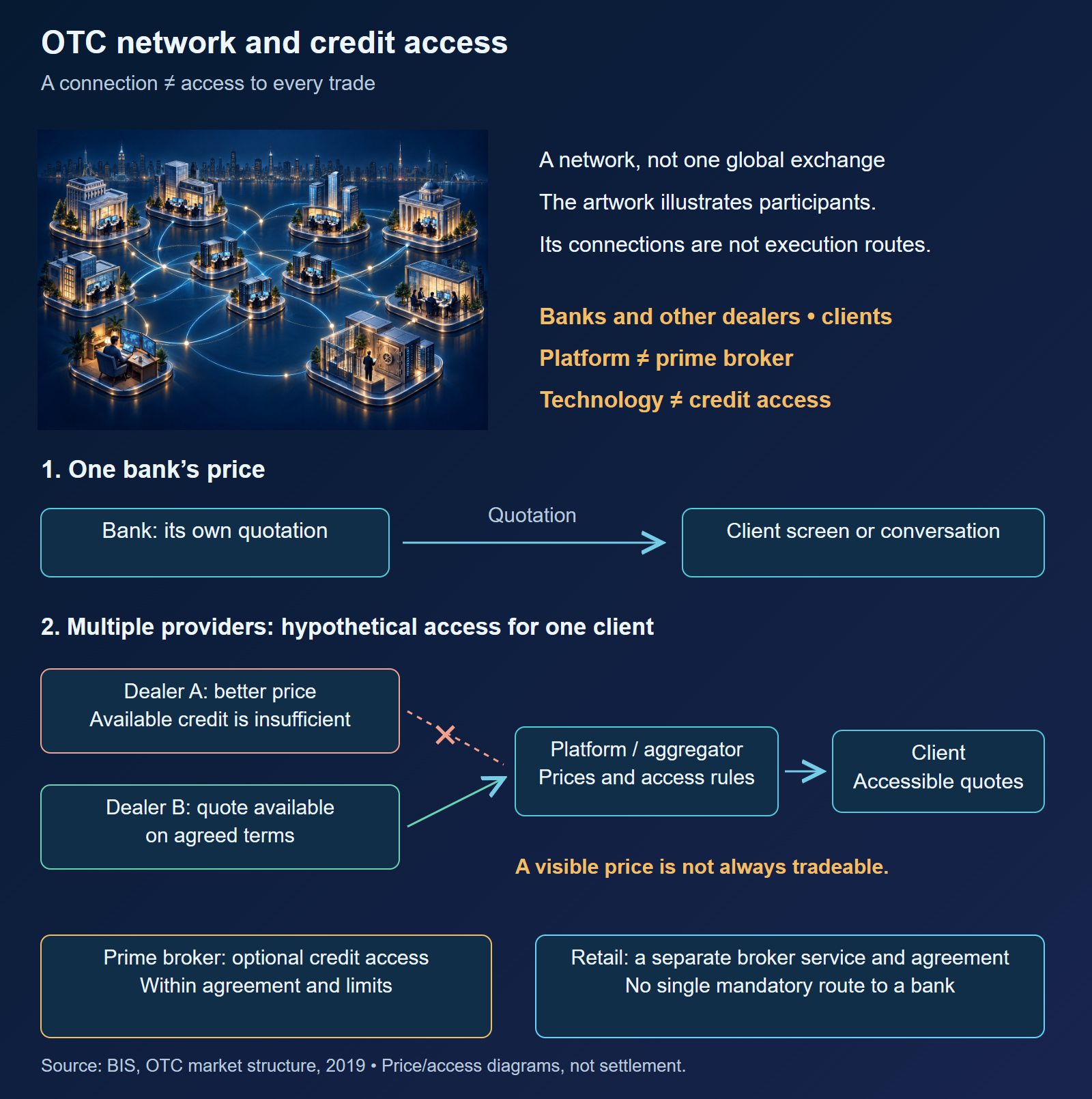
ECN, or Electronic Communication Network, describes an electronic communication or matching network. Providers sometimes use the term differently. It does not alone identify the client's contractual counterparty, access controls or settlement. A multi-provider platform can use RFQ, streams or an order book; not all are anonymous books. Read the service description rather than deriving the entire transaction route from three letters. [1] [2]
How a client obtains prices: streaming, RFQ and RFS
A screen can display successive updates or let the client request a particular transaction's price. Both forms can coexist on one platform. LSEG (London Stock Exchange Group) describes quote requests, price streams and order-book trading. They are different mechanisms, rather than alternative names for one service. LSEG [2]
| Method | What the client does | What is received |
|---|---|---|
| Streaming | Observes an available price stream. | Successive updates usable under that system's conditions. |
| RFQ: Request for Quote | Specifies a particular transaction and requests a quote. | One or more replies from which an offer can be selected. |
| RFS: Request for Stream | Requests a stream of updated provider prices. | A sequence of quotes rather than one reply. |
RFS requests a stream; streaming describes delivery of successive prices. FXall's PriceStream, supplying selected providers' quotes, is one example. The operator's description illustrates a particular arrangement, rather than a standard for every platform. FXall [3]
The same need, a different way of obtaining an offer
Consider a hypothetical UK company buying EUR 10,000 with GBP for delivery on a specified date. Through RFQ, it sends these parameters to one or several selected providers. Replies concern that transaction, and it can select an offer. The four decimal places in the quote are only part of the picture: direction, amount and delivery date are essential. A request is not yet a trade.
With RFS, the company requests updated quotes rather than a single response. As the rate changes, successive prices may arrive in the requested stream. Streaming describes the delivery of updates and can be initiated in different ways. LSEG describes PriceStream on FXall as streams from selected disclosed providers. This is an institutional example, rather than a description of every banking-app screen. [2] [3]
In each case, check whether the price is merely informational or executable and how acceptance works. An offer for specified parameters is not automatically available for any amount and date. Nor does every platform keep every price valid for the same interval. The service terms determine what happens when it is selected.
A telephone conversation can also conclude a trade. Voice and electronic channels coexist; participants' needs and the instrument influence the choice. Using a telephone does not necessarily mean an obsolete or inferior service. IMF [13]
Internalisation: why a dealer matches opposing client needs
Not every client exchange requires a dealer immediately to execute an equally large trade elsewhere. The dealer may temporarily assume risk until another client’s opposing need reduces it. This management of flow is called internalisation. A dealer’s client pool is not a separate “global exchange”; it is the obligations and risk book of a particular institution. BIS shows that growth in this model reduces some turnover visible on external platforms. [1]
A hypothetical example concerns the same currency pair and delivery date. A dealer sells EUR 100,000 against GBP to one company and buys EUR 80,000 against GBP from another. These directions partly offset, leaving a EUR 20,000 difference. Neither client contract disappears. Different prices, trade times, maturities or the failure of one payment can also alter the risk. The dealer may hedge the remaining exposure, wait for another flow or adjust its quotation within its policy. We do not calculate its profit because prices and costs have not been specified.
A large, diversified client base can make such matching easier; under stress, one-sided orders can make it harder and increase external hedging needs. A venue’s small share of total turnover therefore need not imply that its prices and execution opportunities are unimportant. This helps explain concentration alongside fragmentation: more venues can coexist with a substantial role for a few intermediaries. BIS analysis published in December 2025 describes more than 80% of customer trades being matched within dealers’ internal pools; this is not a percentage for every retail broker’s orders. [1] [20]
Three EUR/GBP quotes: what are you comparing?
This example concerns buying EUR 10,000 with pounds sterling with currency delivery. Each offer has the same amount, observation time and delivery date. Additional fees are excluded. All prices are hypothetical, rather than bank or broker quotations. A, B and C are fictional provider labels.
| Provider | Buys EUR from the client: bid | Sells EUR to the client: ask | Client pays for EUR 10,000 |
|---|---|---|---|
| A | GBP 0.8490 | GBP 0.8510 | GBP 8,510 |
| B | GBP 0.8485 | GBP 0.8515 | GBP 8,515 |
| C | GBP 0.8500 | GBP 0.8520 | GBP 8,520 |
A euro buyer needs the right-hand price, or ask. Provider B costs GBP 5 more than A, and C costs GBP 10 more. A and B have the same arithmetic bid/ask midpoint—0.8500—but a different euro purchase price for the client. The midpoint does not replace the price for the transaction's direction. This follows from the calculations without assuming an exchange can occur at that average.
The European Central Bank (ECB) euro foreign exchange reference rate has a different role from an updated provider offer: reference rates are published around 16:00 CET on TARGET business days strictly for information, rather than as an executable price stream. ECB [12] Comparing an evening quotation with a daily reference table must therefore allow for timing. What is Forex? explains average rates, bid/ask and client offers.
An actual comparison also requires checking whether the offer remains available for the amount, the delivery date and fees. The quotations and cross rates lesson develops bid/ask conventions.
The best rate may cover only part of the amount
Change one assumption in the previous model. In a separate scenario, A sells at 0.8510 but only EUR 5,000; B supplies the remaining EUR 5,000 at 0.8515. Both offers are assumed executable, unchanged during acceptance and fee-free. The two parts cost GBP 4,255 and GBP 4,257.50. Total cost is GBP 8,512.50, giving an average execution rate of 0.85125.
This exceeds GBP 8,510 obtained by multiplying the entire amount by the best displayed 0.8510. That rate was available for only part of the required amount. The example shows why an offer needs size information; it does not assume every client can split orders among arbitrary providers. System capabilities determine this possibility; FXall describes order splitting as a feature of its service. [3]
From information to an order and execution
New information can change participants' assessment of a currency. Some update quotes; others want to buy or sell. Information thus enters quotations and transactions. This describes a mechanism, rather than a rule predicting the rate after every release. The Reserve Bank of Australia (RBA) [9] studies information, orders and price changes.
- Information or an exchange need prompts action.
- A provider quotes a price and the client reads its conditions.
- The client accepts the offer or sends a specified order type.
- The system executes under the product's rules and communicates the terms.
- The parties confirm obligations and settle at the appropriate time.
Submitting an order and executing it are separate events. A retail derivative may execute at a price different from the one displayed when the order was entered. This difference is slippage. Depending on the service, an order can also be rejected or a new price offered for acceptance. The UK Financial Conduct Authority (FCA) [4] sets out retail CFD execution and disclosure standards; product documentation specifies the actual service's rules.
Buying EUR 10,000, step by step
Return to the first table, where A offers the full EUR 10,000 at 0.8510. The company buys currency for an invoice. This is a model of an exchange with delivery, rather than instructions for an app. Assume valid acceptance and no additional fees.
- Need and parameters. The company establishes that it needs EUR 10,000, pays GBP and requires delivery on an agreed date. Without these details, a rate does not describe the complete transaction.
- Reading the offer. It selects the provider's EUR selling price: ask 0.8510. It calculates 10,000 × 0.8510 = GBP 8,510 and checks delivery and acceptance conditions.
- Acceptance and execution. It accepts the offer in the prescribed manner. Execution confirmation establishes its obligation to deliver GBP 8,510 and the counterparty's to deliver EUR 10,000. Sending an unconfirmed request alone does not establish a trade.
- Post-trade processing. The parties check matching terms and payment instructions. A correct rate is insufficient if currency goes to the wrong account or instructions do not match.
- Delivery and use. Funds move under the agreed rules. Once euros are available in its account, the company can pay the invoice. Agreeing a purchase and subsequently transferring funds to the invoice issuer are separate activities.
The FCA [4] describes retail CFD execution standards; the Basel Committee [6] and CLS [7] describe confirmation and final settlement. These stages can be automated and appear brief to the client. Their distinction still matters: confirming a price answers a different question from confirming purchased currency is available.
What if the offer changes before agreement? At a new hypothetical rate of 0.8530, EUR 10,000 costs GBP 8,530—GBP 20 more. This does not mean the client must always accept. The system may require renewed acceptance or use another agreed execution mode. If the original offer was validly accepted on binding terms, a later rate does not arbitrarily replace the agreed price. Transaction status and terms matter, rather than merely which number appeared on screen.
A terminal transmits orders; the broker defines the service
A terminal sends instructions and receives responses. MetaTrader 5 documentation distinguishes an order, an executed deal and the resulting position. One order can execute through more than one deal. This matters when checking history: “submitted” is not “executed”. MetaQuotes [14]
In MetaQuotes' process, instructions move from the terminal to the broker's server, where parameters and available funds are checked. Execution or refusal can follow; partial execution is also a supported state. Instrument and provider settings determine the process. For a market order, the price depends on execution conditions, rather than the fact that a number previously appeared on screen. Documentation also describes modes requiring acceptance of a quoted price. [14]
Do not apply this process to every platform or infer the final contractual counterparty from the terminal's brand. A CFD is a contract on price changes: EUR 10,000 notional does not mean euros will appear in a currency account. Name the product before analysing the system's response.
API and latency: which stages technology accelerates
An API, or application programming interface, lets a system send requests and receive data without manual clicks. It can receive prices, submit orders or obtain status. Messages still undergo checks appropriate to the product. Electronic orders can be rejected or partially filled, and responses need correct interpretation. Automation does not turn a request into a guaranteed trade. [1] [14]
Latency may concern transmission, preparing a response, checks or the return path. A single engine's measure does not describe the time from a home computer's request to currency availability after settlement. “Platform microseconds” and “two-day settlement” therefore do not measure the same activity. A shorter technical route may help execution but cannot replace valid limits, a binding offer and an agreed payment date.
Last look: when a request is not yet a trade
In some institutional FX streams, a provider has a final opportunity to accept or reject a request after validity and price checks. This is last look. It does not apply to every market or permit arbitrary changes to an already agreed transaction. Principle 17 of the FX Global Code [15] calls for transparent terms, including treatment of price moves in both directions, and restricts use of client-request information.
The narrowest spread can therefore coexist with rejections requiring another attempt at a different price. In a hypothetical example, a provider shows ask 0.8510 but rejects a EUR 10,000 request; subsequent execution at 0.8530 costs GBP 8,530 rather than GBP 8,510—a GBP 20 difference. This is separate from valid acceptance of a binding offer. Execution quality develops the rules and metrics.
The Code concerns wholesale FX good practice and does not replace law. It is neither a broker licence nor a promise of a safe retail product. Its principles cannot prove that any app rejection resulted from last look; the service terms and trade record are needed. [15]
Price assessment must include unsuccessful attempts
A narrow spread on completed trades can appear attractive if rejected requests and retry costs are omitted. Offers should be compared for similar sizes, times and market conditions. Different slippage in the two directions warrants analysis but does not alone establish misconduct: order type, market movements and sample selection matter. The FX Global Code addresses transparency in last look and execution checks. [15]
| Measure or information | What is compared | Limitation |
|---|---|---|
| Rejection rate | Rejected requests relative to all comparable attempts. | One hundred completed trades without the rejection count do not describe the whole client experience. |
| Check and response time | Agreed measurement start and end points, including any last-look window. | Engine time does not automatically include the client’s network or settlement. |
| Slippage distribution | Favourable and adverse price differences against the same reference method. | An average hides infrequent large deviations and differences between conditions. |
| Retry cost | The new price, fees and elapsed time after an unsuccessful attempt. | A rejection has no single fixed cost; the rate may move either way. |
In a model with 100 requests of which 90 are accepted, the rejection rate is 10%, rather than 10/90. This is an illustrative calculation, not a provider’s result. A complete assessment also requires establishing whether the ten rejected attempts were retried, at what prices and whether the client executed the remaining amount at all. One measure should not be treated as a complete quality ranking.
More digits do not make a price more certain
In a separate EUR/USD model, assume that one pip is 0.0001 USD per EUR. A change from 1.25000 to 1.25005 is 0.00005 USD/EUR, or half a pip. The fifth digit can describe a smaller increment, but does not by itself establish a tight spread, deep liquidity or the ability to execute any amount. Other pairs can have a different pip convention: in typical quotations for pairs involving the yen it is 0.01 rather than 0.0001. The minimum price increment of the particular instrument must be checked separately. This is an arithmetic exercise, rather than a reconstruction of a particular platform’s historical quotations. You can convert pip and fractional-pip increments into account-currency amounts using the pip value calculator and trading cost calculator.
The order route depends on the agreement
Not every click becomes a separate trade on the same institutional platform. These routes illustrate differing obligations and execution venues while omitting detailed technical processing.
| Variant | Route | What the client enters into |
|---|---|---|
| Bank exchange | Client → bank offer → acceptance → confirmation and delivery under the agreement. | An exchange that supplies the purchased currency. |
| Institutional exchange | Client → accessible providers, directly or through a platform → agreement and execution → settlement. | A currency trade with a specified amount and maturity. |
| Retail CFD | Client → investment firm → execution under the service rules → position settlement. | An agreement on price changes, without buying currency to spend. |
| Exchange-traded futures contract | Client → intermediary → specified exchange's trading system → central clearing. | A contract standardised by the exchange. |
The first two rows illustrate channels described by BIS [1]. The remaining two concern contracts described by the UK FCA [4] and CME Group [5]. Technical checks can occur in different sequences across systems.
CFDs and futures have their own rules
A contract for difference—CFD—settles price changes under its terms, without supplying purchased euros to a currency account. A firm can be the client's counterparty or transmit the order onwards. Any broker hedge remains a separate activity from the client's agreement. FCA [4] The lessons on execution infrastructure and execution quality explain these arrangements.
A futures contract is an exchange product with standardised terms, including size and maturity. Trading concerns a specified contract series. A central counterparty (CCP) steps between the parties and manages default risk. The futures price concerns that contract; it is not automatically a bank screen's currency exchange price. CME [5] explains the standard, and the Basel Committee [6] explains the CCP.
Client protection depends on product and service rules. Before entering an agreement, check provider authorisation and CFD client protections.

Easy terminal access does not confer the rights of a currency purchase
The internet made observing prices, submitting instructions and using automated rules easier. It did not by itself change the agreement underlying a position. Similar EUR/USD charts on a bank screen and a CFD terminal may correspond to different contractual outcomes. A currency exchange requires the purchased currency to become available; a CFD outcome depends on the price change, costs, collateral and closing rules. Access to the same type of software does not imply identical client protection in different jurisdictions.
A firm’s risk management must also be distinguished from the client’s contract. It may retain some exposure in its books or hedge it elsewhere; the actual model and its disclosure matter. A-book, B-book, STP and ECN are not licences or evidence that every instruction is sent to EBS. In one model, the client contracts with the firm and its hedge is a separate agreement. In an agency model, the intermediary transmits an order under agreed rules. The terminal’s advertising cannot establish this distinction.
FXCM in 2017: a documented example of why a label is insufficient
On 6 February 2017, the US CFTC imposed a USD 7 million penalty on FXCM and related parties. Findings covered 4 September 2009 through at least 2014: the firm concealed its relationship with an important liquidity provider and misrepresented its “No Dealing Desk” model as having no conflicts of interest. The settlement included withdrawal of the specified parties’ CFTC registration. [21] This is a specific historical proceeding, rather than evidence against every firm using a similar description.
Assessing a service therefore requires the legal entity’s name, its role, execution policy and records of your own transactions. A published losing-account percentage concerns a specified product’s risks and outcomes over a period; it does not detect a broker’s model. Authorisation, execution arrangements and investment outcomes answer three different questions. Loss data and their appropriate scope are explained in myths and facts.
Why a platform is more than a screen with a chart
MetaQuotes announced the official release of MetaTrader 4 for 1 July 2005. The system included a client terminal and components processing transactions on the broker’s side. The provider subsequently launched MetaTrader 5 in 2010. These dates describe the history of software; they do not mark the beginning of the entire retail FX market. [29]
In MT4, Expert Advisors written in MQL4 can analyse data and perform programmed actions. MetaEditor and the strategy tester provide an environment for developing and checking them. The ecosystem of code and tools helps explain the persistence of such a product. It does not replace checking the account’s terms: an identical terminal interface does not imply an identical counterparty, instrument, cost or execution method. The ability to run a program does not establish that its rules are profitable. [30]
After execution, settlement remains
For an exchange with delivery, confirmation identifies currencies, amounts, the rate and the date they must be delivered. Payment instructions are then agreed and funds transferred through the appropriate channel. Rapid confirmation does not mean every exchange has reached final settlement. CLS [7] describes the post-trade cycle.
Risk remains between agreement and final settlement. A counterparty may fail to deliver or deliver late because of operational trouble, insufficient funds or insolvency. Agreeing the price does not eliminate these risks. Basel Committee [6]
CLS provides one settlement arrangement for eligible institutional trades. It links delivery of one currency to the other—payment versus payment (PvP)—protecting against paying one currency without receiving the other. CLS neither determines the rate nor handles every exchange. Access and eligibility matter. CLS [7] A CFD settles contractual obligations, rather than delivering its euro notional.
Spot means near-term delivery, not necessarily delivery this second
In the BIS survey definition, spot is an exchange of two currencies at a rate agreed on the contract date for delivery within two business days. [24] T+2 is a common convention, but a particular pair and agreement may use another date. Same-day and next-day delivery are different arrangements; we do not assume one rule for every product called “Forex”. Two business days also do not always mean 48 clock hours. Relevant currency payment calendars, holidays and cut-off times must be checked with the provider.
For a hypothetical exchange agreed on Monday for T+2 delivery, with no holidays and all service conditions met, the value date is Wednesday. The company can know its rate on Monday but schedule invoice payment around Wednesday’s availability of funds. If it needs euros that same day, it must agree that arrangement rather than infer it from clicking speed. This illustrates a calendar, not a convention applying to every pair.
Netting payments and PvP address different problems
Netting calculates the amount remaining after obligations are offset under agreed rules. It can reduce the number and value of payments, but calculating a balance does not mean both currencies have been delivered. Payment versus payment links the final transfer of one currency to the transfer of the other. This distinction prevents payment calculation from being confused with a settlement mechanism. Not every product, currency or participant is eligible for the same CLS service. [6] [7]
In the hypothetical GBP 8,510–EUR 10,000 exchange, one risk is that the client delivers GBP but the other payment fails. Linking the deliveries addresses that risk. It does not establish a better exchange rate, eliminate every outage or provide unlimited credit. Faster delivery may reduce some risks but requires earlier preparation of funds and instructions, rather than a faster server alone.
Execution, confirmation and settlement answer different questions
Execution establishes whether a trade occurred and on which terms. Confirmation checks that both parties recorded the same currencies, amounts, rate and maturity. Settlement finally fulfils payment obligations. In the model exchange for GBP 8,510, a EUR 10,000 purchase can be confirmed before the euros become available for transfer. An agreed later delivery date is not inherently a problem; delay must be assessed against that date.
CLS illustrates processing for eligible institutional transactions: both parties' instructions are authenticated and matched; on the agreed date, the pair passes required checks and settles with payments linked across currencies. [7] This differs from a CCP's role in futures. Linking deliveries limits the risk of paying without receiving the other currency, whereas a CCP interposes itself between the parties' obligations. The institutions must not be equated merely because both are involved in settlement and clearing.

A market across the day: continuous trading, changing activity
Forex has no common daily opening and closing. Major segments trade almost around the clock on business days with a weekend break. Activity moves across financial centres, while a particular bank, broker or exchange service may have narrower hours. The Australian Foreign Exchange Committee, hosted by RBA [8], describes the usual trading week.
- Pacific and Asia: centres including Sydney and Tokyo operate.
- Europe: European institutions join, including London.
- Europe and America: London and New York working hours partly overlap.
- America: trading continues in American centres after Europe's day ends.
- The next Asian day: activity passes into the next part of the cycle.
This describes sequence and overlapping activity, rather than fixed hours or liquidity for every pair. Time zones and daylight-saving changes affect how those hours are read from London, New York, Sydney or any other location.
Liquidity means the ability to transact a given size without a large price impact. Around-the-clock trading does not guarantee the same conditions at every hour. RBA's 2007 study found greater activity and volatility during London/New York overlap for the pairs studied. This is a historical observation, rather than a current liquidity measure for every currency. RBA [9]
The pair, holidays and data releases also matter. The Asian day can be particularly relevant to Asia-related currencies. The 24-hour market lesson explains time zones; liquidity concentration develops conditions at different times.
Calm conditions and stress: the same screen, different liquidity
In March 2020, RBA observed sharply wider bid/ask spreads and reduced spot-market depth. Depth here means the amount exchangeable with limited price impact. Rapid moves and large turnover did not ensure easy execution of every transaction. RBA [10]
| Observation | Calmer conditions with good liquidity | Stress and weaker liquidity |
|---|---|---|
| Bid/ask difference | Can be narrow and relatively stable. | Can widen substantially. |
| Available amount | A larger transaction is easier to execute near the observed price. | A smaller amount may be available at the same price. |
| Prices over time | Successive updates may be small. | Prices can jump rapidly. |
This illustrates RBA's mechanism, rather than claiming every wider spread means a crisis. Execution conditions concern the available price for a particular size, not just the size of a chart movement. A rate change while an order travels makes its execution rules more important. Low liquidity and risk develops these situations.
Two cases: ordinary exchange and March 2020 stress
In our calm model, the company finds a price for all EUR 10,000, accepts and knows the GBP 8,510 cost. Conditions do not change during acceptance. This establishes successful execution of that exchange, rather than a promise that every larger trade receives the same rate. The two EUR 5,000 offers already illustrated how available size changes the result.
March 2020 was a different, real case. In its May analysis, RBA linked deteriorating market conditions to large currency flows following abrupt asset-price changes. Portfolio managers changed holdings and currency hedges. High volatility constrained intermediaries' risk-taking capacity. Spreads widened, and the amounts exchangeable without larger price impact declined. This describes the spot market studied at that time, rather than every pair and retail provider. [10]
A client can therefore observe moving prices precisely when finding a counterparty for the required size becomes harder. More trades and larger chart moves are not synonymous with good liquidity. A chart alone cannot attribute a particular poor execution to this mechanism: assess its time, order type, size, confirmations and service rules. Historical stress does not establish that any broker acted correctly or incorrectly towards any client.
The franc in 2015: a rule change and execution risk
On 15 January 2015, the Swiss National Bank (SNB) discontinued its minimum exchange rate of CHF 1.20 per euro. At the same time, it reduced the interest rate on certain balances held at the SNB to −0.75%. Its explanation included diverging directions of monetary policy and changes in the euro’s exchange rate against the dollar. The bank did not announce that it was permanently ending all intervention. [27]
The commitment to a floor under EUR/CHF had previously constrained a particular aspect of market expectations. Its withdrawal required participants to reassess their offers and exposures. In a separate, hypothetical example, an ordinary protective stop to sell EUR is triggered at 1.1800, but the first available execution price is 1.1500. The difference is 0.0300 CHF/EUR; for €10,000 this represents CHF 300 relative to the trigger price, before costs. These numbers are not historical lows or customer outcomes from 2015. They illustrate only why the trigger level and execution price need not be identical.
Market risk can combine with service-provider risk. The FCA confirmed that Alpari (UK) Limited entered the UK’s Special Administration Regime on 19 January 2015 after being assessed as insolvent. [28] This is a particular case in a particular jurisdiction. It does not establish that all brokers became insolvent or that every customer automatically lost all their funds. For a new account, execution terms, protection of funds and procedures for a failure to meet obligations must be understood separately.
HFT, speed and liquidity: different algorithmic roles
A historical algorithmic share needs a precise definition
Chaboud and co-authors’ study of EBS data from 2003–2007 measured the share of trades involving an algorithm on at least one side. By late 2007, this approached 60% for EUR/USD and USD/JPY and 80% for EUR/JPY. [31] This did not establish the computer share of the entire global FX market or mean that both parties to every such trade were automated. Pair, platform, period and the numerator’s definition are part of the result; they cannot be replaced with today’s HFT share.
An instruction-executing program need not be a high-frequency firm
HFT is a particular area of algorithmic trading in which very rapid responses, frequent updates and short horizons matter. It can involve providing quotations, responding to price discrepancies between venues or taking available liquidity. Not every participant performs all these functions, and not every strategy closes every position after the same number of milliseconds. The BIS Markets Committee’s 2011 report distinguishes these roles and identifies difficulties in measuring HFT. [22]
An original hypothetical model illustrates the distinction: a company has an instruction to buy euros, and its algorithm splits the amount while remaining a buyer. Another system simultaneously posts buying and selling prices and adjusts them as information arrives. A third searches for discrepancies between two available sources. All may operate automatically, but their objectives and risks differ. “Algorithm” alone does not identify who makes the directional decision or which strategy produced an outcome.
Co-location shortens a signal’s route, not every payment’s route
Electronic markets have physical infrastructure: servers, connections and access points. Co-location means placing a firm’s equipment near a venue’s servers to reduce transmission time. [22] The matching engine, access point and sales desk reporting turnover can be in three different locations. “London is a major FX centre” therefore does not mean every trade or server occupies one building in the City.
Detecting a quotation change sooner may allow one system to adjust its offer before another participant. That alone does not predict the euro’s month-end rate. A short technical response time concerns a specified segment and measurement conditions; it cannot be compared with currency delivery time or prove execution at any price. Infrastructure costs may matter, but no single “entry price for HFT” can be stated without an offer and specification.
A narrow price and persistently available size are different things
When many systems compete to provide the best offer, a client may see a small bid–ask spread. The amount and duration of that offer must also be checked. Numerous rapid updates do not guarantee that a large order can execute without market impact. Under one-sided flow and increasing risk, both algorithmic and traditional providers may reduce quotations. Such episodes require investigation, rather than a predetermined explanation blaming “the machines”. [22] [17]
Fragmentation can offer a choice of venues without ensuring their independence. If several sources depend on similar providers, the disappearance of an important stream may affect several screens. This is an original example of a shared dependency, rather than an account of an identified outage. Assessing resilience requires actual connections, backup channels and procedures; the number of logos in an aggregator is insufficient.
A fast market has no single common low
On 7 October 2016 at around 00:07 BST—23:07 UTC on the preceding day—sterling weakened sharply against the dollar during Asian trading. The BIS Markets Committee report describes depreciation of about 9% during the event, with differing platform lows. It identifies no single cause, examining timing, one-sided flows, protective orders, algorithm responses and liquidity conditions. BIS [17]
The differing observations matter here. When offers disappear, trades in different places can occur at distant prices. One chart's low is not the “official low for all Forex”. Nor can a report alone justify a particular client's execution: reconstruct the instrument, bid/ask source, time, order type and execution rules. This is a historical GBP/USD case, rather than evidence that every move or adverse slippage has the same cause.
Benchmarks and transaction prices require different controls
A reference rate may value portfolios or support agreed settlement. Its data rules and calculation window nevertheless do not constitute an exchange offer available to everyone all day. The benchmark scandal also showed that electronic communication does not eliminate misconduct risk. In November 2014, the UK's FCA fined five banks for control failures and improper G10 spot FX practices, including attempts to manipulate fixes and misuse of client information. FCA [18]
This is evidence of documented practices at particular institutions over a specified period. It does not establish that one banking group controls all rates on all platforms. Sound assessment distinguishes the data source, benchmark methodology, ability to transact and participant conduct. Reform and accountability do not follow merely from moving a telephone conversation into a chat system; supervision and information controls are required.
Why orders concentrated around a benchmark require controls
A portfolio manager may want to exchange currency at an agreed reference rate to compare the outcome with asset valuations. Orders from many clients may therefore coincide within one window. A dealer knowing their confidential parameters holds information unavailable to other participants. Sharing it with a competitor or coordinating conduct around the fix can breach market standards; the FCA’s 2014 findings describe such practices. Not every hedge of a client order is manipulation, however: purpose, rules and information handling matter. [18]
Reforms addressed benchmark methodology, execution arrangements, communication controls and participant conduct. The FSB report of 30 September 2014 recommended, among other measures, separating responsibilities and controls around the fix. [23] This did not turn the reference rate into a price available throughout the day or make every abuse impossible merely by extending a window. Benchmark integrity and individual execution quality still require separate evidence.
In its 2014 report, the FSB recommended widening the then one-minute WMR window, considering five minutes a reasonable balance for major currencies. It also stressed that changing the window alone would not resolve the entire manipulation problem and that less liquid currencies might need a different approach. This describes a recommendation in a specific historical document, rather than a universal methodology for all reference rates in 2026. [23]
A chart displays its provider's data, not all Forex
A candle records open, close, high and low over a period, but first identify which prices it uses. MetaTrader 5 (MT5) documentation states that OTC charts use bid prices and exchange instruments use the last traded price, or last. Ask can therefore be outside the candle displayed. MetaQuotes [11]
Tick volume is not the value of all transactions. In MT5, it counts ticks received during bar formation. Actual transaction volume may be unavailable for an OTC instrument. OTC depth shown in the terminal also comes from the broker's quotes, rather than a shared order book covering the worldwide network. MetaQuotes [11]
A chart allows analysis of prices received from its source. It does not reveal every other institution's trades, available limits or the full route of the client's order. These data limits matter when comparing screens. MT4, MT5 and cTrader develops platform characteristics.
What can be established from different data
A tick here is a price-data update received by the platform. Many updates do not automatically mean a large exchanged amount. MT5 documentation distinguishes tick count from actual trade volume. An OTC source does not provide complete information on trades elsewhere. [11]
| Data | What they show | What they do not establish alone |
|---|---|---|
| MT5 OTC bid candle | Bid prices received from that source during the candle period. | The complete ask path or prices accessible from every provider. |
| Tick volume | The number of received ticks during bar formation. | The notional amount traded throughout Forex. |
| OTC depth in a terminal | The broker's data for the particular instrument. | A global book of every currency order. |
| Executed trade history | Account executions, prices and amounts. | Other institutions' trades or the provider's separate hedge. |
Chart and data properties: MetaQuotes [11]; order/deal/position distinctions: [14]; incomplete market-wide observation: BIS [1].
Hypothetical bid 0.8500 and ask 0.8520 may coexist. If a candle records only bid, ask 0.8520 need not fit within its range. This explains why comparing a purchase price with a candle requires care. It does not alone assess an order's execution rules: the appropriate quote side and transaction records are needed.
Automation supports execution but serves different purposes
A system can assemble quotes, choose a provider or split a larger order into parts. FXall describes such capabilities in its order-processing system. FXall [3] Algorithmic trading means using programmed rules; not every algorithm is speculative.
Splitting an order is not a market forecast
An execution algorithm receives a task, such as buying a specified euro amount within a defined period. It can split the order, set the pace and choose accessible venues, reducing the risk of immediately consuming all favourable offers with one large order. In return, it lengthens the interval during which the rate can move. Splitting does not guarantee lower cost: it exchanges one set of constraints for another. BIS Markets Committee [16] examines these execution tools separately from strategies choosing position direction.
For an institution, a larger amount makes the problem clearer. Suppose a fund must sell $50 million by a specified time. Selling the full amount immediately can consume available offers and require subsequent, less favourable prices. Gradual slicing allows other participants time to update their offers, but leaves the fund exposed to exchange-rate changes before the order is complete. We do not know the depth or subsequent prices, so calculate no saving. This model illustrates a choice between price impact, exposure time and completion certainty, rather than a recipe for invariably cheaper execution.
Pacing by time or observed volume
A basic TWAP slices an order over time. In our model, buying €10,000 in four equal parts means four transactions of €2,500 at successive intervals. We specify no prices and promise no better outcome. A VWAP bases its pacing on a volume profile, such as historically higher activity at particular hours. In OTC markets, the data set must be identified: one platform’s records are not the world’s entire volume. Both approaches need rules for responding to changing conditions; an algorithm’s name does not guarantee completion at the expected price. [16]
In a separate hypothetical model, a company buys EUR 4,000 at 0.8500 and EUR 6,000 at 0.8520. Cost is GBP 3,400 + GBP 5,112 = GBP 8,512, and the weighted average is GBP 0.8512 per EUR. The simple mean, 0.8510, would be wrong because more currency was bought at the less favourable rate. Without fees, this is the average of actual executions, rather than a forecast of the final price or proof of algorithm effectiveness.
Execution assessment requires a reference: the starting price, a specific benchmark, quotes for the required size or the cost of an alternative route. Timing, fees and available prices matter. BIS describes both benefits and risks from transferring more execution responsibility to the user. [16]
High-frequency trading (HFT) is a more specific topic, explained in the HFT entry. Automating price delivery or order splitting alone is insufficient to classify a service as HFT.
New technologies must be assigned to the appropriate transaction stage
Training a model and responsibility for execution
A statistical model may help select execution pace, detect unusual quotations or assess available sources. These are potential uses, rather than evidence that a product advertised as AI performs them effectively. The order still requires limits, missing-data rules, change controls and a way to stop the system. Training results from a calm period do not ensure appropriate behaviour under stress. Assessing an execution algorithm requires observing the whole process, rather than an impressive model name. [16]
CBDCs and tokenisation: the form of money versus exchanging two currencies
A CBDC is a digital form of central-bank money. It should not be equated with every electronic entry in a commercial-bank account. The ECB’s current explanation describes the proposed digital euro as another form of the same euro, rather than a new currency with its own exchange rate. Its distribution would still involve payment service providers. [25] This does not automatically imply the disappearance of brokers, banks or EUR/USD markets.
For wholesale cross-border payments, Project Agorá explores a shared platform combining tokenised central-bank reserves and commercial-bank deposits. BIS describes a prototype and controlled real-value payment tests conducted in July 2026. This is an important stage in testing the mechanism, rather than a universally deployed replacement for all FX infrastructure. [26] Linking two payments can improve settlement; it does not itself establish a favourable rate, provide unlimited credit or remove legal requirements.
Cloud computing and shorter settlement: what a faster computer cannot achieve
Rented computing capacity can support data analysis and system testing. That differs from maintaining a continuous quotation channel or delivering funds in two currencies. Design must distinguish computation time, transmission, checks, confirmation and final settlement. Replaying historical data can appear highly efficient while handling an outage or an interruption to the live stream remains unresolved.
Same-day settlement requires available funding and correct instructions in the relevant systems. A shorter interval may reduce exposure time while also reducing the time to prepare or correct an error. New technology, including a tokenised platform, must therefore be assessed alongside finality rules, liquidity access and operational procedures. Research projects do not establish that every FX contract has already moved to T+0. [6] [26]
Assessing a transaction requires its product, counterparties, execution price and settlement method. These are developed in Forex definitions and instruments and broker execution quality. The next lesson covers market size and what turnover statistics measure.
Questions and answers
Where does the Forex rate on a screen come from?
From a particular data source and the provider’s pricing rules. A bank may display its exchange offer, an institutional platform its accessible providers’ quotes, and a broker its instrument’s price. It is not one official rate for the entire currency market.
Does clicking Buy mean execution at the displayed price?
Not always. The price may change between submission and execution. Order type and service rules determine the result, which appears in the execution confirmation.
How do RFQ, RFS and streaming differ?
RFQ, Request for Quote, asks for a particular transaction’s price. RFS, Request for Stream, requests updated quotations. Streaming describes the delivery of successive prices. The provider or platform sets the conditions for using them.
Does an EUR/USD CFD purchase deliver euros?
No. A contract for difference settles price changes under the agreement and does not credit a currency account with purchased euros. The broker’s risk hedge is a separate activity.
Does Forex operate identically throughout the day?
No. Major segments trade almost around the clock on business days, but activity and quotes change as financial centres operate. Currency pair, holidays and data releases also matter. Particular products may have narrower hours.
Does MetaTrader volume show the entire Forex market?
No. MetaTrader 5 tick volume counts ticks received during bar formation. Actual transaction volume can be unavailable for OTC instruments. One broker’s data do not cover every global currency transaction.
Is CLS a central counterparty?
No. CLS links settlement of eligible payments in two currencies using payment versus payment. A CCP interposes itself between parties’ obligations and manages default risk. These are separate functions.
What is last look?
In selected institutional streams, a provider has a final opportunity to accept or reject a request after validity and price checks. Its terms should be disclosed. It does not apply to every platform or permit arbitrary changes to an already concluded agreement.
Does an execution algorithm predict exchange-rate direction?
Not necessarily. It may only split a specified amount, set the pace and choose accessible providers. Execution goals differ from choosing a position’s direction. Average execution prices must be weighted by amounts rather than averaging unequal sizes equally.
Why is the telephone still used in modern FX trading?
A conversation allows a larger amount or bespoke terms to be agreed with a particular counterparty. Voice channels coexist with electronic trading. Electronic execution accounts for approximately 58.2% of April 2025 turnover on the full net-net base in the BIS’s final table of June 2026; this is neither the HFT share nor evidence that other methods have disappeared.
What are EBS and a central limit order book?
EBS is one venue for institutional currency trading. A central limit order book organises offers within a particular system, rather than across the whole world. Access to an offer can depend on permissions, credit limits and the platform’s rules.
What does trade internalisation mean?
A dealer can match opposing needs of its own customers and manage the remaining exposure. It need not immediately hedge every transaction externally in an identical amount. Obligations to customers, and exchange-rate, credit and payment risk, still exist.
Is every algorithm HFT?
No. A program can gradually slice a large amount over an hour, whereas HFT uses very fast responses and frequent updates. An electronic channel, an execution algorithm and an HFT strategy describe different features of the process.
Does spot always mean T+2 settlement?
No. In BIS statistics, spot includes exchange for delivery within two business days. T+2 is a common convention, but shorter periods and pair-specific or calendar-specific rules exist. The value date must be confirmed in the contract.
Does a broker operating a B-book always act fraudulently?
Retaining risk as the counterparty does not by itself establish fraud. Disclosed terms, conflicts of interest and execution practices must be assessed. External hedging is not an automatic guarantee of fair conduct either; the particular contract and the firm’s behaviour matter.
Would a stop loss always protect against an event like the SNB decision in 2015?
An ordinary stop loss sets a trigger condition, but does not always guarantee an execution price. A gap in available offers can lead to slippage. A guaranteed order, if offered by the service, has separate terms and costs.
Will the digital euro create a new currency pair?
No. In the ECB’s description, it would be a digital form of the same euro, complementing cash. It would not create a separate currency with an independent exchange rate against ordinary euros. Potential changes concern payments, distribution and settlement.
Will AI replace human responsibility for an order?
No. A model can support analysis and execution, but correct data, limits, oversight and stopping rules remain necessary. An automated decision does not remove the service provider’s responsibility or the risk of the contract.
What does technological development offer someone exchanging currency for a holiday?
It makes it easier to compare offers and submit instructions remotely. The outcome still depends on the rate for the correct exchange direction, amount, fees and delivery terms. A tight institutional spread does not mean that every consumer obtains the same price.
Sources
Sources checked on 29 October 2026. Operators describe specified services, rather than every platform. RBA's 2007 study illustrates historical intraday activity only. Regulatory publications (FCA, CFTC, ECB, RBA) apply within their respective jurisdictions.
- Andreas Schrimpf, Vladyslav Sushko, BIS, FX trade execution: complex and highly fragmented, December 2019: network structure, direct/indirect channels, aggregators and voice trading.
- LSEG, TORA to offer access to all LSEG FX trading venues through a single GUI, 22 March 2024: RFQ/RFS terminology and different platform trading methods.
- LSEG, FXall — End-to-end solution for your FX trades, undated: PriceStream, multi-provider streams and order splitting.
- Financial Conduct Authority (FCA), PS19/18: Restricting contract for difference products sold to retail clients, July 2019: retail CFD mechanics, execution disclosures and client protection standards in the UK.
- CME Group, Definition of a Futures Contract, undated: standardised contracts and exchange trading.
- Basel Committee on Banking Supervision, Foreign exchange risks, RMA20, published 1 January 2026, based on January 2013 guidance: CCP definition and risks between execution and final settlement.
- CLS Group, CLSSettlement, material marked © 2024, pp. 1–2: payment-versus-payment and the cycle for eligible trades.
- Australian Foreign Exchange Committee, Questions and Answers, undated, question 3: absence of common daily hours and the usual trading week.
- Kristina Clifton, Michael Plumb, RBA, Intraday Currency Market Volatility and Turnover, December 2007, pp. 1 and 8–9: information, orders and historical intraday activity. The source specifies periods and currency pairs.
- RBA, Box B: Recent Developments in Foreign Exchange Markets, Statement on Monetary Policy, May 2020: wider spreads and reduced spot-market depth in March 2020.
- MetaQuotes, Price Data in the Trading Platform, undated: bid/last chart prices, tick volume and OTC data.
- European Central Bank (ECB), Euro Foreign Exchange Reference Rates, updated around 16:00 CET on TARGET business days: daily informational snapshots rather than executable quotes.
- Randall Dodd, IMF, Financial Markets: Exchange or Over the Counter, Finance & Development, Back to Basics, 15 June 2019: dealer relationships, different quotes and OTC agreement channels.
- MetaQuotes, Basic Principles, undated: order/deal/position, terminal-to-server instructions, order states and execution modes. This concerns MT5, rather than every platform.
- Global Foreign Exchange Committee, FX Global Code, updated December 2024, foreword and Principle 17: scope, last-look control and disclosed terms.
- BIS Markets Committee, FX execution algorithms and market functioning, October 2020: execution algorithms’ aims, order splitting, risks and execution-quality assessment.
- BIS Markets Committee, The sterling ‘flash event’ of 7 October 2016, January 2017, pp. 1 and 5–8: BST/UTC timing, differing venue lows and interacting factors.
- Financial Conduct Authority, FCA fines five banks £1.1 billion for FX failings and announces industry-wide remediation programme, 12 November 2014: proceedings and documented practices, without generalisation to the whole market.
- BIS Papers nr 12, Foreign exchange markets in the 1990s — August 2002, p. 139, section 2: Reuters Dealing 2000-2 from April 1992 and EBS from September 1993. Monitor 1973: Reuters Annual Review 2000, p. 13; Dealing 1981: LSEG service history.
- BIS, The FX trade execution landscape through the prism of the 2025 BIS Triennial Survey — December 2025: execution methods, voice channels, disclosed and anonymous venues, and internalisation. Data period: April 2025.
- CFTC, Release 7528-17 — 6 February 2017: USD 7 million penalty, findings period, related market maker, misleading No Dealing Desk claims and registration withdrawal terms.
- BIS Markets Committee, High-frequency trading in the foreign exchange market — September 2011, pp. 4–6 and 18–19, glossary p. 30: HFT characteristics and roles, co-location and liquidity conditions. A historical source, not a current HFT-share estimate.
- FSB, Foreign Exchange Benchmarks — Final Report — 30 September 2014: methodology, WMR window and execution-control recommendations; scope also summarised in the FSB release.
- BIS, Reporting guidelines for turnover in April 2025 — Section 5.1: spot definition with delivery within two business days; a statistical definition does not specify every client service’s terms.
- ECB, FAQs on the digital euro — Updated 17 August 2026, questions 1, 11 and 12: central-bank money, providers’ role and the same euro rather than another currency.
- BIS, Project Agorá — Prototype description and Real-Value Testing section: July 2026 tests; a controlled experiment rather than universally operating infrastructure.
- SNB, Swiss National Bank discontinues minimum exchange rate and lowers interest rate to −0.75%, release and attached PDF, 15 January 2015: CHF 1.20/EUR floor, interest rate and continued possibility of intervention.
- FCA, News for customers of Alpari (UK) Limited, 20 January 2015, updated 23 March 2018: entry into the Special Administration Regime on 19 January 2015.
- MetaQuotes, MetaTrader 4 Release Date Announcement, 15 June 2005, and company history: announced release on 1 July 2005, client and back-office components, MT5 in 2010. The manufacturer’s description, without independent confirmation of its market-share claims.
- MetaQuotes, Algorithmic Trading with MetaTrader 4: Expert Advisors, MQL4, MetaEditor and Strategy Tester. Product-function documentation, without a promise of returns.
- Alain Chaboud, Benjamin Chiquoine, Erik Hjalmarsson, Clara Vega, Federal Reserve, Rise of the Machines: Algorithmic Trading in the Foreign Exchange Market, IFDP 980, 2009, section 3.1 and Figure 1: EBS 2003–2007, participation on at least one side, pair-specific shares.
- BIS, 2025 Triennial Central Bank Survey — final annex, June 2026 (PDF), Table 1, p. 1/75: net-net total and execution methods; the electronic-share calculation retains undistributed turnover in its denominator.

