
What is Forex? Currency markets, exchange rates and CFDs
Forex is the market for exchanging and pricing currencies, including contracts linked to their exchange rates. Follow a shop in Poland that needs to pay an invoice in euros: learn how to read a quote, compare the total cost and establish whether an agreement will provide currency for the payment.
Listen to the podcast episode on Spotify (8 min 10 sec)

How Forex works in practice: an invoice in euros
Imagine a shop in Poland that has ordered goods from a German supplier. It must pay EUR 10,000 in 30 days, but keeps its money in Polish zlotys. The owner wants to know how many zlotys to set aside and how to make sure the supplier receives euros on time. You do not need a trading platform to understand this problem.
If the business buys euros at PLN 4.30 each, the currency alone will cost PLN 43,000. At 4.40, the cost rises to PLN 44,000. That PLN 1,000 difference arises with the same invoice and the same quantity of goods. What changed was the price of the currency the business needs to pay in.
Forex is the market for exchanging and pricing currencies, including contracts linked to their exchange rates. Its users include businesses making international payments, banks managing currency needs, funds and people exchanging money before a trip. Some participants take exchange-rate risk in the hope of making a profit. Others want to reduce that risk or simply make a payment. The names Forex and FX come from foreign exchange.
The rates, offers and fees in this example are hypothetical. They explain the mechanism rather than current service prices. First, we will compare buying euros today; we will return to the invoice deadline when choosing how to hedge the payment. These calculations leave out interest and the cost of setting money aside early. The Reserve Bank of Australia [1] explains how exchange rates affect payments and trade.
How to read EUR/PLN without reversing the transaction
An exchange rate expresses the price of one currency in another. That is why rates are quoted as currency pairs. We read EUR/PLN = 4.30 as: one euro costs PLN 4.30. EUR is the base currency, whose unit is being priced. PLN is the quote currency, in which that price is expressed. CME Group [13] explains this convention.
When the shop buys euros, it simultaneously gives up zlotys. Buying EUR 10,000 at 4.30 means exchanging PLN 43,000 for EUR 10,000, before any fees. A rise in EUR/PLN to 4.40 means the euro has appreciated against the zloty. That increases our shop's cost. For an exporter receiving euros, the same move may increase the amount received in zlotys.
Reversing the order of the currencies changes the number. With EUR/PLN at 4.30, PLN/EUR is approximately EUR 0.2326 per zloty: we calculate 1 ÷ 4.30. A statement that “the rate rose” therefore needs a currency pair, a direction and a reference point. A number without units is not enough to calculate a payment cost.
The lesson on bid/ask quotations and cross rates develops price conventions in more detail.
Which offer actually costs less?
The owner compares two offers to buy the full EUR 10,000 today. In the table, “buy” and “sell” describe the provider's perspective. When a bank buys euros from a client, it quotes its bid. When it sells euros to a client, it quotes its ask. Our shop is buying euros, so it needs the ask: the provider's selling price.
| Item | Offer A | Offer B |
|---|---|---|
| Provider buys EUR from the client — bid | 4.2800 PLN/EUR | 4.2850 PLN/EUR |
| Provider sells EUR to the client — ask | 4.3000 PLN/EUR | 4.3020 PLN/EUR |
| Cost of EUR 10,000 at the ask | PLN 43,000 | PLN 43,020 |
| Additional exchange fee | PLN 50 | PLN 0 |
| Total amount debited in PLN | PLN 43,050 | PLN 43,020 |
Offer A has a lower selling price for euros, but is PLN 30 more expensive once the fee is included. Its effective cost per euro is PLN 4.3050, compared with PLN 4.3020 for B. The useful question is: how much money will be debited, and how many euros will the client actually receive? Compare the same amounts, delivery date and service. A separate transfer fee, if there is one, also belongs in the calculation.
An information service might show the owner a hypothetical reference rate of 4.2900. Multiplying by it would give PLN 42,900, but neither provider in our comparison offers to sell the business euros at that price. An informational rate provides a reference point. NBP's average rate, the ECB's reference rate, a bid/ask midpoint and an available offer are produced under different rules. We compare their actual historical values and uses later in the table of four euro rates.
Buying euros, hedging and CFDs: what does the business receive?
The shop needs euros to make a transfer. In an ordinary exchange with currency delivery, it pays zlotys and receives euros that it can use under the service's terms. That meets its payment need. It still needs to choose when to buy and allow enough time for settlement and the transfer.
The business could also enter into a deliverable forward: agree the rate and terms of a future exchange with a provider in advance. It must then perform that agreement in 30 days, even if the rate available in the market at that time would be more favourable. The hedge aims to reduce uncertainty about the cost of a particular payment. The agreement may require collateral; a later invoice deadline does not remove possible earlier funding needs. CME [17] explains how a forward can be tailored to an amount and date.
By contrast, a CFD on EUR/PLN settles a change in price. Opening a position with notional exposure corresponding to EUR 10,000 does not put EUR 10,000 in an account ready to transfer to the supplier. A CFD's result may affect the business's finances, but the contract itself does not deliver the currency needed for the invoice. Position financing, margin and close-out rules must be considered separately. Poland's financial supervisor, KNF [7], explains the construction of retail CFDs.
All these products may display the same EUR/PLN pair on screen. The agreement determines the client's rights: what it must deliver, what it receives, when settlement occurs and what further obligations may arise. The full product comparison below also covers futures, ETFs and other sources of risk.
From a price on screen to euros in the account
The main part of the currency market operates off exchange, in an OTC network. Banks and other price providers enter into agreements with clients and with one another. Individual platforms can have their own order books and trading rules. None shows one shared order book covering the entire Forex market. The International Monetary Fund [2] describes this market structure.
For our shop, it helps to distinguish three stages. Quotation is the price a provider shows for particular conditions. Execution means entering into the transaction under the rules for accepting the order. Settlement concerns performing the obligations, including delivering the currencies. A screenshot of a price is not confirmation that the euros have arrived.
The business should therefore check whether the price covers the full EUR 10,000, how long it is valid and when the funds will be available. If the bank later hedges its own risk with another provider, that is a separate transaction entered into by the bank. A client's order does not have to pass through one mandatory chain of intermediaries. BIS [20] describes the different execution channels and banks' role.
Alongside OTC trading, exchanges list specific currency instruments, including futures. The trading venue, settlement arrangements and exposure to exchange-rate changes are separate features. Later in this article, we will examine how they affect clients' rights and why an app's appearance cannot tell you what those rights are.
Before the exercises: six basics
- Forex connects currency exchange and pricing with contracts concerning exchange rates and future payments.
- EUR/PLN gives the price of one euro in zlotys; reversing the exchange direction changes the calculation.
- When buying euros, check the provider's selling price and the full cost of every service you need.
- A reference rate helps compare information but does not itself secure an executable exchange.
- A currency purchase, a deliverable forward and a CFD create different rights and obligations.
- Quotation, entering into the transaction and delivering the currencies are stages worth checking separately.
Apply these ideas in the exercises below. The rest of the article provides detailed explanations and further cases.
Try applying what you have learned
Three short exercises based on the shop's invoice
The shop must pay its supplier EUR 10,000 in 30 days and holds its funds in Polish zlotys. In the first two exercises, the owner is considering buying euros today. Every rate, offer and agreement below is hypothetical. Choose an answer first, then open the explanation.
Explore the details
The wider market: prices, agreements and infrastructure
The shop example shows the basic calculation. The following sections explain why rates differ, how individual instruments work and what can affect a transaction's execution and result. Read them in order or choose a topic from the contents.
Why different euro rates exist
A “euro rate” may be a reference, the midpoint of two prices or a client's offer. These numbers have different meanings. An informational rate does not promise a transaction at that price.
- Reference rate: for example, the average rate in Table A from Narodowy Bank Polski (NBP), Poland's central bank, or the European Central Bank (ECB) reference rate. It follows a specified methodology. The ECB expressly states that its publication is informational and discourages using it for transactions. [8] [9]
- Mid-price: the arithmetic average of bid and ask in a given source at a given time. It may help comparisons, but need not be a price at which anyone will execute an exchange. It is not automatically NBP's average rate. CME [15] uses this bid/ask midpoint definition.
- Bank or currency exchange provider rate: a price for a particular direction, amount and service. A provider's “euro buying rate” usually means it buys euros from the client. A client buying euros needs its selling rate.
- Execution price: the rate actually applied to the transaction. A price previously visible on a chart may use a different source or market side, or may be informational.
- CFD quotation: the price of a contract referring to a currency pair. It is not an offer to sell euros the client can withdraw.
The midpoint and the cost of an actual exchange
The earlier offer comparison shows which side of the quote to use. Here, let's calculate the midpoint of bid and ask. In a separate hypothetical quote, the provider buys euros at 4.36 and sells them at 4.40. The midpoint is (4.36 + 4.40) ÷ 2 = PLN 4.38 per euro. It is not a separate offer to exchange at 4.38. A client buying EUR 1,000 pays PLN 4,400; a client selling that amount receives PLN 4,360.
If the client bought and immediately resold the same EUR 1,000 at unchanged prices, the difference would be PLN 40: 4,400 − 4,360. This comes from crossing from the provider's selling price to its buying price, before any additional fees. The rate does not move over time in this model, so the result is not a loss caused by a market move.
Four different euro rates available on the same day
The following four values were available on 1 October 2026. All express PLN per EUR 1 but come from different publications. These are actual historical reference data, rather than a comparison of offers to buy currency.
| Publication | PLN per EUR 1 | Date and nature of the price |
|---|---|---|
| NBP average rate, Table A | 4.3770 | Table 191/A/NBP/2026 of 1 October; usual publication window 11:45–12:15 Polish local time. [8] [10] |
| ECB reference rate | 4.3735 | Data for 1 October; usually published around 16:00 Central European time, for information. [9] |
| NBP buying rate, Table C | 4.3202 | Table 191/C/NBP/2026 of 30 September, effective 1 October. A different publication from Table A. [11] |
| NBP selling rate, Table C | 4.4074 | The other side of the same Table C quotation. It does not determine a commercial bank's or exchange provider's selling price. [11] |
The date a rate is available is not its observation time. Table C was announced on the preceding day, while NBP and the ECB publish references at different times. These differences do not establish that either central bank offered a client cheaper euros.
What a client compares in an actual exchange
The figures below are educational assumptions, rather than quotes from those institutions or offers from 1 October. Suppose that, at the same moment, a bank sells euros at PLN 4.40 and a currency exchange provider at PLN 4.38. Buying EUR 1,000 would cost PLN 4,400 and PLN 4,380 respectively—a PLN 20 difference before additional fees. A meaningful comparison requires both rates to concern sales of euros to the client, the same amount and the same form of exchange.
If a broker simultaneously displays hypothetical EUR/PLN CFD quotes of 4.3790 and 4.3810, the midpoint is 4.3800. A similar number does not mean the client can buy EUR 1,000 there for a trip. The price concerns a contract, rather than a euro balance. The lesson on spreads, commissions and swaps discusses exchange and contract costs.
Paying by card abroad and converting into zlotys
A card payment's conversion rate depends on the account and transaction currencies and the card issuer's and payment network's rules. A terminal may offer dynamic currency conversion (DCC): the merchant or ATM operator converts the amount into the card's currency, such as PLN in this Polish example. You compare that offer with conversion under the card's rules. Neither option should be assumed always cheaper. Visa stresses disclosure of the rate and markup and preserving the customer's choice. [12]
Suppose a purchase costs EUR 100. The terminal proposes DCC at PLN 450. In our assumed outcome, the alternative—paying EUR 100 and conversion under the card's rules—costs PLN 438 including fees. The difference is PLN 12. If the final card conversion instead cost PLN 456, the comparison would reverse. These hypothetical amounts compare two conversion routes. Before payment, you may not know the final amount under the second route, so a lower rate number on one screen is insufficient: the conversion method and fees matter. Visa [12] explains DCC presentation rules.
A transfer illustrates the same basic distinction: sending euros already held does not require buying them again, whereas funding a EUR transfer from PLN may involve exchange. Establish who performs it and which rate applies.
Exchange, hedging and speculation have different purposes
Someone buying euros for a trip needs currency to spend. An importer wants to pay a foreign invoice. A fund may exchange currencies before purchasing assets abroad. In these cases, exchange serves payment or investment rather than a pure bet on the rate.

Hedging addresses risk arising from an existing or anticipated payment or position. The shop in the opening example can agree the terms of its future euro purchase in advance. This reduces uncertainty about the invoice cost without requiring a correct prediction of the market's direction.
In the same model, the importer can agree a deliverable forward at 4.35, making EUR 10,000 cost PLN 43,500. If the rate is 4.40 on the payment date, it avoids a rise to PLN 44,000. If the rate falls to 4.20, it still performs the forward for PLN 43,500, even though a new exchange at 4.20 would cost PLN 42,000. Asking only whether the company bought as cheaply as possible cannot establish the hedge's effectiveness: its purpose was to know the cost in advance. Fees and other contractual conditions are excluded; all figures are hypothetical.
Speculation means accepting exchange-rate risk in the expectation of profit. An investor can open a position without an invoice to pay or a need to hold the currency. An adverse rate move causes a loss. The instrument's name alone does not establish the purpose: both spot and derivatives can serve different needs. BIS [5] distinguishes hedging and speculative uses.

Currency risk also affects savings, foreign-currency debt payments and the cost of imported goods. Not every overseas payment requires a new exchange: someone who already holds euros and transfers them to a recipient accepting euros may avoid conversion. The role of Forex in the global economy develops these applications.
Rates also affect money you are not trading
Exposure to a currency means its rate affects funds held, an obligation or a future cash flow. It does not require a brokerage account. Consider two hypothetical cases: someone with a EUR 400 payment needs PLN 1,720 at 4.30 and PLN 1,760 at 4.40; a Polish exporter receiving EUR 10,000 converts it into PLN 43,000 at 4.30 or PLN 42,000 at 4.20. Fees are excluded. The rate move has opposite consequences for the payer and the recipient of euros.
In both cases, a payment or receivable creates the risk. A speculator may instead deliberately create a new exposure in anticipation of a rate change. A rise in EUR/PLN is therefore not “good” or “bad” for everyone: the consequence depends on which currency someone holds or must deliver. RBA [1] describes the effect on overseas purchases and debt service. These calculations show only direct conversion, rather than the full effect on prices in an economy.
OTC markets and exchanges: where transactions are agreed
The main part of the foreign exchange market operates off exchange, in an OTC network, short for over-the-counter. Banks and other price providers transact with clients and with one another. They can use electronic platforms, telephone calls and other channels. An electronic screen showing prices does not establish that a transaction takes place on an exchange.
There is no single global order book covering all Forex. A particular trading system may have its own book, showing only orders available within that system. Providers can quote different prices to different clients. Timing, transaction size and conditions matter. A rate from one information service does not guarantee a price available to every client. The International Monetary Fund (IMF) [2] describes this market structure.
Trading in the main segments takes place almost around the clock on business days, with a weekend break. A particular product may have narrower hours. The Australian Foreign Exchange Committee, hosted by Australia's central bank [14], describes the trading week; the lesson on the market across the day covers time zones.
A network of participants, rather than a ladder for every order
In wholesale markets, both banks and specialised non-bank firms supply prices. A corporation or fund can transact directly with a bank or use a platform gathering several offers. A bank can retain some risk, offset clients' opposing needs or enter into a separate transaction with another provider. There is no mandatory route followed by every exchange. BIS [20] describes this range of channels.
Access requires more than a price screen. Participants establish whom they can trade with, which amounts are acceptable and the conditions for delivering currencies. A price offered to a large institution is therefore not automatically an offer for someone buying EUR 100. Differences cannot be reduced to a rule that a “higher layer always gets a better rate”: size, credit, service, costs and execution time all matter. The market participants section develops the roles of the different groups.
Competition and the ability to enter offsetting transactions help limit price discrepancies, but do not guarantee identical quotes. Arbitrage—using an executable price difference—requires access to both offers and allowance for fees, timing and risk. Merely seeing two different numbers on screens does not establish an available profit. [20]
How orders contribute to price formation
A dealer does more than pass on a number from an external screen. By offering to buy and sell, it takes exposure to exchange rate changes and non-performance. Incoming orders, known as order flow, reveal which currencies and amounts its clients want to exchange. If euro purchases predominate for a time, the dealer may adjust quotes or hedge the resulting exposure. Other providers respond to their own orders and available information. Prices form across connected venues and relationships, rather than in a single computer setting a rate for the world. BIS [20] describes the role of dealer channels and platforms in price discovery.
Consider a model in which one bank client buys EUR 2 million while another sells EUR 1.6 million around the same time. The bank can offset matching needs, leaving EUR 0.4 million to manage separately. This illustrates internalisation, without assuming that every opposing order is automatically matched. The bank remains a party to its client agreements and responsible for their performance. Any external hedge it enters is a separate transaction. It does not establish that the client has itself transacted with another bank.
A chart or volume figure on one platform therefore cannot show all participants' decisions. Many transactions may be agreed bilaterally. Electronic order books, meanwhile, allow participants to observe offers within those venues. Both channels contribute to price discovery, but each provides only part of the picture.
A tight spread does not imply unlimited size at one price
The spread measures the distance between prices; depth measures available amounts at successive levels. Assume a hypothetical, static book of EUR/USD sell offers. The best bid is 1.0850 and best ask 1.0851 USD per EUR, giving a one-pip top-level spread. The buyer wants EUR 50 million, but only EUR 5 million is available at the best ask.
| Available amount | Ask, USD per EUR | USD payment |
|---|---|---|
| EUR 5,000,000 | 1.0851 | 5,425,500 |
| EUR 15,000,000 | 1.0852 | 16,278,000 |
| EUR 30,000,000 | 1.0854 | 32,562,000 |
| Total EUR 50,000,000 | Average 1.08531 | 54,265,500 |
The weighted average price is USD 54,265,500 ÷ EUR 50,000,000 = 1.08531 USD/EUR. Compared with an assumed full execution at 1.0851, the buyer pays USD 10,500 more: a difference of 2.1 pips across the entire amount. This is not an extra commission, but the result of executing portions at different prices. The model assumes every offer remains available and executable; live offers can change or be subject to credit restrictions.
Using several levels is commonly called sweeping the book. Slippage compares a reference price with execution. Market impact concerns the order's own effect on prices and providers' behaviour. This static table demonstrates the cost of moving through levels, rather than proving a lasting shift in the entire market. The distinction also matters for smaller orders when liquidity is limited. The lesson on market operation follows an order in detail.
What an intermediary can do after receiving an order
A person exchanging currency at a bank receives that bank's service and offer. A corporate treasurer can request prices from several dealers for the same invoice. A fund can use a multi-bank platform, while a specialised institution may obtain access through a prime broker. These situations should not be combined into a mandatory chain of “client → broker → bank → exchange”. They differ in product, counterparty and credit conditions.
For a CFD, the client contracts with the entity identified in the account documentation. The broker may manage exposure internally, hedge a portion or use an external execution provider. Labels such as STP, ECN and NDD do not by themselves establish the legal counterparty or how a complaint will be handled. Check the agreement, order execution policy and fee schedule. The broker's hedging method does not turn a CFD into a deliverable currency purchase. [7]
Why an OTC market is useful to a business
A company rarely needs currency in an exactly round amount on the expiry date of an exchange contract. Its invoice may be for EUR 37,850, payable in 47 days. This hypothetical situation illustrates the value of an agreement negotiated off exchange: the company and bank can agree an exchange for the particular amount and date. CME [17] describes this ability to tailor a forward.
Suppose, solely for this example, that the company enters a deliverable forward: in 47 days it will buy EUR 37,850 at PLN 4.35 per euro. Its agreed cost is PLN 164,647.50. The euro amount matches the invoice and delivery matches the payment need. Using contracts of standardised size and maturity would leave the company to address the matching separately; one contract may not replicate the invoice exactly. This does not mean futures cannot be used for hedging. The distinction concerns contract design, rather than a division into instruments “for businesses” and “for speculators”.
Tailoring does not mean unlimited choice. The bank must offer the instrument and accept the terms, and the client must understand the obligation. A forward is neither a forecast of the future rate nor a free right to choose whichever price proves better. In this model, the company pays the agreed PLN 164,647.50 even if the euro is cheaper on the payment date. In return, a higher market rate alone will not raise that cost. Uncertainty is exchanged for a defined obligation, assuming that both parties perform the agreement properly.
Matching a contract to a payment also involves execution choices. A large client can ask dealers to price the whole amount or spread execution over time. Limiting public disclosure of its intention may help manage market impact, but does not make the transaction invisible or guarantee unchanged prices. The provider knows the order it receives and may limit its offer or adjust its price. Client confidentiality and fair conduct matter regardless of channel.
Nor should “around-the-clock OTC” be contrasted with an exchange operating only during office hours. Electronic futures also have long sessions, but specific contracts and platforms have schedules, breaks and holiday calendars. A bank offering exchange through an app can apply its own hours and conditions. For payments, what matters is not only the ability to click, but the available price, delivery date and operation of payment systems in both currencies.
Exchanges trade specific currency contracts
Derivatives exchanges operate alongside the OTC market. They offer products including currency futures and options. The exchange defines a contract's standard, and its price forms within that exchange's trading system. It is not a common price for every currency transaction worldwide. CME currency contracts [3] are one example.
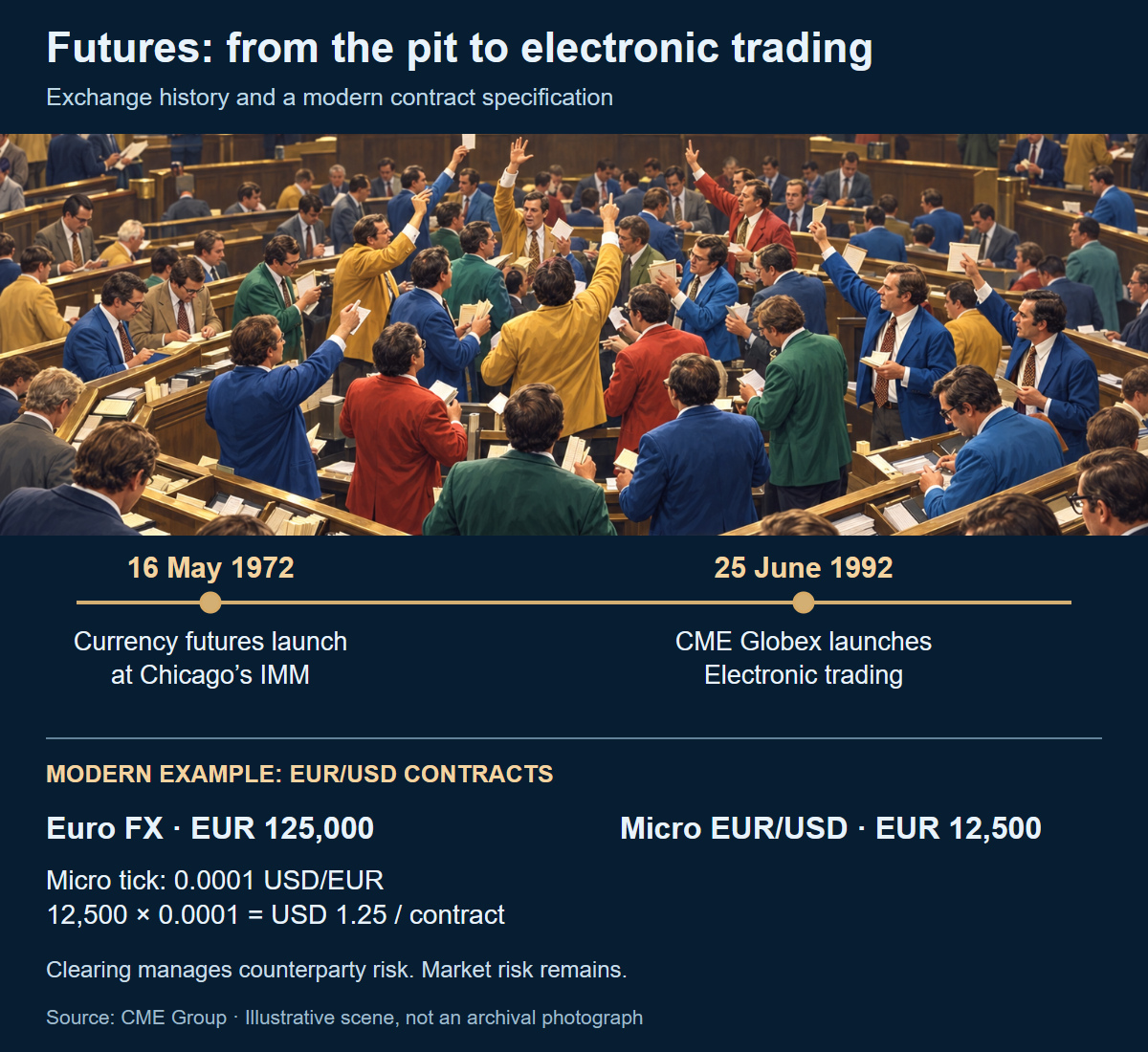
The OTC/exchange distinction describes how trading is organised. It does not by itself determine whether a product is suitable or safe. A clearinghouse manages counterparty risk in exchange contracts but does not eliminate exchange-rate risk. Collateral requirements can also apply to OTC instruments. The lesson on how Forex works today develops market mechanics.
What a clearinghouse does
In central clearing, a central counterparty, or CCP, steps between the parties. It becomes buyer to sellers and seller to buyers. Clients access this arrangement through an intermediary and clearing member. A participant therefore does not rely solely on the solvency of an anonymous person on the opposite side of the original trade. CME Clearing [18] explains the mechanism.
The clearinghouse requires collateral and settles changes in position value. In a hypothetical example, one participant must pay PLN 500 following a change in contract value, while another is due PLN 500. Central clearing organises these obligations under the system's rules; one party's gain does not disappear merely because the original seller or buyer changes their mind. PLN 500 is only an illustration, unrelated to the specification of any particular futures contract. At CME, value changes are settled at least daily, and collateral and other resources manage default risk. This does not promise the absence of risk: the CCP manages risks of its own, and losses from adverse price changes remain the participant's responsibility.
The place where a trade is agreed and the way it is cleared are separate matters. CME Clearing also handles selected OTC products, including non-deliverable currency forwards. An off-exchange trade may therefore be centrally cleared. Clearinghouse risk and price risk still require separate assessment. [18]
| Question | OTC market | Exchange-traded currency futures contract |
|---|---|---|
| How are amount and maturity set? | A forward can be agreed with the provider to match a client's need. | Contract size and maturities follow the specification. |
| Where is the price found? | At a bank, dealer or accessible platform; there is no book for the entire market. | In the trading system for a particular contract on a particular exchange. |
| Who is responsible for obligations? | This depends on the agreement and clearing arrangements. Bilateral arrangements or central clearing for selected products are possible. | The contract is centrally cleared, involving an intermediary and clearing member. |
| What do visible data cover? | The source or platform accessible to the client, rather than all OTC trades. | The specified contract and exchange market, rather than all currency trading. |
| Can an adverse rate cause a loss? | Yes; its consequences depend on the instrument's obligations. | Yes; central clearing does not eliminate price risk. |
This comparison uses the IMF's OTC description [2], CME's futures standard [3] and forward customisation [17], and CME Clearing's account of central clearing [18]. Provider regulation and duties require separate checks; trading location alone does not determine them.
A screen, an exchange and clearing are different features
The old distinction “telephone means OTC, screen means exchange” cannot describe today's market. An OTC platform can match offers electronically and display its own order book. Conversely, a selected off-exchange agreement can be centrally cleared. Electronic order entry, the place where an agreement is concluded and the entity managing its obligations answer three separate questions. [20] [18]
Technologies may look similar, but a client's rights do not follow from an interface's appearance. There is no need to declare that the boundary between OTC markets and exchanges has “disappeared”. Identifying the instrument, execution venue and clearing arrangements is enough. This distinction also explains why an exchange contract on a rate and a bank's euro exchange do not become the same product when both move onto a phone.
One number illustrating scale: the Bank for International Settlements (BIS) final annex of June 2026 puts average daily notional OTC turnover in April 2025 at approximately USD 9.51 trillion. This is the value of transactions agreed, not a pool of traders' invested money, profits or market capitalisation. The result adjusts for local and cross-border double reporting (net-net) and excludes exchange-traded futures and options. April was exceptional because of volatility following US tariff announcements. Sources: BIS Table 1 [4] and its analysis of the survey month [5]. The market size lesson explains the details.

Hybrid infrastructure does not erase contractual differences
Electronification allows OTC and exchange markets to use similar screens and technology. One concrete example is CME FX Spot+, launched for trade date 14 April 2025. It connects access to OTC spot and futures liquidity through FX Link, an instrument representing the difference between their prices. Connecting liquidity does not make spot a futures contract or move all Forex onto one exchange. The operator's description is used here to explain the mechanism, rather than recommend the platform. [22]
Post-crisis reforms of OTC derivatives are a separate development. Their scope depends on jurisdiction and product. In the United States, the Treasury determination of 16 November 2012 exempted specified deliverable FX swaps and forwards from mandatory central clearing and exchange trading, while retaining reporting and business conduct requirements. It did not extend the exemption to every FX derivative. Neither “OTC has no oversight” nor “all OTC goes to a clearing house after 2008” is an accurate rule. [23]
The useful distinction is between three questions: where was the price agreed, which contract was created and how will the obligations be performed? A new electronic channel can change the first answer without automatically changing the others. The history lesson develops Globex and electronification in detail.
A short map of foreign exchange instruments
The market includes several kinds of transactions. This map shows differences in their construction; it is not advice on choosing a product. A derivative is an agreement whose value depends on an underlying instrument—here, currencies or their exchange rate.
| Instrument | What the parties agree | Example use |
|---|---|---|
| Spot transaction | An exchange of currencies at an agreed rate with a near delivery date. In BIS statistics, delivery is within two business days; this does not always mean receiving currency immediately. | Exchanging currency for a current payment. |
| Outright forward | A future currency exchange or cash settlement at a rate agreed when the contract is entered into. In BIS classification, maturity is later than two business days after agreement. | Hedging a future invoice cost. |
| FX swap | Two linked exchanges of the same currencies in opposite directions, on a nearer and a later date. The first need not take place on the trade date. Both rates are agreed at inception. | Obtaining a currency temporarily. |
| Currency swap | An exchange of payments in different currencies, usually including interest and principal. Its construction differs from an FX swap. | Changing the currency of financing cash flows. |
| Currency option | The buyer receives the right to a specified exchange or cash settlement, rather than an obligation to exercise. The contract defines the buyer's rights and writer's obligations. | Hedging an adverse rate move. |
| Futures contract | A standardised exchange-traded contract obliging the parties to settle on specified terms, with a defined size and maturity. The specification sets final settlement arrangements. | Hedging or taking exchange-rate exposure. |
| Contract for difference (CFD) | Settlement of price changes under the contract, without delivering the underlying currency to the client. | Exposure to a rise or fall in the rate. |
OTC instrument definitions: BIS [6]; futures: CME [3]; CFDs: the Polish Financial Supervision Authority (KNF) [7].
The importance of these structures is visible in the data: in April 2025, FX swaps accounted for approximately USD 4.02 trillion daily, or 42.2% of final BIS OTC turnover. Spot was approximately USD 2.95 trillion, or 31.0%. The large swap share explains why Forex should not be reduced to predicting the next chart movement: exchanging currency for a period also serves funding needs. An instrument's share does not establish every transaction's motive, however. The market-size lesson covers comparisons with 2022, revisions and other categories; this OTC table should not be added to a count of futures contracts. [4]
FX swap: a currency needed for a limited period
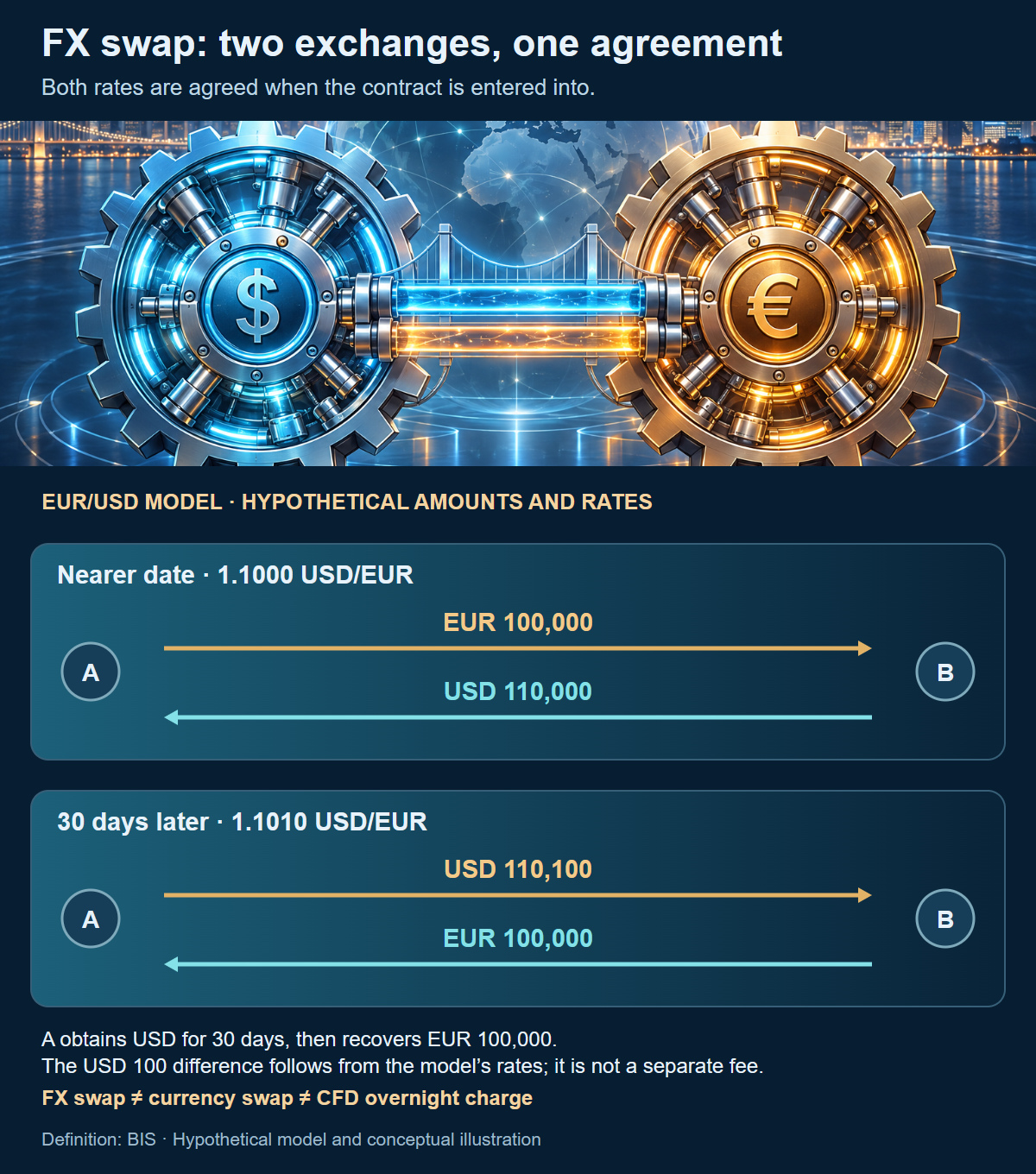
It is easier to understand an FX swap as two agreed exchanges than as another contract name. A participant may hold euros but need dollars for a month. The earlier exchange supplies USD; the later one reverses direction and returns EUR. Both legs form one agreement: the later exchange rate is not left to be determined next month. BIS [6] defines the two legs.
| Contract leg | Agreed rate | Participant delivers | Participant receives |
|---|---|---|---|
| Nearer exchange date | USD 1.1000 per EUR 1 | EUR 100,000 | USD 110,000 |
| Later date, 30 days afterwards | USD 1.1010 per EUR 1 | USD 110,100 | EUR 100,000 |
The participant obtains dollars for an agreed period, then delivers the specified USD amount and recovers euros. The USD 100 difference follows from the two hypothetical rates and EUR 100,000 amount. It is not a separate commission or a universal price for this financing. The example excludes additional fees and collateral terms. The first leg need not settle on the trade date: BIS also identifies structures with both dates in the future. Nor is an FX swap the same as the charge for holding a CFD position that brokers often call a “swap”. [6]
Currency swap: exchanging payment streams
A currency swap concerns payments in different currencies, including interest and, depending on the agreement, principal exchanges. It can align financing with the currency of business activity. In a simplified non-numerical model, a company owes debt payments in USD but earns revenue in EUR. The agreement may require it to pay agreed amounts in EUR to the counterparty and receive USD payments needed to service its debt. Unlike the earlier table, recurring interest payments matter, rather than only two exchanges of principal.
BIS describes currency swaps as usually longer agreements used, among other purposes, to align debt-related cash flows. A longer maturity alone does not turn an FX swap into a currency swap: the distinction primarily concerns the agreed payment types. Rates, dates and detailed obligations must be read from the contract. BIS [19]
In offers, “Forex” may describe spot, a product using margin, or a CFD. Currency trading with a margin deposit is sometimes called margin FX. This does not guarantee currency delivery: the Australian Securities and Investments Commission (ASIC) generally describes margin FX as a type of CFD, allowing speculation on rates without owning the underlying currency. This is a product description in that jurisdiction, rather than a definition of every offer worldwide. Identify the instrument and settlement arrangements from its agreement. ASIC [16]
CNY and CNH: one currency, separate markets
The renminbi illustrates why a currency's name does not guarantee a single rate. In quotations distinguishing the two markets, CNY refers to onshore renminbi in mainland China; CNH is the designation used for renminbi in the offshore market outside mainland China. Market access and liquidity differ. Flows between the markets face restrictions, so arbitrage does not eliminate every discrepancy. These are not two currencies issued by separate central banks. A study published by BIS in 2015 explains the mechanism. [25]
In that historical study, onshore USD/CNY was subject to a daily ±2% band around the central parity rate; its footnote dates the widening to 17 March 2014. This is not a limit for every renminbi pair or for the CNH rate. In a model with central parity of CNY 7.00 per USD, a band of that width gives 6.86–7.14. This is simply arithmetic illustrating the rule described for that period, rather than today's parity or an offer.
Stress can widen the pricing gap. BIS described such divergences in early 2016 alongside sharp changes in offshore funding costs. This does not produce a simple buy or sell signal. The client should establish whether an instrument references CNY, CNH or a particular fixing. A CFD labelled USD/CNH remains a contract governed by the broker's terms; the symbol alone does not provide access to a deliverable onshore transaction. [26]
The underlying market and the client's product: do you receive currency?
“EUR/PLN” identifies a pair, rather than the entire agreement. The table distinguishes a rate as a reference from a client's contractual rights.
| Client situation | What is received or agreed | Role of EUR/PLN |
|---|---|---|
| Exchanging PLN for EUR at a bank or currency exchange provider | Euros in an account or cash, under the service terms. | Determines the price of actual currency. |
| Deliverable forward for a future payment | An obligation to exchange specified currency amounts in the future at an agreed rate. | Sets the future exchange price. Non-deliverable forwards (NDFs) also exist, settling in cash without currency delivery. |
| Exchange-traded currency futures contract | A position in a standardised contract. The specification sets further obligations and settlement. | Underpins contract valuation and settlement; opening a position does not immediately credit a euro account. |
| EUR/PLN CFD | An agreement settling price changes, without providing euros to spend. | A reference for a derivative's price and result. |
Definitions and settlement boundaries follow BIS classification [6], CME futures rules [3] and KNF's CFD explanation [7]. Currency purchases and CFD positions create different rights, even if the same pair appears on the screen.
A CFD is complex and can cause a loss. Protections for a particular client category do not make it a safe substitute for currency exchange. Margin and leverage are developed in the leverage and margin lesson; broker offer conditions belong to choosing a Forex broker.

CFDs and futures: similar exposure, different terms
A reference to EUR/USD is not enough for a fair comparison between CFDs and futures. Check contract size, maturity, financing, closure and final settlement, market data and intermediary fees. The account provider and legal protections also matter. A CCP in the futures model does not replace every obligation that the broker owes its client.
CME specifies Micro EUR/USD at EUR 12,500, one tenth of the standard EUR 125,000 Euro FX contract. The minimum price increment for Micro EUR/USD is 0.0001 USD/EUR: one such increment changes contract value by 12,500 × 0.0001 = USD 1.25. Its size is small relative to the standard future, but “micro” does not mean low risk for every account. Exchange rate movements still affect the full notional. [24]
| Term | Currency CFD | Currency futures contract |
|---|---|---|
| Unit and minimum | Defined in the broker's specification; lot sizes and volume steps are not identical across every instrument. | The exchange specification defines the size of one contract. |
| Holding period | Product terms define financing, any expiry and closure. | The selected expiry has a maturity; extending exposure may require closing it and opening another expiry. |
| Price and data | Quotation and execution under the provider's terms. | The price of a particular contract; data access and fees also depend on the broker's service. |
| Margin and losses | Margin and protection depend on jurisdiction, entity, product and client category. | Clearing house and broker requirements; losses and additional payment demands remain possible. |
Margin is collateral, rather than the value of currency bought for cash. Assume a CFD model with EUR 10,000 notional, a rate of 1.10 USD/EUR and an assumed notional-to-margin ratio of 30:1. Exposure is USD 11,000 and margin approximately USD 366.67. A decline worth 1% of notional produces a USD 110 loss, approximately 30% of that margin before costs. This model does not describe a legal limit, current offer or forced close-out point: other account funds and close-out rules matter separately. A correct directional forecast may be insufficient if funds run out before the position can be maintained.
ETF shares and instruments inside a fund
Exchange-listed fund shares can provide another route to exposure. The trading venue for a share does not determine the portfolio's components: it can hold currencies or specified derivatives. An ETF, another form of ETP and a retail CFD have different structures. Read the prospectus instead of deciding from an abbreviation in the name. The US SEC explicitly distinguishes registered funds from other exchange-traded products that may commonly be called ETFs. That US classification is not applied here to every country. [27]
Buying shares with your own funds does not itself open a margined CFD. Broker financing of the account and leverage within the product are separate matters. Some leveraged ETFs use swaps, futures and other derivatives; their daily objective does not promise an identical return multiple over longer periods. Exchange trading does not remove the need to understand those terms. [28]
Risk has several sources
Exchange-rate risk means a price change worsens a result or payment cost. Counterparty risk concerns the other party's failure to perform. Settlement risk arises when delivering currencies: one party may have paid before receiving the other currency. Operational errors, outages and the need to supply collateral on time add further risks. They are connected but not synonymous. Basel Committee guidance [21] distinguishes them.
A CCP limits and organises default risk in the contracts it handles; it does not guarantee a favourable rate. Payment-versus-payment (PvP) links delivery of both currencies; it neither determines prices nor performs the CCP's role. Collateral or margin requires funds when due, even if the transaction's economic purpose was reasonable. An honest comparison cannot assign “risk only to OTC” and “safety only to exchanges”. The lesson on execution and settlement explains these distinctions. [21]
Client loss statistics require equally precise scope. In the Polish supervisory authority UKNF's report for 2025, 72.2% of the surveyed clients of domestically supervised entities recorded losses, covering Polish and foreign residents and excluding zero results. The report covers OTC derivatives, rather than currency pairs alone. It does not describe every Forex participant or the probability of loss on a particular trade. It provides context for speculative risk, rather than a judgement about every individual. The myths lesson develops the denominators and historical scope of ESMA warnings. [29]
A later move in the expected direction does not guarantee profit either. In a hypothetical model, you buy a CFD with EUR 100,000 notional at an ask of 1.1000 USD/EUR. The stop is triggered when its bid condition of 1.0980 is met, but the sale executes at 1.0978. The price-difference result is −USD 220 before commission and financing. A subsequent rise to 1.1020 does not change the already realised loss. This is an assumed path, rather than typical slippage or evidence of manipulation. Trigger conditions, execution and funds needed to maintain a position matter alongside the forecast.
Master agreements, collateral and netting
OTC markets do not rely solely on trust in a bank's name. Master agreements, such as ISDA, establish common terms for a set of transactions. Collateral documentation can define eligible assets, valuation, transfer deadlines and dispute procedures. Payment netting reduces amounts to transfer, whereas close-out netting determines a single balance after covered contracts are terminated, for example following default. Effectiveness depends on law and documentation; using the ISDA name does not guarantee recovery. [21]
In a model, following contractual termination of two contracts, one party has a USD 100,000 receivable and a USD 70,000 payable. If enforceable close-out netting covers both, the net receivable is USD 30,000. This compares termination values in one currency, rather than subtracting EUR 100,000 notional from USD 70,000. It excludes enforcement costs and changing valuations over time. A smaller exposure balance is not a promise to recover the full USD 30,000.
Cash collateral can limit the counterparty's exposure while increasing the other party's immediate funding needs. With a hypothetical contract value of −USD 20,000 and a requirement to cover that value fully, without thresholds or existing collateral, USD 20,000 must be delivered. A business may still expect export proceeds next month, while the collateral payment is due now. Distinguish the overall economic result of a hedge from cash availability on the day of a call.
These mechanisms explain why a division into “risky OTC” and “safe exchanges” is inadequate. Documentation, collateral, central clearing and PvP address different problems. None eliminates adverse price changes or every operational failure. The history and market mechanics lessons develop historical events and their effects on liquidity.
The spread, commission and contract result
Comparing products also requires comparing costs. In ordinary currency exchange, the spread can be embedded in a bank's or exchange provider's two rates, while a separate fee increases the final cost. A speculative contract can add commissions and financing for holding a position. Slippage is the difference between a reference price and execution; it can be adverse or favourable and is not automatically a separate tariff item. A CFD financing charge labelled “swap” does not mean an institutional FX swap has been entered into.
| Assumption or component | Calculation and meaning |
|---|---|
| EUR 100,000 notional; pip of USD 0.0001/EUR | 100,000 × 0.0001 = USD 10 per pip. Notional is not deposited capital. |
| Unchanged one-pip spread; immediate opening and closing | Buying at ask and selling at bid gives −USD 10 before other costs. The spread is not added again as two separate fees. |
| USD 3 commission on opening and USD 3 on closing | Total commission is USD 6; the result after spread and commissions is −USD 16. |
| Separate variant: USD 2 financing debit | If the position is held through a period subject to this hypothetical charge, total cost is USD 18. The rate is not universal. |
The model assumes no price change beyond the fixed bid/ask difference, no slippage and no conversion from USD into the account currency. It does not describe a current tariff or required margin. It shows why an advertised “one pip” does not fully answer the cost question, and why it matters whether commission is quoted per side or for the round trip. The spreads, commissions and swaps lesson develops the calculations. KNF [7] describes CFD construction and costs.
A checklist for a specific offer
Work through these four questions for the offer you are considering. Record the answers for your chosen amount, direction of exchange and date.
- Subject of the agreement: will you receive currency in an account or cash, or only the result of a derivative?
- Direction and convention: which currency are you buying, which are you paying in, and are you using the appropriate bid or ask?
- Time and conditions: when was the rate observed, for what amount is it available, and when does settlement occur?
- The complete price: what will you ultimately pay or receive after fees specified in the offer?
The next lesson, how the Forex market emerged, covers its history. Forex myths and facts addresses common misunderstandings.
Questions and answers about Forex
What do Forex and FX mean?
Both names come from foreign exchange and refer to currency exchange or the currency market. The market includes spot transactions and derivatives. Retail currency CFDs are one product linked to this market.
Is Forex an exchange?
The main part of the currency market operates off exchange in an OTC network. No single global order book covers all Forex. Exchanges do list specific currency instruments, including futures and options.
How do you read EUR/PLN?
EUR is the base currency and PLN the quote currency. A hypothetical EUR/PLN rate of 4.30 means PLN 4.30 per euro. When buying euros, check the price at which the provider sells euros to the client and any additional fees.
Why does the NBP rate differ from a currency exchange provider’s rate?
NBP, Poland’s central bank, publishes its average rate as a reference once each business day. A currency exchange provider sets buying and selling prices that may change during the day. Differences can reflect observation time, direction, margin and offer conditions. NBP’s average rate does not guarantee an executable exchange price.
Does buying an EUR/PLN CFD give me euros?
A CFD is an agreement settling changes in the underlying price. Opening an EUR/PLN CFD does not credit a currency account with euros that can be spent or transferred. Currency exchange and a CFD create different rights and risks.
Does Forex operate around the clock and at weekends?
Trading in the main currency-market segments takes place almost around the clock on business days, with a weekend break. A product’s availability also depends on bank, platform or exchange hours. Being able to request conversion in an app at a weekend does not mean the whole market is trading normally.
Why does most currency trading take place OTC?
The market developed around banks and client relationships. An OTC agreement can match an exchange amount and date to a particular payment. Electronic platforms facilitate access to offers without creating one global order book. Futures organise contracts through a different standardised arrangement and can also hedge risk.
Does OTC always mean more risk than an exchange?
Not without identifying the instrument and clearing arrangements. A CCP manages default risk in its contracts without eliminating losses from price moves. Collateral and liquidity risk also exist in OTC markets. PvP links delivery of both currencies but is not the same as a CCP.
Is an FX swap the charge for holding a CFD?
No. An institutional FX swap links two currency exchanges in opposite directions on two agreed dates. A CFD financing debit or credit commonly called a swap follows a different agreement and does not supply currencies to the client.
Is a chart price executable for my order?
Not necessarily. The chart may show bid, ask or a mid-rate from another source. Execution also depends on available size, timing, product terms and order type. Compare the same side of the quote at the same time; a difference between a data service and broker does not itself prove manipulation.
Why are a small CFD and Micro EUR/USD futures different?
A CFD has a unit and terms defined by its provider. CME Micro EUR/USD has EUR 12,500 notional and its own specification, maturity and settlement rules. Actual currency purchases, CFDs and futures create different rights. The word micro or an identical pair does not establish cost and risk.
Must an exchange-listed ETF hold only exchange-traded instruments?
No. The venue for trading fund shares and the portfolio itself are separate matters. A fund can have currency exposure, and some ETFs use derivatives. Check the prospectus, legal structure, strategy and costs: not every product commonly called an ETF follows the same rules. Buying shares does not automatically buy spendable currency.
Do CNY and CNH always have the same rate?
No. In quotations distinguishing the two markets, CNY refers to onshore renminbi, while CNH is the convention for designating offshore renminbi. Differences in access, liquidity and flows can create a pricing gap. The historical ±2% band discussed here concerns USD/CNY around central parity, rather than every pair or CNH. Establish the applicable reference for the product.
Do BIS data also include exchange-traded futures?
The final USD 9.51 trillion average daily turnover result for April 2025 covers OTC FX on a net-net basis. It excludes exchange-traded currency futures and options. Contract counts on an exchange require conversion using contract specifications, and turnover is not the same as open interest.
Why does London feature in descriptions of Forex?
The United Kingdom is an important transaction reporting location, while London hours connect European activity with parts of the Asian and American sessions. Final BIS 2025 data show 37.8% of turnover by sales-desk location on a net-gross basis. This differs from the global net-net measure and is not sterling's share. The market-size lesson also covers benchmarks and historical context.
Sources
Sources checked on 29 October 2026. The rate table contains historical publications relating to 1 October. Other numerical examples are hypothetical, rather than current offers. NBP links point to the dated archived tables; the ECB entry also links to its archive. NBP and KNF are Polish institutions; ASIC's product description concerns Australia.
- Reserve Bank of Australia, Exchange Rates and the Australian Economy, undated educational material: exchange-rate definition, payments and trade.
- Randall Dodd, IMF, Financial Markets: Exchange or Over the Counter, Finance & Development, Back to Basics, 15 June 2019: OTC organisation, dealer quotations and the market/platform distinction.
- CME Group, Definition of a Futures Contract, undated educational material: standardised contracts and exchange trading.
- BIS, 2025 Triennial Central Bank Survey — Detailed Tables: OTC Foreign Exchange Market Turnover in April 2025, final annex, June 2026, Table 1 and net-net notes. Average daily notional turnover: USD 9,510,240 million.
- Wenqian Huang, Ingomar Krohn, Vladyslav Sushko, BIS, Global FX Markets When Hedging Takes Centre Stage, BIS Quarterly Review, 8 December 2025: exceptional April conditions and hedging/speculative uses.
- BIS, Reporting Guidelines for Turnover in April 2025, version of 8 April 2024, pp. 14–15: definitions of spot, forwards, FX swaps, currency swaps and options.
- Polish Financial Supervision Authority (KNF), Forex questions and answers, undated: CFD construction and risks. This source is not used here to state current regulatory limits.
- Narodowy Bank Polski (NBP), Average exchange rates, Table A, Table 191/A/NBP/2026 of 1 October 2026: EUR = PLN 4.3770.
- European Central Bank, Euro Foreign Exchange Reference Rates, data for 1 October 2026: PLN 4.3735 per EUR 1, retained in the official ECB archive. Informational purpose and usual update time.
- NBP, Exchange-rate publication schedule, undated: table update windows.
- NBP, Buying and selling rates, Table C, Table 191/C/NBP/2026 of 30 September, effective 1 October 2026: EUR bid PLN 4.3202, ask PLN 4.4074.
- Visa, Dynamic Currency Conversion, undated: displaying the rate and markup and allowing the payer to choose.
- CME Group, Understanding FX Quote Conventions, undated educational material: base currency, quote currency and pair notation.
- Australian Foreign Exchange Committee, hosted by RBA, Questions and Answers, question 3, undated: the usual trading week and absence of one fixed daily session.
- CME Group, CME Liquidity Tool User Guide, Using the Tool / Mid-Price, undated: bid/ask midpoint definition, rather than OTC market statistics.
- Australian Securities and Investments Commission (ASIC), Moneysmart, Forex Trading, updated 10 September 2026, Ways to Trade Forex: margin FX generally as a type of CFD in Australia without ownership of the underlying currency. This classification is not extended to every jurisdiction.
- CME Group, Futures Contracts Compared to Forwards, undated: customisable forward amounts and dates versus futures standardisation. The source's simplified claims of no risk and no regulation are not adopted.
- CME Group, What Is Clearing? and CME Clearing Knowledge Center, undated: CCP and clearing-member roles, collateral, value changes and default management, including selected OTC instruments. The current Cleared OTC FX page also confirms the NDF clearing offering.
- BIS, Bank Positions in FX Swaps: Insights from CLS, BIS Quarterly Review, September 2023, definitions in “A two-tiered market with dealer banks at the core” and the long-term financing discussion: FX swap/currency swap cash-flow distinction. Historical statistics are not presented as current.
- Andreas Schrimpf, Vladyslav Sushko, BIS, FX trade execution: complex and highly fragmented, December 2019: access channels, fragmentation, internalisation and the platform/market distinction. Historical data are not presented as current. For a newer survey-based account, see Ingomar Krohn, Andreas Schrimpf and Vladyslav Sushko, The FX trade execution landscape through the prism of the 2025 BIS Triennial Survey, BIS Quarterly Review, 8 December 2025, Box B, pp. 36–37.
- Basel Committee on Banking Supervision, Foreign exchange risks, RMA20, version of 1 January 2026: counterparty, settlement, liquidity and operational risks, and the CCP/PvP distinction.
- CME Group, EBS Market on CME Globex Notice: January 30, 2025, FX Spot+ section, launch trade date 14 April 2025. Connection between OTC spot and futures through FX Link. Actual operation confirmed by the CME release of 22 May 2025; volume records are not used here as evidence of platform quality.
- U.S. Department of the Treasury, Fact Sheet: Final Determination on Foreign Exchange Swaps and Forwards, 16 November 2012, archived content. Scope of the US exemption and retained reporting and conduct standards; not a global rule for all FX.
- CME Group, Micro FX Futures Product Overview and FX Product Guide 2026, Micros & Minis section. Micro EUR/USD (M6E): EUR 12,500 and a 0.0001 USD/EUR increment; the USD 1.25 increment value follows by multiplying these figures.
- Michael Funke, Chang Shu, Xiaoqiang Cheng, Sercan Eraslan, BIS, Assessing the CNH-CNY Pricing Differential: Role of Fundamentals, Contagion and Policy, Working Paper 492, 27 February 2015, pp. 4–7, Table 1 and footnote. Historical onshore/offshore comparison and date of USD/CNY band widening, rather than a current market-access rule table.
- Robert N. McCauley, Chang Shu, BIS, Dollars and Renminbi Flowed Out of China, March 2016, paragraph on Q1 2016. Historical example of onshore/offshore pricing divergence and funding changes.
- SEC, Investor.gov, Characteristics of Mutual Funds and Exchange-Traded Funds (ETFs), 29 April 2025. Shares, prospectuses and distinctions between registered funds and other ETPs; US legal scope.
- SEC, Investor.gov, Updated Investor Bulletin: Leveraged and Inverse ETFs, 29 August 2023. Derivatives in the strategy, daily objectives and their limitations.
- UKNF, Client Results on the Forex Market for 2025, release of 27 March 2026, Table 1, p. 1. Clients of domestic entities, Polish and foreign residents, realised annual results, excluding zero results.