
How did Forex emerge? From gold to floating exchange rates
The modern Forex market emerged gradually as currencies moved away from gold, major exchange rates began to float and trading became electronic. These changes concern different things: what money can be exchanged for, how its price is set and how people trade it. Closing the US gold window in 1971 did not make every currency float that day. Following those separate changes makes the history much easier to understand.

One payment, different rules for its price
Imagine a workshop in country A ordering a machine from country B. The seller wants 1,000 units of currency B. At an exchange rate of 2 units of A per B, the workshop needs 2,000 A. At 2.20, it needs 2,200 A. The machine and the invoice have not changed, but their cost in the workshop’s money has risen by 200 A.
All the amounts and exchange rates in this example are invented. They are a way to compare monetary arrangements, not a reconstruction of any historical transaction.
Under a floating exchange rate, the price of B can change without authorities announcing a new official parity. Under a fixed arrangement, the authorities commit to maintaining a specified relationship, subject to that system’s rules. That commitment affects how pressure on the currency is handled. It does not guarantee our workshop an unlimited supply of B at the official number, free of fees or restrictions.
Separate the money, the exchange-rate rule and the trading channel
Three questions prevent many misunderstandings in this history:
- What is the money, and what can its holder claim? A metal coin, a banknote redeemable under specified conditions and a balance in a modern bank account are different arrangements.
- How is the exchange rate determined? It might be linked to gold, fixed against another currency, managed within a band or allowed to float.
- How do the parties agree a trade? They may use a merchant’s bill, a telephone conversation, an exchange or an electronic platform.
Changing one layer need not change the other two. Moving a dealer’s conversation onto a screen does not itself turn a fixed exchange rate into a floating one. Introducing a futures contract does not replace the money used to pay for the machine. The detailed history below follows all three layers without treating them as a single invention.
A fixed rate changes how the adjustment happens
Return to the workshop. Suppose more buyers want currency B while the authorities in A maintain the parity. The market pressure has not disappeared merely because the official number stays the same. Depending on the arrangement, defending it can involve intervention, changes in monetary conditions or restrictions. A parity may also be changed or abandoned. A fixed rate is a policy commitment, not a promise that nothing in the economy will adjust.
With a floating rate, part of the adjustment can occur through the exchange rate itself. That makes the workshop’s future payment cost uncertain. It does not mean the authorities never intervene or that every country uses a freely floating currency. The comparison is about how a system works, not a ranking in which one arrangement is always best. The IMF’s guide to exchange-rate arrangements [32] explains these choices and constraints.
Why 1971, 1973 and 1978 are different dates
Keep three changes apart before reading the full timeline:
- 15 August 1971: the United States suspended official conversion of dollars into gold for foreign monetary authorities. This closed an important promise at the heart of Bretton Woods. It was not a simultaneous announcement that every currency would float. Federal Reserve History [6]
- March 1973: major currencies moved to floating rates against the dollar after attempts to preserve adjusted parities. The December 1971 Smithsonian agreement belonged to that intervening attempt, not to a completed transition to floating rates. Federal Reserve History [7]
- 1 April 1978: the IMF’s Second Amendment entered into force, changing the legal framework for exchange arrangements and the role of gold. The legal framework followed changes already taking place in markets. IMF Articles of Agreement [10]
Later electronic dealing made information and execution faster. It helped shape the market we recognise today, but it was a different development from ending gold convertibility.
Removing zeros is not the same as freeing an exchange rate
Poland offers a useful test of the distinction. Redenomination changed the unit in which amounts were written: from 1 January 1995, 10,000 old zlotys equalled one new zloty. Current-account convertibility concerned payments and transfers for current international transactions; Poland accepted the relevant IMF Article VIII obligations with effect from 1 June 1995. Floating the zloty concerned the exchange-rate arrangement, introduced on 12 April 2000. These were separate changes. Redenomination Act [18], IMF [19], NBP [20]
Dividing a wage, a price and a bank balance by the same factor changes their written amounts. On its own, it does not increase the number of things that wage or balance can buy. The exercise below makes that distinction visible. Nor does permission to make current international payments, by itself, mean that every capital transaction is unrestricted.
What to carry into the historical timeline
- Currency exchange is older than the modern electronic Forex market.
- Money, exchange-rate arrangements and trading technology have different histories.
- A fixed parity can shift the adjustment elsewhere and can eventually be revised.
- 1971, 1973 and 1978 describe different stages, not three names for the same event.
- Redenomination, convertibility and a floating rate answer different questions.
You now have a framework for the dates. Try the questions, then follow the timeline from coins and merchant networks through Bretton Woods to electronic dealing.
Three questions that test the distinctions
The first two questions check the main explanation. The third is an optional policy challenge. Each answer includes the reasoning; you can open it without submitting the form.
Explore the details
The full history: institutions, constraints and trading methods
The opening example isolates the rules. The following sections explain how those rules developed, where they came under pressure and why changes in monetary policy and trading technology must be read separately.
A timeline: successive changes in currency exchange rules
Dates help when they identify what actually changed. Suspending gold convertibility, floating a currency and opening an electronic platform concern different parts of the market. This table therefore includes decisions about the monetary system alongside later changes in trading methods. A parity is an officially established currency value; with a floating rate, its price can adjust without defending that fixed relationship.
| Date | Change | Meaning |
|---|---|---|
| 1821 | Britain restores banknotes' convertibility into gold. | Begins a long period of sterling's gold basis. [1] |
| 1914 | War interrupts the pre-war system; Britain suspends the gold standard. | War financing undermines the previous rules. [2] |
| 1925 | Britain returns to gold at the pre-war parity. | The old rule is restored under different economic conditions. [2] [3] |
| September 1931 | Britain leaves the gold standard. | The 1925 return to parity proves unsustainable. [1] |
| 22 July 1944 | Bretton Woods agreements adopted. | New monetary cooperation arrangements and foundations for the IMF and International Bank for Reconstruction and Development (IBRD). [4] [5] |
| 15 August 1971 | The US suspends official dollar convertibility into gold. | The gold basis breaks down, but major rates do not immediately become freely determined by the market. [6] |
| December 1971 | Smithsonian Agreement. | An attempt to preserve the system after changing parities. [7] |
| 16 May 1972 | Chicago Mercantile Exchange (CME) launches standardised futures on seven currencies. | Exchange-traded currency contracts develop. [11] |
| March 1973 | Major currencies move to floating rates against the dollar. | Bretton Woods parities cease to operate. [7] |
| 1973 | Reuters introduces Monitor. | Subscribers receive currency quotations electronically. [14] |
| 7–8 January 1976 | IMF meeting in Kingston, Jamaica. | Agreements prepare changes to formal exchange-rate rules. [9] |
| 1 April 1978 | The IMF Articles' Second Amendment takes effect. | Different exchange-rate arrangements receive a basis in the new rules. [5] [10] |
| 1981 | Reuters Dealing System. | Dealers negotiate trades through electronic communication. [15] |
| 22 September 1985 | Plaza Accord. | Coordinated official action aims to weaken the dollar. [12] |
| 22 February 1987 | Louvre Accord. | Authorities seek stability after the dollar's decline. [12] |
| 16 September 1992 | Britain leaves the European Exchange Rate Mechanism (ERM). | Defending an agreed band can become too costly to sustain. [1] |
| September 1993 | Electronic Broking Service (EBS) launches. | Electronic matching of banks' offers expands. [16] |
| 1 January 1995 | Poland redenominates: 10,000 old zlotys = 1 new zloty. | The unit in which amounts are expressed changes. [18] |
| 1 June 1995 | Poland accepts IMF Article VIII obligations. | Convertibility for current international transactions. [19] |
| 1 January 1999 | The euro becomes the currency of monetary-union participants. | Initially used in settlement and accounting. [13] |
| 12 April 2000 | Poland introduces a floating zloty. | The previous rule limiting fluctuations is removed. [20] |
| 1 January 2002 | Euro banknotes and coins enter circulation. | The new currency becomes visible in everyday cash payments. [13] |
Currency exchange is older than modern Forex
Selling goods abroad required establishing the payment currency and how to convert it. This need existed long before EUR/USD screens. Yet not every historical exchange of coins should be equated with the market covered by modern central-bank statistics.
Coins made payment easier without eliminating valuation problems
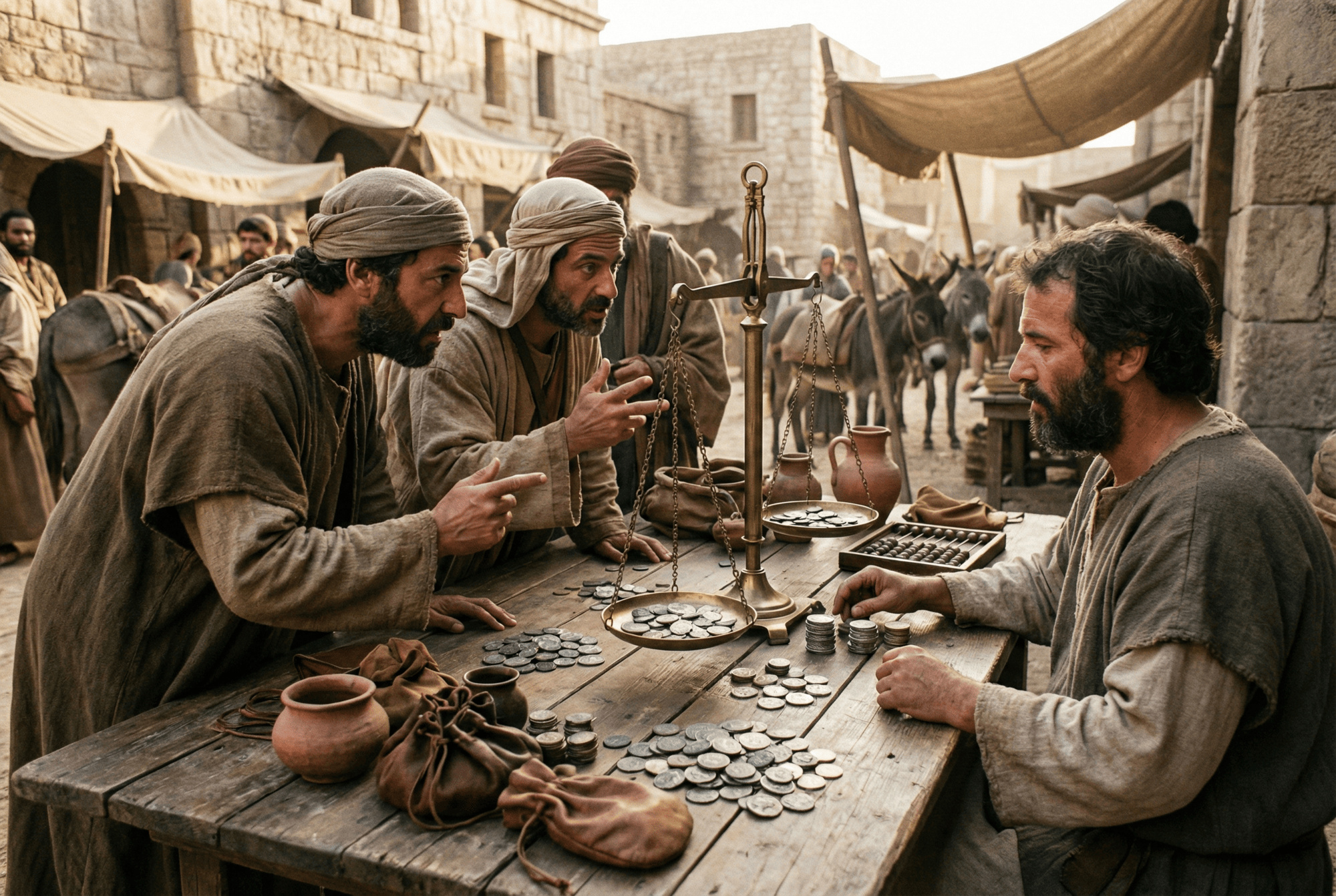
Early Lydian coins from the seventh and sixth centuries BC were made of electrum, an alloy of gold and silver. Numismatic research continues to refine their sequence and dating; one memorable date for the “invention of coinage” cannot describe the entire process. Austrian Archaeological Institute [33] A stamp and specified weight helped identify money, but exchanging different coins still required assessing metal content, wear and acceptance by the recipient. Valuing a foreign coin was different from counting its denomination.
A hypothetical example: two coins have similar names, but the first contains 5 grams of silver and the second 4 grams. Valued solely by pure metal content, five of the second coins equal four of the first. An actual price could also reflect verification and exchange costs. This simple calculation shows why an intermediary needed to understand the money’s characteristics, rather than its name alone. These are neither specifications of Lydian coins nor a historical exchange rate. Converting metals and goods provides monetary-history context; we do not call it the modern OTC market.
Merchant networks: transferring value without transporting coins
Longer-distance trade required ways to pay in another city without carrying the same purse. In traditional value-transfer systems such as hawala, a sender provides funds to an intermediary in one country, while a cooperating intermediary pays the agreed equivalent to the recipient in another. Settlement between the intermediaries is a separate stage. FinCEN’s description also shows connections between these networks and formal banks; they are not invariably a banking-free “system of trust alone”. [34]
Merchant bills of exchange provided another route. The document instructed a specified intermediary to pay a named recipient, often in a different place and currency. In his study of the Medici bank, Raymond de Roover cites a register from 1455: its Rome branch was to honour bills issued in Florence by authorised bank representatives. The amount and exchange rate mattered, but so did the instruction’s authenticity and who could issue it. [35]
A hypothetical model illustrates the combination of payment, credit and exchange: a merchant provides 100 units of currency A today, and the document provides for payment of 200 units of B after an agreed interval in another city. The sender knows the future amount but still bears the risk of non-performance. Deferred payment and two currencies create a resemblance to later forward instruments; they do not make a historical bill identical to a modern forward or futures contract. These parameters are invented. Without documentary evidence, we do not attribute this transaction to a particular merchant or Medici branch.
The florin: why merchants trusted a particular coin
Florence began minting the gold florin in 1252. Banca d’Italia notes that its weight and composition were maintained for about three centuries: 3.53 grams of 24-carat gold. Confidence in its metal content and the role of Florentine trade helped the coin function in European payments. [40] A merchant did not have to consider all coins equally reliable merely because each carried a currency name. A recognisable standard reduced some verification costs, but did not remove the risk of counterfeiting, transport or the other party’s insolvency.
Amsterdam: paying through records instead of handing over more coins
The Bank of Amsterdam, founded in 1609, initially accepted deposits backed by gold and silver coins and settled payments through transfers between deposit records. Research published by De Nederlandsche Bank documents both the development of this bank money and the later loss of confidence following shocks, extensive lending and a lack of fiscal support. [41] Using records simplified payments, but depended on the credibility of the institution and its assets. Moving value from a purse to a ledger did not remove risk: it changed its source.
From deposit receipts to paper money
In Britain, paper money developed partly from receipts issued by goldsmiths for funds entrusted to them. After the Bank of England’s foundation in 1694, its notes also acknowledged deposits; these gradually developed into banknotes. Its museum collection contains a note fragment dated 18 June 1697 for £22. Bank of England [36] This is a British example, rather than a claim that the world’s first paper money originated there.
The object of trust changed: a recipient accepting a document relied on the issuer’s promise, rather than solely on the metal in a coin. Paper made value easier to carry but required assessing whether the obligation would be honoured. This distinction between money and a claim on an institution would reappear in gold convertibility and bank settlement. A lighter medium did not eliminate risk; it changed where that risk had to be examined.
Ancient money changers and later merchant settlements are background here, rather than earlier versions of today's platform. Understanding the modern market requires a more important question about the rules: can money be converted into metal, who promises to maintain its price, and what happens if that promise cannot be kept? The history of the modern monetary system begins with these questions.
The gold standard: a stable conversion rate had a cost
What linked currencies
Under a gold-based system, the monetary unit corresponded to a specified amount of metal, and convertibility was intended to support that relationship. If two currencies had defined gold contents, these also implied their conversion rate. The rate need not be perfectly fixed: transporting gold, insurance and other costs allowed some deviation. The foundation remained the promise to exchange at a fixed price. [2]
A calculation with invented units illustrates the mechanism. If one unit of currency A corresponds to 2 grams of gold and one unit of B to 1 gram, parity is 1 A = 2 B. A large deviation could encourage participants to exchange money for gold and move the metal to where it buys more. Transport and insurance determine that operation's costs. This is a mechanism example, rather than a historical quotation.
Britain resumed convertibility in 1821. This timeline date concerns sterling, rather than every country simultaneously adopting identical rules. [1] The gold standard developed across countries with different central-bank practices.
A fixed rate required the economy to adjust to parity. When gold flowed out, defending convertibility could require tighter credit and higher interest rates. This could help retain reserves but hinder business financing. The cost of a fixed conversion rate therefore also appeared in production and employment. Exchange-rate stability did not always mean economic stability. [3]
1717, 1821 and the 1870s identify different stages
Before gold became the international basis for exchange rates, silver money, gold money and bimetallic systems coexisted. In 1717, the gold–silver relationship established by Isaac Newton, who headed the English mint, encouraged silver coins to leave circulation and gold to become dominant in practice. This was not a conference establishing a global standard. Britain’s resumption of convertibility in 1821 was another stage, while the international gold standard matured only in the 1870s. The Federal Reserve’s historical review explains these distinctions. [37]
“Gold points” were boundaries determined by the costs of transporting and insuring metal. When a currency price deviated sufficiently from parity, participants could compare ordinary exchange with obtaining gold and shipping it abroad. Such a comparison requires identical units of weight and fineness. Dividing a fine-gold ounce price by the price of an ounce of a different alloy without adjustment is invalid. Sterling’s historical return in 1925 used a parity of approximately USD 4.86 per GBP, but defending it required adjustment to prevailing economic conditions. [3]
How gold outflows affected credit and business activity
In a simplified international-payments mechanism, metal outflows restrict a country’s monetary resources. More expensive or less available credit weakens expenditure, while price adjustment may improve the competitiveness of goods. This is the logic of the price–specie-flow mechanism, rather than a promise that every trade imbalance corrects quickly and painlessly. In practice, central banks influenced the process through interest rates and credit policies. The gold standard was not a machine operating without institutional decisions. [37]
Consider a purely hypothetical company: it has finished goods in stock, but buyers reduce purchases and its bank demands a higher interest rate on inventory financing. A fixed conversion rate for its currency protects neither margins nor employment. The company may cut production before lower costs allow it to expand sales again. This is not an account of an identified nineteenth-century business. It illustrates the cost of real adjustment, which disappears from view when a system is judged solely by exchange-rate stability.
War and an unsuccessful return to earlier conditions
The First World War undermined the pre-war rules. Britain suspended its gold standard in 1914; restoration in 1925 used the pre-war parity. [2] Returning to an old price did not reverse changes in price levels or competitiveness. Defending parity could require a painful reduction in domestic prices and costs. The Bank of England's historical assessment describes the adjustment burden on wages and prices. [3]
In September 1931, pressure on sterling and reserves led Britain to leave gold. [1] Inter-war experiences, including devaluations and trade restrictions, subsequently supported the case for shared international rules. [4]

Genoa in 1922: rebuilding need not mean copying the old system
The financial commission at the Genoa conference in 1922 recommended central-bank cooperation and economising on gold by keeping part of reserves in foreign balances. Its programme allowed, among other assets, bank balances, bills and short-term securities in other participating countries. Returning to gold did not necessarily mean restoring the old parity: the decision was to depend on economic conditions. The resolutions were printed in the Federal Reserve Bulletin in June 1922. [43] Under such an arrangement, confidence in reserves also depended on another country’s currency and assets, rather than only on bars held in a domestic vault.
Bretton Woods: the dollar linked currencies to gold
What was agreed in 1944
In July 1944, delegates from 44 countries met at Bretton Woods. They wanted to rebuild trade and international payments without returning to competitive devaluations and inter-war restrictions. This established the foundations of the International Monetary Fund (IMF) and International Bank for Reconstruction and Development (IBRD), which became part of the World Bank Group. The IMF would support monetary cooperation and assist countries facing balance-of-payments difficulties; IBRD addressed reconstruction and development. [4]
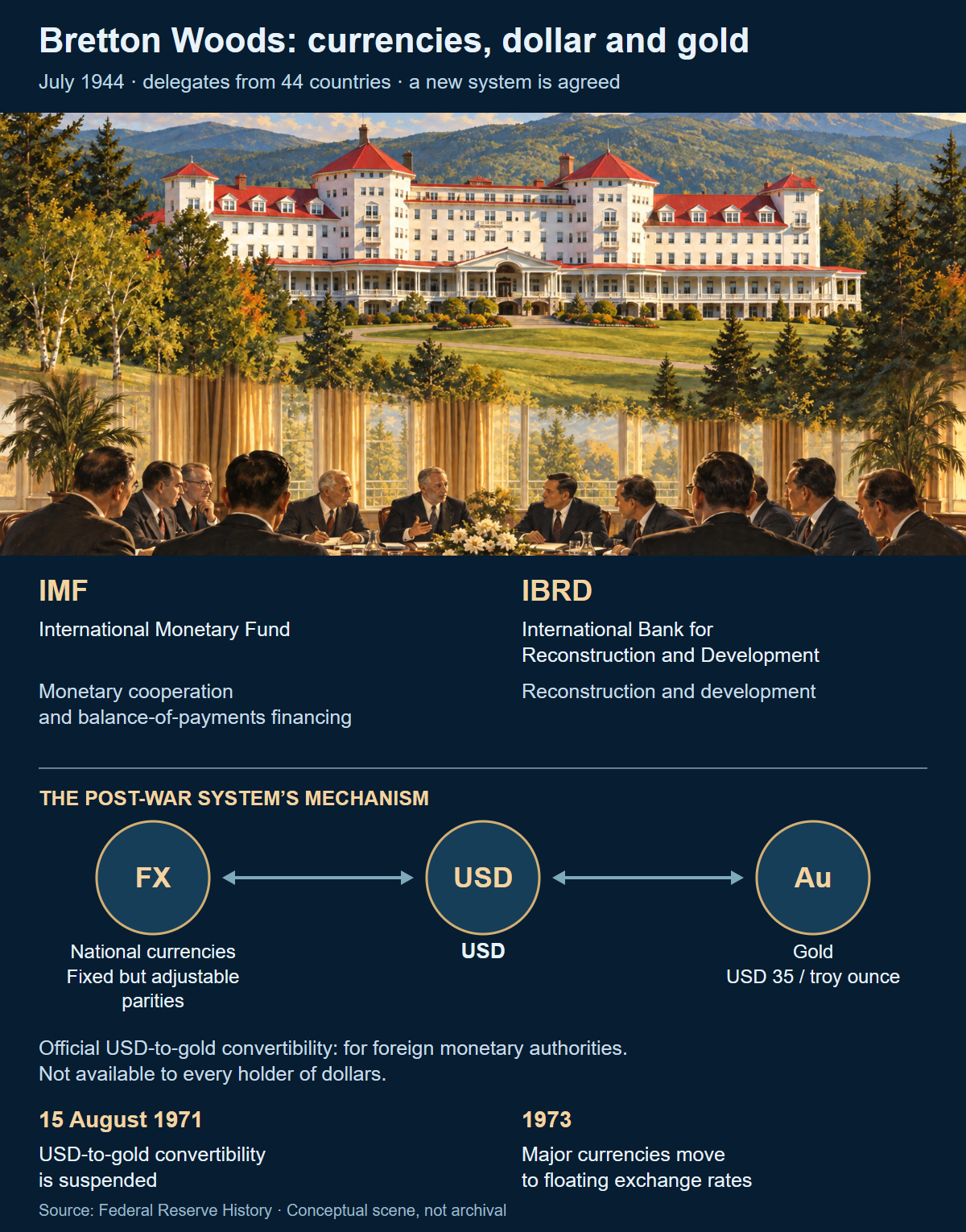
The system used fixed but adjustable parities. A parity is an officially established currency value. In practice, most currencies were linked to the dollar, while the US maintained its official convertibility into gold at USD 35 per troy ounce. Conversion rights applied to foreign monetary authorities, rather than every banknote holder. [6]
Gold ↔ dollar ↔ other currencies
- The US undertakes to exchange foreign monetary authorities' official dollar reserves for gold at the fixed price.
- Other countries maintain currency parities, in practice primarily against the dollar.
- Central banks defend permitted fluctuations by buying or selling currencies. A serious imbalance may justify a parity change.
This did not promise an unchanging rate forever. The system allowed adjustment in exceptional circumstances, rather than free daily price formation. [6]
Keynes and White: who should bear the cost of an imbalance?
Two proposals competed before the conference. On the British side, John Maynard Keynes proposed an international clearing union and a settlement unit called bancor. Both persistent deficit countries and surplus countries would be encouraged to adjust. Harry Dexter White of the US Treasury favoured a fund based on countries' contributions and lending national currencies. The adopted arrangement was closer to White's plan, although it incorporated some British proposals. IMF [29]
The dispute concerned financing and responsibility, rather than just the institution's name. A country short of currency for payments can reduce imports and demand, seek financing or change its rate. If deficit countries bear all adjustment, a surplus country has less reason to alter its own policy. This explains why designing international money combined economics and political negotiation from the outset. Bancor remained a proposal; it was not a currency used by the subsequent Forex market. [29]
What a central bank did when a rate came under pressure
Suppose that, at a fixed parity, importers need more dollars than exporters and other sellers supply. Without intervention, dollars would become more expensive in domestic currency. A central bank can sell part of its dollar reserves and buy its own currency to keep the rate within permitted limits; under opposite pressure, it buys dollars. This is a simplified account of defending parity, rather than a description of a particular day or country.
Intervention buys time, but a persistent imbalance requires more action. Reserves and available financing matter. This is where IMF assistance for a temporary balance-of-payments difficulty—settlements with the rest of the world—came in. A deeper change in conditions could justify a parity adjustment. The arrangement was intended to limit both abrupt payment disruptions and competitive weakening of currencies at neighbours' expense. [4]
From reconstruction and dollar shortages to convertibility
The 1944 blueprint did not immediately provide unrestricted currency exchange in post-war Europe. Countries needed dollars to import food, energy and equipment while retaining exchange controls. Federal Reserve History identifies 1958 as the system’s operational launch following the removal of controls on current-account transactions. This did not mean unrestricted capital movements. [38]
The perspective changed: the initial problem was a shortage of the currency needed for payments; later, growing dollar claims raised doubts about gold backing. Dollars could also reach foreign countries through US investment, so the entire balance of payments should not be reduced to the trade balance alone. The system expanded payment possibilities while requiring US domestic policy to be reconciled with the dollar’s role in other countries’ reserves. [38]
Why keeping the promise became harder
The world needed dollars for payments and reserves. Dollar outflows from the US supplied that need, while increasing foreign claims potentially convertible into American gold. If dollars accumulated faster than credible backing, concerns grew that the conversion promise could not hold. This tension is the Triffin dilemma. [6]
US balance-of-payments deficits and inflation aggravated the problem. At the fixed gold price, a foreign central bank had an incentive to exchange dollars before conditions changed. As more institutions did so, the system's defences weakened. The promise of a fixed gold price thus began to undermine confidence in the arrangement itself. [7]
This concerned a shared reserve system, rather than two separate prices. A foreign dollar holder assumed the US promise would remain credible even if other holders demanded gold. Anticipating a future parity change could therefore bring forward conversion requests. Confidence weakened precisely when it was needed most to limit the gold outflow. [6]
The eurodollar market—dollar deposits in banks outside the US—also expanded, developing in London from the 1950s. [8] Its name has no connection to the later euro. Dollars could circulate outside the American banking system, complicating management of international liquidity.
1971 and 1973: two different changes
On 15 August 1971, Richard Nixon announced suspension of dollar-for-gold conversion for foreign monetary authorities. The system's central promise disappeared. [6] But all currency parities were not abolished that day.
In December 1971, the Smithsonian Agreement tried to rescue the system by changing official conversion rates and widening fluctuation bands. Countries sought new rates compatible with closure of the US “gold window”. This did not restore confidence that parities would last. [7]
What the new gold parity changed
At Smithsonian, the official gold price was agreed to rise from $35 to $38 per ounce. At that same parity, a dollar therefore represented less gold: 1/38 rather than 1/35 of an ounce. This did not restore unrestricted conversion of dollars into gold. The change in parity was intended to help realign exchange rates after convertibility had been suspended. Subsequent pressure demonstrated that a new number was insufficient when participants expected the rules to change again. Federal Reserve History [7]
During 1972, inflows pushed European currencies towards the top of their bands. Their central banks bought dollars to defend rates, increasing domestic liquidity and complicating inflation control. After another dollar devaluation in February 1973, pressure returned; in March, major currencies began floating against the dollar. Another official price change had not resolved credibility problems in the overall arrangement. [7]
Suspending convertibility in 1971 and floating rates in 1973 were separate events. Official dollar/gold conversion was suspended in 1971; defence of major currencies' parities broke down in 1973. A float means the currency is not maintained within a prescribed band around an official parity.
The location of adjustment changed. Previously, pressure could cause reserve losses and a devaluation decision. Under a float, the currency's price takes on more adjustment. Rate risk did not disappear; businesses and institutions needed to allow for it more frequently in their payments. The role of Forex in the economy explains hedging's function.

Jamaica: the law adapts to the changed system
Agreement in 1976, entry into force in 1978
The IMF Interim Committee met in Kingston on 7–8 January 1976 and agreed the direction of exchange-rate and gold reforms. [9] The Articles' Second Amendment took effect on 1 April 1978. [5] These are separate dates: political agreement first, operative rules afterwards.
The new Article IV allowed a choice of arrangements, including floating rates and links to other currencies, while excluding valuation in terms of gold. The IMF received responsibility for surveillance of members' exchange-rate policies. [10] Jamaica did not require every country to float. Fixed rates, bands and other managed arrangements therefore remained possible.
The change recognised a reality established earlier. Major currencies had floated since 1973, while formal international rules still reflected the previous order. After reform, a promise to exchange money for a specified amount of gold would no longer determine its value. Economic-policy and institutional credibility gained importance, while countries retained a choice of arrangements. Legal rules and everyday trading therefore changed at different times. [10]
Currency futures: exchange-rate risk also reaches an exchange
On 16 May 1972, CME launched futures on seven currencies through the International Monetary Market (IMM). [11] This preceded major currencies' move to floating rates. Exchange-rate uncertainty already made agreements about future exchange more important.
A futures contract is a standardised exchange agreement with specified size and settlement rules. Participants can therefore enter comparable contracts. This did not transform all Forex into one exchange. OTC trading and exchange currency instruments developed alongside one another. Their place on the market map is explained in the definition of Forex lesson.
The innovation was primarily a repeatable agreement about a future rate, available on an exchange. A uniform contract helped participants with opposing needs meet, while an OTC agreement allowed matching to a particular payment amount and date. These are two ways of organising an obligation. Expanding the exchange offering responded to currency risk that also existed while countries were trying to preserve parities. [11]
Why a future rate interested Chicago
Leo Melamed, leading CME, recognised demand for an instrument transferring rate-change risk. Milton Friedman prepared a case for currency futures in 1971. Melamed's account presents the project as a response to changes in the monetary system and hedging needs, rather than the invention of currency exchange itself. CME, Melamed's account [30]
A repeatable contract standard brought together participants with different purposes. A company might hedge a future payment while someone else accepted risk in expectation of profit. Both sides did not need identical economic needs. A bank forward remained useful for matching an amount and date; a futures contract offered a uniform contract, exchange-system trading and central clearing. Exchange-traded currency contracts were a new organisational arrangement alongside the existing OTC market.
Globex: bringing exchange contracts to electronic trading
CME launched the Globex platform on 25 June 1992. This developed electronic trading in exchange-traded futures and options. It did not convert every dealer OTC transaction into one order book. In both segments, a screen could help users find a price and submit an order, but contract standards, access and settlement arrangements remained different. The proximity of the launch years for Globex, Reuters Matching and EBS therefore does not imply one shared infrastructure or an identical agreement. CME [11]
Plaza and Louvre: authorities still influence floating rates
1985: why countries wanted a weaker dollar
In the early 1980s, a high dollar and trade imbalances caused increasing tensions. The US ran a deficit, while Japan and West Germany had large trade surpluses with the US. Pressure to restrict imports grew in Washington. Treasury Secretary James Baker sought coordinated policy changes rather than leaving the problem to exchange rates alone. Yet the dollar began weakening in February 1985, months before the agreement—an important fact when assessing its effects. [22]
On 22 September 1985, G5 representatives from the US, Japan, West Germany, France and Britain met at New York's Plaza Hotel. They agreed to support orderly appreciation of major currencies against the dollar. Central banks intervened jointly; US authorities sold dollars and bought marks and yen. [12] [22]
The mechanism had two parts. Dollar sales changed current market supply, and the shared statement signalled the direction authorities were prepared to support. Buying foreign currency with dollars is an intervention aimed at weakening the US currency. [24] Participants' response also depended on whether they considered the announcement consistent with future economic policy.
1987: weakening gives way to stabilising
Further dollar depreciation shifted concerns: excessive exchange-rate movements could hinder growth and economic adjustment. The Louvre Accord, agreed in Paris on 22 February 1987 by G5 countries and Canada, aimed at greater stability around prevailing levels. It also included economic-policy commitments: Japan and West Germany would stimulate domestic demand, while the US would reduce its budget deficit. [12] [22]
The meetings therefore had different aims. Plaza supported dollar weakening; Louvre sought to restrain further large changes. Stabilisation did not prove a lasting promise of fixed rates. In the IMF Managing Director's 1995 assessment, Plaza's success also depended on policy and economic conditions being consistent with a lower dollar; Louvre's later difficulties exposed the weakness of declarations without sufficient policy support. [23]
These episodes demonstrate influence, rather than the ability to set any price permanently. The entire dollar decline cannot be attributed to one statement or the sum of interventions: the direction preceded Plaza, while interest rates and policy also changed afterwards. Central banks in Forex develops the influence/control distinction.
European experiences: from defending a rate to sharing a currency
European exchange-rate bands did not begin in 1992
European countries tried to limit fluctuations between their currencies before the euro was introduced. The “currency snake” sought to narrow exchange-rate bands; the European Monetary Cooperation Fund, established in 1973, supported intervention, short-term financing and settlement between central banks. From 1979, the European Monetary System and the ECU accounting unit operated. ECB [42] These were arrangements between countries retaining their own currencies, rather than today’s shared currency. The crisis in sterling’s exchange-rate defence in 1992 and the subsequent adoption of the euro by some countries therefore concern successive, different arrangements.
On 16 September 1992, Britain left the European Exchange Rate Mechanism (ERM). Rate rises and intervention failed to maintain sterling at the bottom of its permitted band. The Bank of England describes withdrawal as abandoning rate defence once its cost became too high. [1] Maintaining the rate had become more expensive than the authorities were prepared to accept.
Why defending sterling in 1992 was more than a contest with one speculator
Keeping a currency within a band required economic policy and available reserves to support that promise. Buying sterling with reserve currencies could counter selling pressure, while higher interest rates could increase the cost of positions against it. Each action had a cost: reserves diminished or domestic households and businesses faced more expensive financing. A central bank’s ability to intervene did not mean it could repeat the intervention without limits.
The events of 16 September 1992 demonstrate this conflict. Sterling’s defence did not sustain the agreed rate, and the authorities withdrew from the ERM. [1] Investors’ actions increased pressure, but an account confined to one fund manager’s name omits the policy and reserve mechanism. For a beginner, understanding why expectations of a rule change can encourage many participants to make similar trades matters more than memorising an unverified position size or fund profit.
The euro was introduced on 1 January 1999, initially for settlement and accounting. Banknotes and coins entered circulation on 1 January 2002. [13] Between monetary-union participants, irrevocable conversion rates into a shared currency replaced the need to determine fluctuating national-currency rates daily. A market for exchanging euros into dollars, yen and other currencies remained necessary.
Asia in 1997: exchange rates and the currency of debt
On 2 July 1997, Thailand stopped defending the baht's previous link and allowed its rate to change. The crisis spread to other economies in the region, including Indonesia and South Korea. This was not solely a story of “speculators against a central bank”: weak financial systems, short-term foreign financing and unhedged foreign-currency liabilities mattered. The IMF [31] describes the chronology and mechanisms.
A simplified model illustrates one channel. A company earns in its local currency but must repay USD 100,000. At an assumed rate of 25 local units per dollar, it needs 2,500,000 units. At 40 per dollar, the liability is equivalent to 4,000,000 units—60% more. The USD debt amount remains unchanged. The rates are invented, rather than historical baht observations; interest and hedging are excluded.
Depreciation can therefore weaken a borrower's balance sheet precisely when foreign funding becomes harder to renew. This differs from a higher imported-goods price, although both can occur together. Asia's experience adds another question to exchange-rate history: in which currency did the government, banks and businesses obtain financing? Choosing a float alone does not eliminate an existing mismatch.
From telephone to screen, then to the internet
Electronic trading developed in stages. Reuters Monitor, introduced in 1973, supplied quotation information to subscribers. [14] Reuters Dealing System, introduced in 1981, facilitated electronic communication between dealers agreeing trades. [15] Displaying a price and automatically finding a counterparty are different functions.
Electronic matching expanded in the 1990s. EBS launched in September 1993; Reuters Dealing 2000-2 had introduced a similar function earlier. [16] Interbank trading organisation changed, but agreements, credit relationships and differences between platforms remained.
The change is clearest in successive tasks. First, a screen helped identify prices quoted by others. Next, it allowed communication with a particular dealer without a telephone call. Only a matching system took over the task of finding compatible buying and selling terms. Reuters Dealing 2000-2 launched in April 1992 and EBS in September 1993. BIS's historical study reports that electronic interbank trading initially developed faster than banks' electronic client trading. [16]
Dealers could assess prices and find counterparties faster. The platform still had to allow for whom a participant could transact with. Technology facilitated contact and comparison, but did not automatically create one universal exchange for all banks and currencies. Launch dates describe stages, rather than a one-off “digitisation of Forex”.
The internet subsequently widened individuals' access to electronic trading. BIS's 2010 account documents intermediaries serving this segment online. [17] There is no single date when all retail Forex became available globally: country, technology and product mattered. Access to a platform did not mean access to the same product as at a bank. The first lesson explains currency exchange versus CFDs; the next article describes today's transaction process.
BIS describes new online intermediaries' important retail role: they gathered bank quotations and made them accessible to smaller clients. Some acted as intermediaries, some were contractual counterparties and some combined these functions. [17] The internet lowered information and order-entry barriers, but did not eliminate intermediation or contractual differences. Platform-access history and product history should be read together.

Poland: exchange controls, convertibility and a floating rate
Under communist-era Poland, currency transactions were subject to exchange controls. The Act of 28 March 1952 required permission for specified activities involving foreign-exchange assets, including trading and transfers. [21] Holding foreign money, legally exchanging it and freely sending it abroad were different matters. An official conversion rate is not proof of a freely functioning market. Poland provides a specific national example here, rather than a chronology applying to other countries.
1989–1991: legal exchange and stabilisation
The change did not begin with redenomination. The Foreign Exchange Law of 15 February 1989, effective from 15 March, permitted domestic persons to operate currency buying/selling outlets with Narodowy Bank Polski (NBP), Poland's central bank, authorisation. Prices in those exchanges could be agreed between buyer and seller. This provided the legal basis for exchange bureaux under the new conditions and illustrates an official rate versus a transaction price. [25]
From the beginning of 1990, the stabilisation programme combined internal convertibility with a fixed dollar rate. Internal convertibility covered much current international business, particularly access to currencies for external settlement; capital flows remained administratively restricted. [26] The Foreign Exchange Law amendment of 28 December 1989 took effect on 1 January 1990. [28] Opening was gradual, with separate rules for trade payments and capital movement.
On 1 January 1990, the rate was set at 9,500 old zlotys per dollar. It would provide a visible anti-inflation reference: participants knew the official conversion instead of expecting repeated changes. Persistent inflation differences between Poland and trading partners nevertheless complicated competitiveness. In May 1991, the zloty was linked to a five-currency basket; October introduced a gradual, pre-announced parity change. [27]
Why is a fixed conversion alone insufficient? In a simple model, a producer raises a price from 100 to 120 zlotys while the exchange rate remains 10 zlotys per dollar. The product's price for an overseas buyer rises from USD 10 to USD 12. The nominal rate is unchanged, but relative prices change. This is an original calculation, not historical prices or a zloty quotation; it explains possible tensions between a stable rate and rising domestic costs.
A crawling parity and gradually wider bands
A “crawling” parity moves the official reference under a pre-announced rule. It differs from freely changing rates in each transaction. A crawling band adds a range within which the market price can fluctuate. Wider bands give the market more room. The Polish reform's successive stages illustrate this distinction. [27]
| Date or period | Change | Distinction to retain |
|---|---|---|
| March 1989 | The law permits exchange bureaux with NBP authorisation and prices agreed by the parties. | Legal bureau exchange does not mean unrestricted transfers. [25] |
| January 1990 | Internal convertibility for much current business; 9,500 old zlotys per USD. | Access to currency and price-setting rules are separate. [26] [27] |
| May and October 1991 | A currency basket, followed by a crawling parity. | A pre-announced reference change differs from a float. [27] |
| 1 January 1995 | Redenomination: 1 new zloty = 10,000 old zlotys. | A change in the unit expressing amounts. [18] |
| 16 May 1995 | The band around the crawling parity widens to ±7%. | More room for market changes, still with formal limits. [27] |
| 1 June 1995 | IMF Article VIII obligations accepted. | Convertibility for current international payments. [19] |
| 1998–1999 | The band widens, reaching ±15% in March 1999. Remaining internal-convertibility rules are removed in 1999. | Greater rate flexibility and separate exchange liberalisation; some capital restrictions remain. [26] [27] |
| 12 April 2000 | A floating rate is formally introduced. | NBP stops announcing a central parity and band. [20] [27] |
1995: two important changes, without a full float
On 1 January 1995, redenomination replaced 10,000 old zlotys with one new zloty. Prices, wages, savings and obligations were converted accordingly. [18] For example, a price of 100,000 old zlotys became 10 new zlotys. Redenomination changed how amounts were expressed, without itself increasing purchasing power.
The IMF announced that Poland accepted Article VIII obligations effective 1 June 1995, following removal of restrictions on payments for current international transactions. [19] This included trade and services settlement; it did not mean immediate freedom for every capital flow.
The exchange-rate arrangement was changing separately. From 16 May 1995, the zloty could move within ±7% of a still-crawling parity; limits were widened later. Moving from a single official reference to broader bands gave market participants more influence over price. [27]
1998–2000: the final stage of changing the rules
In the late 1990s, wider bands and reduced intervention gave the actual rate more freedom before the formal float. Foreign exchange transactions were also liberalised. The new law effective in 1999 removed remaining internal-convertibility rules, although some short-term capital-flow restrictions persisted. [26] “Convertible” therefore always requires a scope and date.
Poland adopted a floating rate on 12 April 2000. [20] This was another separate stage. Convertibility answers which payments and exchanges are permitted; an exchange-rate regime determines how a currency's price is formed; redenomination specifies the unit used to express amounts. Mixing the three incorrectly suggests the zloty was already floating freely in January 1995.
Poland's route shows three parallel processes. Businesses and households gradually gained access to legal exchange and payments; monetary reform shortened how amounts were written; authorities progressively gave the market more price-setting influence. These changes could occur at different times, so the whole transformation cannot be explained by one “birth of Polish Forex” date.
What this history explains about today's market
The impossible trinity: three objectives that require a choice
History repeatedly exposes tension between a fixed exchange rate, free capital movement and independent monetary policy. With fully mobile capital, all three cannot be sustained simultaneously. Higher or lower domestic interest rates encourage funds to move, while defending an unchanged rate constrains the freedom to maintain those interest rates. This is the “impossible trinity”, or trilemma. IMF [32]

| Two retained objectives | What must be constrained | Mechanism |
|---|---|---|
| Fixed rate and free capital movement | Independent domestic monetary policy. | Monetary conditions must support the link to the anchor currency. |
| Fixed rate and domestic monetary policy | Free capital movement. | Flow restrictions aim to reduce pressure caused by different financing conditions. |
| Free capital and domestic monetary policy | A promise of an unchanged rate. | The currency price can absorb some adjustment. |
This helps compare the gold standard, post-war capital controls and subsequent floating rates. Actual arrangements have intermediate degrees: bands, intervention and partial flow restrictions. A float gives domestic policy more room but does not isolate the economy from global financing conditions. Nor can observing tension alone identify a crisis date. The trilemma is a framework for understanding constraints, rather than a trading signal. [32]
What changed between systems
| Question | Classical gold standard | Bretton Woods | After major parities broke down |
|---|---|---|---|
| What links the rate? | A defined currency/gold relationship. | Fixed but adjustable parities; the dollar officially convertible into gold. | Different regimes: major currencies float; others may have a link or band. |
| Where does adjustment occur? | Reserves, credit, prices and economic activity while defending convertibility. | Intervention, policy, IMF financing or parity changes. | Also in the daily rate, with possible intervention and differing reserve roles. |
| Does technology determine the regime? | No: the rule concerns money's value. | No: telephone trading did not create the parity promise. | No: electronic platforms can handle currencies with different regimes. |
Moving between these arrangements was not a journey from a “bad” to a “good” system. Each imposed different requirements and allocated costs differently. A stable rate can facilitate payment planning but needs consistent economic conditions to be defended. A float can help adjustment while increasing uncertainty about future amounts in domestic currency. History shows these trade-offs, rather than promising a solution without risk.
Why reserve-currency debates returned after gold convertibility ended
Closing the gold window removed a specific promise to exchange dollars for metal, but the question of reconciling global needs with the issuing country’s policy remained. In an essay dated 23 March 2009, Zhou Xiaochuan proposed a greater role for the IMF’s Special Drawing Rights, or SDRs, as a supranational reserve asset. This was a reform proposal, rather than the announcement of a new currency replacing the dollar. [39]
That year, Mark Carney of the Bank of Canada emphasised that changing the reserve asset alone would not resolve asymmetric adjustment between deficit and surplus countries. [39] This connects the later debate with Keynes and White’s disagreement: the money’s name is only part of the question; financing rules, asset liquidity and the allocation of adjustment costs also matter. We do not, however, equate present-day tensions with the former risk surrounding conversion at USD 35 per ounce. Some questions are similar, while the specific obligations differ.
Every system shifts the cost of adjustment
The gold standard required defending metal convertibility. Bretton Woods linked currencies to the dollar and the dollar to an official gold-conversion promise. After parities broke down, exchange-rate changes absorbed more adjustment. Electronic trading later accelerated information exchange and contracting without eliminating why participants need currencies.
Today's liquidity and access result from this development. Detailed figures nevertheless have their own meaning and methodology, explained in market size. The next article moves from history to how prices form and transactions proceed today.

Questions and answers
When did the modern Forex market emerge?
There is no single starting date. Currency exchange existed earlier; major currencies’ move to floating rates in March 1973 established important conditions for the modern market. Later growth involved electronic trading and wider access to currency services.
Did every currency start floating on 15 August 1971?
No. The US suspended dollar/gold conversion for foreign monetary authorities. The December 1971 Smithsonian Agreement still sought to preserve revised parities. Major currencies moved to floating rates against the dollar in March 1973.
Could everyone exchange dollars for gold under Bretton Woods?
No. Official convertibility at USD 35 per ounce concerned foreign monetary authorities. Other currencies had fixed parities that could be changed in defined circumstances. This was not a universal retail counter converting dollar banknotes into gold.
What did the Jamaica agreements change?
The January 1976 agreement prepared changes to IMF rules. The Second Amendment took effect on 1 April 1978 and permitted different exchange arrangements, including floating rates, with IMF surveillance of members’ exchange-rate policies. It did not require every country to float.
Did redenomination make the zloty stronger?
No. From 1 January 1995, one new zloty equalled 10,000 old zlotys. Prices, wages, savings and obligations used the same conversion. Shortening the notation alone did not increase purchasing power.
When did the zloty begin floating?
On 12 April 2000. Poland had previously changed currency-exchange and rate-setting rules gradually. Convertibility for current international payments and redenomination in 1995 were separate changes and did not yet mean a fully floating rate.
What was the Triffin dilemma?
The world needed dollars for reserves and payments, so dollar outflows from the US supported the system. Growing foreign dollar claims simultaneously weakened confidence in conversion into American gold at the fixed price. Liquidity needs and confidence in convertibility increasingly conflicted.
What does the impossible trinity explain?
With fully mobile capital, a fixed rate and independent monetary policy cannot be sustained simultaneously. The three objectives require a choice or constraints on one of them. Actual regimes include intermediate arrangements; the trilemma alone cannot predict a crisis date.
Why did currency futures launch before major currencies floated?
Parity and exchange-rate uncertainty already existed while Bretton Woods was being rescued. CME began futures trading on seven currencies on 16 May 1972; major currencies floated in March 1973. The contracts responded to uncertainty rather than marking the start of currency exchange.
Why was the gold standard abandoned?
War interrupted the pre-war rules, and the restored system operated under different price, debt and policy conditions. Defending convertibility could require more expensive credit and adjustment in wages and prices during an economic downturn. Britain returned to the pre-war parity in 1925 but left gold in September 1931. The entire history cannot be reduced to one government’s lack of discipline.
How does a fixed exchange rate differ from a floating rate?
Under a fixed rate, the authorities undertake to maintain a specified relationship or band using the tools available. Under a floating rate, they do not defend such a parity and the market price can change. Economic policy influences the rate and intervention is possible under either arrangement. Greater conversion-rate predictability and greater adjustment flexibility carry different costs; with free capital movements, complete exchange-rate stability and monetary-policy independence cannot both be maintained.
Why did capital controls matter under Bretton Woods?
Restrictions on flows were intended to give countries more domestic-policy flexibility while maintaining parities. Convertibility for trade payments therefore did not mean complete freedom for every foreign investment and loan. International financing made this separation harder to maintain. The system’s breakdown also involved the dollar’s gold promise, inflation and economic policy; controls alone do not explain it.
How did Plaza differ from Louvre?
The Plaza Accord of 22 September 1985 supported a weaker dollar through coordinated action by the G5 countries. The Louvre Accord of 22 February 1987 sought to limit further large movements and stabilise rates. Both show official influence within a floating system, but neither established a new global parity. Intervention effects also depended on economic policy and market conditions.
Who was Leo Melamed, and what did currency futures change?
Melamed led CME and supported the creation of an exchange-traded currency-contract market; Friedman prepared the case for the idea in 1971. CME launched futures on seven currencies on 16 May 1972. Standard contracts, exchange trading and central clearing complemented the earlier OTC market. This did not mean inventing currency exchange or agreements for future payment.
Would returning to gold automatically ensure stability?
No. A fixed relationship to metal limits policy discretion, but gold quantities and flows also change. History includes both periods of stable conversion rates and costly defences of convertibility, as well as changes to parities themselves. Gold alone does not eliminate banking risk, ensure constant goods prices or create an arrangement resistant to every crisis.
Why read monetary-system history today?
It distinguishes the medium of money, convertibility rules, exchange-rate arrangements and trading technology. It also helps explain who bears adjustment costs when flows or confidence in an exchange-rate promise change. This is a framework for comparing institutions and risks, rather than a method of predicting crisis dates or a guarantee of trading profit.
Sources and dates
Sources checked on 29 October 2026. Historical reports establish events, rather than today's market size. Page references use printed numbering where specified. Polish laws and institutions describe Poland's national case; they are not presented as global rules.
- Bank of England, History, updated 9 December 2024: restored convertibility in 1821, departure from gold in September 1931 and ERM withdrawal on 16 September 1992.
- Bank of England, The Exchange Equalisation Account — its origins and development, 1 December 1968: suspension in 1914 and restoration in 1925.
- Andrew Bailey, Revisiting the Norman Conquest of $4.86, Bank of England, 2025: economic limits to defending parity.
- Federal Reserve History, Creation of the Bretton Woods System, 22 November 2013: the conference, IMF and IBRD.
- IMF, Articles of Agreement, March 2020 reprint, PDF page 5: adoption on 22 July 1944 and the Second Amendment taking effect on 1 April 1978.
- Federal Reserve History, Nixon Ends Convertibility of U.S. Dollars to Gold, 22 November 2013: official conversion, the Triffin dilemma and the decision of 15 August 1971.
- Federal Reserve History, The Smithsonian Agreement, 22 November 2013: December 1971 negotiations and the move to floating rates in 1973.
- BIS, CP and CDs markets: a primer, September 2023, footnote 8: the eurodollar market developing in 1950s London.
- IMF, Annual Report 1976, pp. 122–123 (PDF pages 135–136): the Kingston meeting communiqué of 7–8 January 1976.
- IMF, Articles of Agreement, Article IV, Sections 2–3, pp. 6–7 (PDF pages 18–19): choice of arrangements, gold exclusion and Fund surveillance.
- CME Group, Product Anniversaries: currency futures launch on 16 May 1972; The Role of Derivatives in Risk Management, introduction: IMM trading began on the same date; Futures Contracts Compared to Forwards, comparison table checked on 29 October 2026: futures standardisation and forward customisation.
- Bordo, Humpage and Schwartz, Federal Reserve Bank of Cleveland, U.S. Foreign-Exchange-Market Intervention during the Volcker-Greenspan Era, Working Paper 10-07, July 2010, pp. 15–22: Plaza/Louvre dates, objectives and implementation; further context is described in [22].
- European Central Bank, Our money: euro introduction on 1 January 1999, cash on 1 January 2002 and fixed conversion rates.
- Reuters Group PLC, Annual Review 2000, p. 13: Monitor introduced in 1973.
- LSEG, Global Forex Trading Ecosystem: operator history describing Reuters Dealing System in 1981.
- BIS Papers 12, Foreign exchange markets in the 1990s: intraday market volatility and the growth of electronic trading, August 2002, p. 139 (PDF page 147), Section 2: electronic matching origins, including EBS in September 1993. Source document.
- Michael R. King and Dagfinn Rime, The $4 trillion question, BIS Quarterly Review, December 2010, p. 39: online retail development. Source document.
- Poland, Act of 7 July 1994 on redenomination of the zloty, Articles 1–2 and 4: effective date, 10,000:1 conversion and scope. Source document.
- IMF, Poland Accepts Article VIII Obligations, 21 July 1995: acceptance effective from 1 June 1995.
- Michał Konopczak, Assessment of Polish credit risk using contingent claims, NBP, Materials and Studies 267, 2012, p. 25, footnote 12: the float from 12 April 2000. Source document.
- Poland, Foreign Exchange Act of 28 March 1952, Journal of Laws 1952 No. 21 item 133, Articles 9–10 and 19–22 (PDF pages 2–3): historical permission and restrictions on trading, holding and transferring foreign-exchange assets. Source document.
- Michael D. Bordo, Owen F. Humpage and Anna J. Schwartz, U.S. Foreign-Exchange-Market Intervention during the Volcker-Greenspan Era, Federal Reserve Bank of Cleveland Working Paper 10-07, July 2010, pp. 11–12, 15–19 and 21–22 (PDF pages 13–14, 17–21 and 23–24), footnote 18 on p. 60: Plaza/Louvre context, action, participants and attribution limits. This is the authors’ research, rather than a position of the entire Federal Reserve System. Source document.
- Michel Camdessus, The Dollar, the Yen and European Currencies, IMF Managing Director speech of 17 November 1995: Plaza/Louvre and the consistency of intervention with economic policy.
- Federal Reserve Bank of New York, Foreign Exchange Operations, institutional description checked on 29 October 2026: intervention directions when buying or selling currencies against dollars.
- Poland, Foreign Exchange Law of 15 February 1989, Articles 10, 14(3) and 34: NBP-authorised exchange bureaux, prices agreed by parties and entry into force on 15 March 1989. Source document.
- İnci Ötker-Robe, Zbigniew Polański, Barry Topf and David Vávra, Coping with Capital Inflows: Experiences of Selected European Countries, IMF Working Paper 07/190, July 2007, Appendix II B, pp. 39–40 (PDF pages 41–42): internal convertibility from 1990, the 1995 expansion, 1999 changes and gradual capital liberalisation. Source document.
- İnci Ötker-Robe, David Vávra and collaborators, Moving to Greater Exchange Rate Flexibility, IMF Occasional Paper 256, 2007, Poland chapter by Zbigniew Polański and Piotr Szpunar of NBP, pp. 44–49 (PDF pages 53–58), including Table 8 on p. 46: 1990–2000 regimes, reasons for change and preparing the float. Source document.
- Poland, Act of 28 December 1989 amending the Foreign Exchange Law, Articles 1 and 5: changes in exchange rules and entry into force on 1 January 1990. Source document.
- James M. Boughton, IMF, Why White, Not Keynes? Inventing the Post-War International Monetary System, Working Paper 02/52, March 2002: differences between the plans and international financing design.
- Leo Melamed, CME Group, The Birth of FX Futures, participant account: Friedman’s role and the futures proposal. The exact trading launch date is independently confirmed by CME’s calendar [11]; chronological errors in the essay are not adopted.
- IMF, Financial Sector Crisis and Restructuring: Lessons from Asia, Occasional Paper 188, 1999, Part I and chronology: Thailand on 2 July 1997, currency mismatches and funding.
- Marco Casiraghi, Karl Habermeier and Thomas Harjes, IMF, Monetary Policy Frameworks — Choice of Exchange Rate Arrangement, December 2022, pp. 5–6 and 18: the trilemma, regime choice and limits of simplified analysis.
- Austrian Archaeological Institute, Early Lydian Coinage and Chronology — Seventh–sixth centuries BC; research project and coin chronology.
- FinCEN, Informal Value Transfer Systems, Advisory 33 — March 2003, PDF pp. 1 and 4–5: traditional hawala, intermediaries and their separate settlement; supplemented by FIN-2010-A011, revised 5 July 2022.
- Raymond de Roover, The Medici Bank Financial and Commercial Operations — Footnote 19: the cited 1455 register and authority to issue bills; footnotes 21 and 23 concern instructions and exchange accounting.
- Bank of England Museum, Our earliest Bank of England note — 5 March 2021: goldsmith receipts, Bank of England notes and the surviving 1697 document.
- Laurence H. Meyer, The Future of Money and of Monetary Policy — Federal Reserve, 5 December 2001, The Evolution of Money and Money, Monetary Standards, and Monetary Policy: 1717, the international standard from the 1870s and adjustment mechanisms.
- Federal Reserve History, Launch of the Bretton Woods System — 1958: current-account controls, post-war dollar shortages and foreign investment in the balance of payments.
- Zhou Xiaochuan, Reform the international monetary system — Essay, 23 March 2009, pp. 1–3; and Mark Carney, The Evolution of the International Monetary System, Bank of Canada, 19 November 2009, Increased Use of Special Drawing Rights and A Substitution Account.
- Fabio Panetta, Banca d’Italia, Moneta e fiducia, dal Rinascimento all’era digitale, 29 October 2025, florin section: 1252, coin weight and composition, and trust.
- Jon Frost, Hyun Song Shin, Peter Wierts, De Nederlandsche Bank, An early stablecoin? The Bank of Amsterdam and the governance of money, Working Paper 696, 10 November 2020, research description: initial coin deposits, payment transfers and subsequent confidence risk.
- ECB, The European Monetary Cooperation Fund (1973–93), archive description: currency snake, the Fund’s duties from 1973 and EMS and ECU from 1979.
- Federal Reserve Board, Federal Reserve Bulletin, June 1922, Genoa Financial Commission Report, pp. 678–679, resolutions 8–11: parity depending on conditions, coordination and foreign reserves. Primary text in the St. Louis Fed’s FRASER archive.

